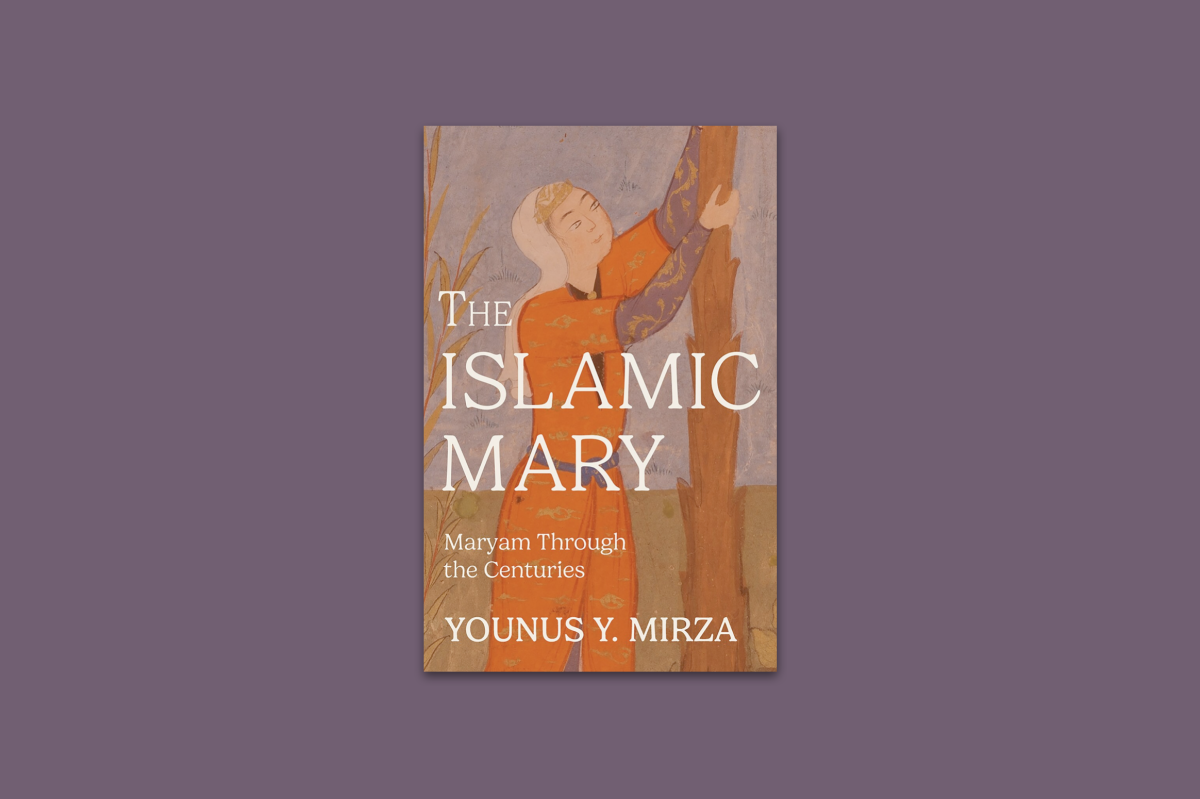
THE ISLAMIC MARY: Maryam Through the Centuries. By Younus Y. Mirza. Minneapolis, MN: Fortress Press, 2025. Vii + 177 pages.
Protestants have always struggled with what to do with Mary. While traditionally they have affirmed the virginal conception/birth of Jesus, in part because Matthew and Luke suggest the possibility. They may continue to hold this view in part because they believe it supports Jesus’ divinity or because they regard it as a foundational element of the doctrine of biblical inerrancy. At the same time, because Mary plays such an important role in Roman Catholicism, this can be viewed as a strike against giving her such a prominent place in Protestant thought. What is notable about Mary is that, in addition to her role in Christianity as the mother of Jesus, she also plays a major role in Islam. While Muslims deny the divinity of Jesus, they do affirm the perpetual virginity of Mary. This may surprise many Christians. So, maybe it’s time to hear a word from within Islam about Mary (aka Maryam).
Younus Y. Mirza has undertaken the task of exploring Mary’s role in Islam from the earliest days to the present in his book The Islamic Mary: Maryam Through the Centuries. Mirza is the founding director of the Barzini Institute for Global Virtual Learning at Shenandoah University, and the co-author with John Kaltner of The Bible and the Qur’an: Biblical Figures in the Islamic Tradition. While writing that book, Mirza became fascinated with Mary and her role in Islam.
Mirza wrote this new book, The Islamic Mary, hoping that by lifting up the role of Mary, a Jewish woman who gave birth to the founder of Christianity, in Islam, he might contribute to greater understanding among these three related faith traditions. In fact, Mirza notes that while “the term Abrahamic still holds currency, new books have emerged discussing the Islamic Mary or Maryam. These books build on the ecumenical spirit of the early discussions on Abraham, but it highlights a new figure who opens innovative possibilities regarding Christian-Muslim relations, spirituality, and women and religion” (p. 9). At the very least, focusing on Mary opens a new avenue for conversation among the two largest religions in the world.
With this ecumenical/interfaith possibility in mind, Mirza begins his exploration of the story of Mary by examining “Maryam in the Qur’an” (Chapter 1). Here, we examine how Mary is situated within the Qur’an as a “Qur’anic Daughter.” Note that in the Qur’an, Maryam’s story begins with her role as a daughter, not as a mother. It appears that the Qur’an may draw on the story of her birth in the Protoevangelium of James as well as other noncanonical sources. In this account, the prophet Zakariyya (father of John the Baptist) serves as Maryam’s protector.
In the Qur’an, Maryam is described as one of the spiritual elites to whom God speaks. The question that emerges in the Qur’an and continues to be raised is whether she is the greatest woman of her time or of all. Then there is her role as mother of ‘Isa (Jesus). Interestingly, in this account, Joseph is absent. Instead, Maryam gives birth to ‘Isa in isolation, while her pregnancy begins after she is touched by the angel Jibril (Gabriel). As one can see, the Islamic story is quite different from the one we find in Matthew and Luke. Mirza writes that “The Qur’an presents Maryam as an independent figure with her own genealogy and miracles, specifically her birth, labor, and inner thoughts and prayers” (p. 31).
Maryam appears not only in the Qur’an, but as Mirza reveals in chapter two, we also find “Maryam in the Prophetic Literature.” In this chapter, Mirza discusses her appearances in the Hadiths and in the biography of Muhammad. One example is a story in the biography of Muhammad, where his followers go to the Christian kingdom of Abyssinia. Upon their arrival, word of the Islamic embrace of Maryam provides an entry point for the group, creating an opportunity for trade. She appears in numerous other places in these texts, often serving as an exemplar, along with Muhammad’s wives and his daughter Fatima, along with ‘Asiya, Pharaoh’s wife in the story of Moses. These stories reveal reverence for the Islamic Mary.
We move in chapter three to “Maryam in Theology.” Because Mary figures prominently in the Qur’an, the Hadiths, and other prophetic literature, it was necessary to find a place for her in Islamic theology. The question that Muslim scholars faced concerned her role in the Islamic story. This included questions of whether she was a prophet or ranked among the greatest of women. She plays a different role in Shi’i theology because here, Fatima, wife of Ali and daughter of Muhammad, has the preeminent role. Still, she was an honored person, worthy of being emulated. From there, we move on to the chapter titled “Maryam and Mysticism” (Chapter 4). In this chapter, Mirza explores Mary’s place within Islamic mysticism, including in Sufi thought. Here, Maryam serves as a model of spiritual devotion and sainthood, especially in terms of being a model of celibate asceticism.
Islamic Art is different in many ways from that found in Christianity. In large part, this is due to the rejection of depictions of God and of Muhammad. Nevertheless, because art comes in a variety of forms, including film, Maryam appears in Islamic art. Her place in Islamic art forms is discussed in Chapter Five, “Maryam in Islamic Art and Film.” Regarding depictions of Maryam, some reflect aniconism and others offer full depictions, in part because she was not considered a prophet by most scholars. Thus, she could be portrayed in ways that a prophet might not. She is portrayed by various artists “as a nourisher, ancestral mother, or as a spiritual guide” (p. 123).
The final chapter of Mirza’s The Islamic Mary discusses “Maryam in Contemporary Times.” In this chapter, Mirza brings Mary’s Islamic story up to the present day. It is here that Mirza focuses his attention on Mary’s role as a bridge between Christianity and Islam. He introduces us to a pilgrimage site in Turkey near Ephesus, where Maryam supposedly lived. Both Muslims and Christians gather to honor at this location to venerate this beloved saint. He also notes that Vatican II’s Nostra Aetate makes note of Islam’s reverence for Mary. The same is true of the more recent document, “A Common Word.”
In sharing how Christian scholars have taken notice of Mary, Mirza makes note of the work of Rev. Daniel Madigan, SJ, who suggests that Muhammad should not be seen in competition with Jesus, but instead Muhammad might be seen as a type of Mary. That is, Muhammad and Mary both bear God’s Word, but they are not the Word. Another parallel here is that even as Mary is depicted as a Virgin, so Muhammad is depicted as illiterate, but both can bring about the Word of God. I thought that this was a fascinating insight. There are also feminist engagements with Mary from both Christian and Muslim scholars that reveal similarities of vision. The important thing here is that Mary could serve as a bridge for contemporary interfaith conversations between Christians and Muslims.
As Mirza points out in his conclusion to The Islamic Mary, Mary/Maryam remains an important figure in the modern world for both religions. As such, she can serve as a bridge between the two. Therefore, in his view, more attention needs to be paid to Mary in the pursuit of finding that common word. With that in mind, we can see in Mary/Maryam an important figure around whom we can gather. That might be difficult for some Protestants, but perhaps the fact that Mary plays such an important role in Islam can open spaces for Protestants to embrace Mary as well. All in all, Mirza’s The Islamic Mary is a fascinating, accessible, and in my estimation, very important book that can build bridges between the two communities at a critical moment in world history.
This review originally appeared on BobCornwall.com.
Robert D. Cornwall is an ordained minister in the Christian Church (Disciples of Christ). Now retired from his ministry at Central Woodward Christian Church (Disciples of Christ) of Troy, Michigan, he serves as Minister-at-Large in Troy. He holds a Ph.D. in Historical Theology from Fuller Theological Seminary and is the author of numerous books, including “Eating With Jesus: Reflections on Divine Encounters at the Open Eucharistic Table” and “Second Thoughts About Hell: Understanding What We Believe” coauthored with Ronald J. Allen. His blog Ponderings on a Faith Journey can be found here.