NOTE: This piece was originally published at our newsletter A Public Witness.
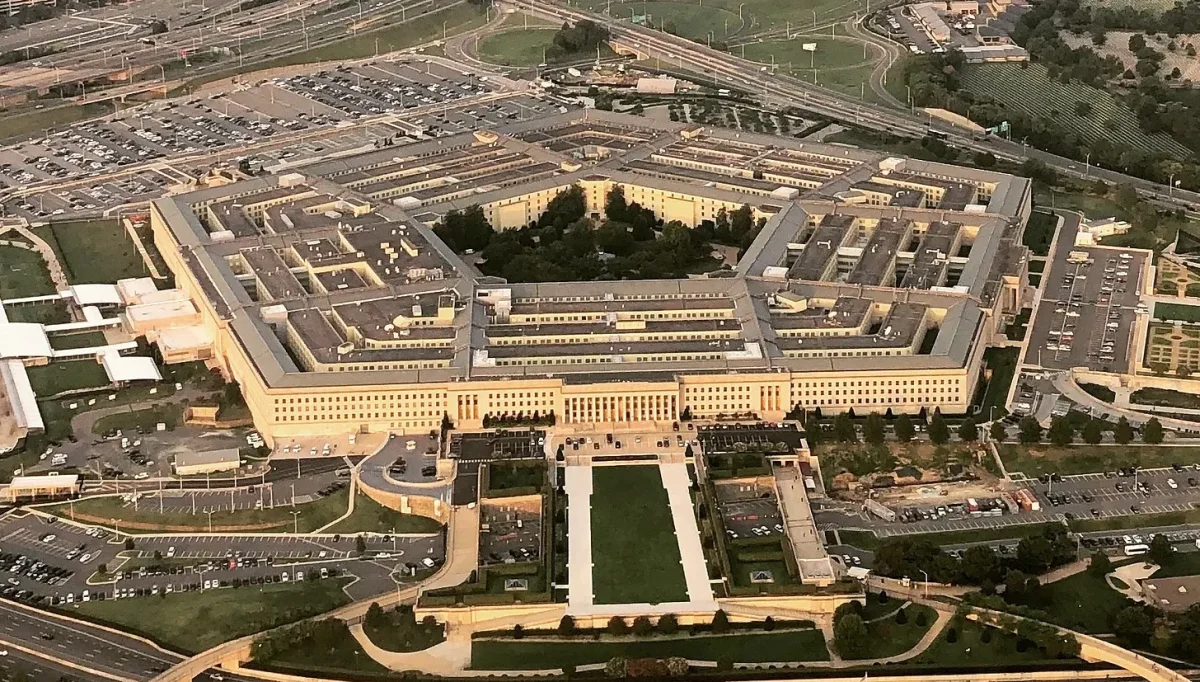
The Pentagon is learning what any graduate student in religious studies could’ve told them: categorizing faith traditions sounds like it should be simple, but it is actually quite complex. And the stakes now are much higher than a class grade. When the U.S. Department of Defense miscodes a faith tradition, it could lead to service members not receiving the spiritual care and religious accommodations that they need.
Pete Hegseth, who likes to call himself “secretary of war,” announced in March that the Pentagon would be reforming the religion codes that service members can select, which provide insights to chaplains and others in the military about how to assist the members in practicing their faith. He complained that “the previous system had ballooned to well over 200 faith codes,” which was because it categorized people on a denominational level. Hegseth insisted such a large number “was impractical and unusable,” though that might say more about human behavior and religion than the U.S. military. Although it should be noted that the last time the list grew (and got up to 211) was because of an expansion by the first Trump administration.
Hegseth added in his March video that the new system would have just 31 codes, but the Pentagon didn’t release the list. So we’ve been guessing about that draconian cut until it finally came out last Thursday (June 4). It mostly involved consolidating numerous denominations into faith traditions, like condensing 29 Baptist codes into just one, 14 Methodist codes into just one, and 13 Presbyterian codes into just one. But other changes quickly sparked significant criticism.
Many faith traditions were completely cut, including Atheist, Druid, Humanist, New Age, Pagan, and Wicca. Ironically, two other traditions cut in this year of celebrating the 250th anniversary of the founding of the United States were popular among the founders: Deist and Unitarian Universalist. Hegseth is saying that individuals in these traditions don’t count. And it will likely lead to less spiritual care for them. The organization American Atheists quickly filed a Freedom of Information Act request to obtain records on how the decisions were made, and litigation might follow. Others, like the Unitarian Universalist Association, also condemned the cuts and are considering how to challenge the new system.
Over the weekend, a second wave of criticism erupted, this time especially from Republican senators who are members of the Church of Jesus Christ of Latter-day Saints. Twenty-one of the new codes used the word “Christian” as an identifier, such as “Christian – Baptist,” “Christian – Episcopal/Anglican,” and “Christian – Lutheran.” But the LDS code did not include “Christian” in front of it, which critics said suggested the LDS church is not Christian.
MAGA Sen. Mike Lee of Utah posted several complaints on Elon Musk’s X platform about the lack of the “Christian” label for his tradition. He invoked the Constitutional protections against the government mistreating people because of their faith. He added, “The Pentagon shouldn’t disparage the beliefs of Americans willing to die for their country.” John Curtis, Utah’s other Republican senator who is also part of the LDS church, made similar arguments.
So on Monday morning, the Pentagon released a new updated list that removed the “Christian” prefix from all labels, calling the previous list a “mistake” with “redundant and unnecessary labeling.” Lee, Curtis, and others in the LDS church praised the shift. But what went unnoticed by many — and unmentioned in most news reports on the second draft of the new system — is that the list also dropped from 31 codes to 30.
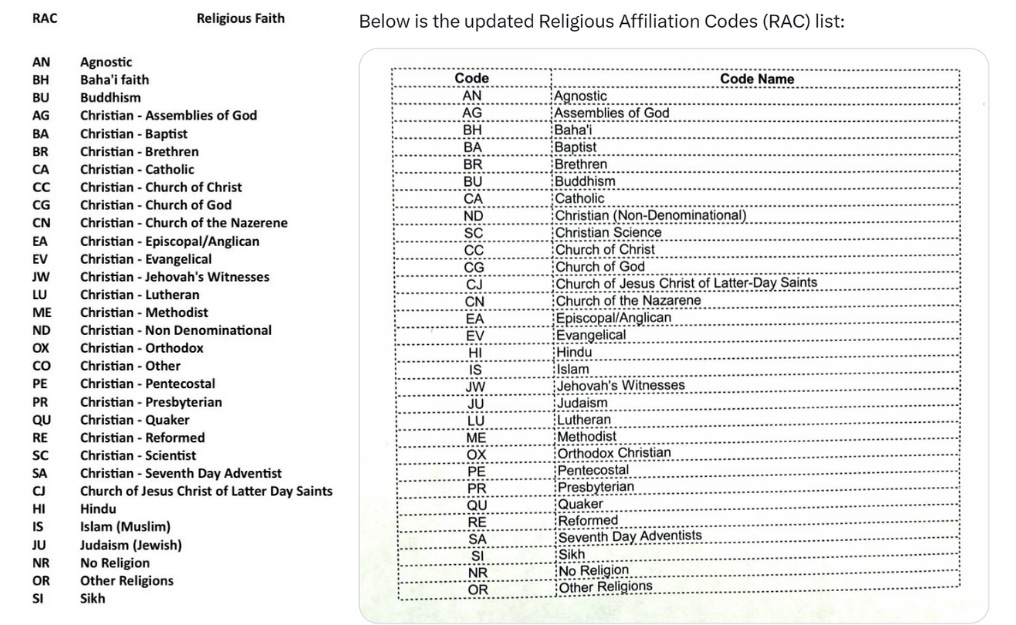
The Pentagon’s list of 31 religion codes (left) released last week and the revised list with 30 codes (right) released this week.
While last week’s version included a category called “Christian – Other,” that disappeared completely in Monday’s version. Rather than renaming it “Other Christian” (which would match how they shifted “Christian – Orthodox” to “Orthodox Christian”), the Pentagon just dropped the category. But in doing so, they just completely excluded some Christians who now do not fit any of the codes, including historic and prominent denominations like the Christian Church (Disciples of Christ) and the United Church of Christ.
The administrative excommunication of these traditions with round two not only creates new problems but also underscores the problems with the coding scheme. So this issue of A Public Witness examines the new mess created by the Pentagon and the larger problems with the religion codes that underscore the religious illiteracy and general incompetence behind its creation.
Crossing the Mainline
This saga hit home this week since one of us (Jeremy) is a member of the Christian Church (Disciples of Christ) and has been left with no coding option that would fit his religious affiliation. With the “Christian – Other” category removed from Monday’s updated list, the only broad category like that is “Other Religions” — and that obviously isn’t accurate. But servicemembers are required to choose a coding option to represent their religious background. So what other code options would be even remotely possible?
“Christian (Non-Denominational)” doesn’t work because the Disciples are, in fact, a denomination. The broad category “Evangelical” doesn’t work because the Disciples are one of the “Seven Sisters” of mainline Protestantism, fully supporting the ordination of women and LGBTQ+ inclusion. And the “Church of Christ” option really does not work, both because of this evangelical/mainline split and due to denominational history.
What is known as the Restoration Movement or the Stone-Campbell Movement fractured into three distinct branches: the Churches of Christ, the Christian Church (Disciples of Christ), and the independent Christian Churches/Churches of Christ. Yes, this is incredibly linguistically confusing. But places like Pew Research Center understand this lineage and code them correctly in entirely different sections, with Disciples labeled “Restorationist family (mainline trad.),” and the others labeled “Restorationist family (evangelical trad.).”
Similarly, another influential mainline denomination does not fit into the latest Defense Department coding: the United Church of Christ. Despite its name sounding similar to the aforementioned “Church of Christ” category, the UCC was formed by the merger of the Congregational Christian Church and the Evangelical and Reformed Church. So they are not even historically related to the Churches of Christ traditions.
There’s something else notable about the UCC’s exclusion. So far, other reporting on Monday’s update has focused on the LDS church angle and failed to mention that the UCC is not only left out of the religious affiliation coding categories for the military but also represents a group with strong historical ties to the nation’s founders — just like the excluded Deists and Unitarian Universalists.
The UCC traces a substantial part of its lineage to the Congregationalist tradition. And at least nine Declaration signers can be easily classified as Congregationalists. This included probably the most famous person to sign the document: John Hancock. And these ties remain visible today with the Old South Church in Boston, which Samuel Adams was a member of, still meeting today and belonging to the UCC.
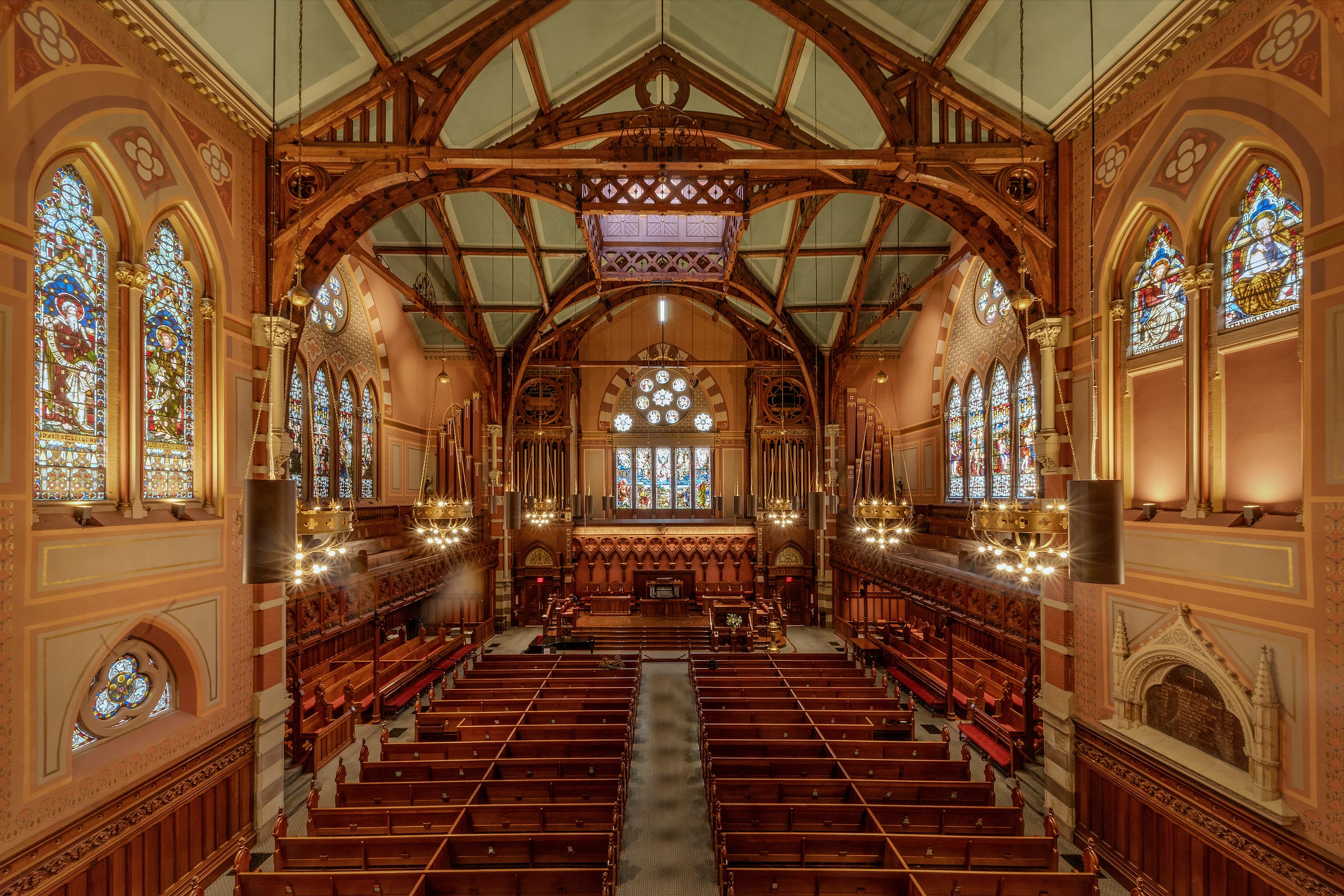
The sanctuary of Old South Church in Boston, Massachusetts. (Nate Bergin/Public Domain)
Just as LDS politicians complained and managed to force an edit, others are now speaking out about the elimination of the 31st category for other Christians. Like Rev. Jonathan R. Fisher, director of chaplaincy and specialized ministries for the Disciples and a retired U.S. Army chaplain.
“We are dismayed at the actions of the unnecessary and harmful decision of the Department of Defense to remove the Christian Church (Disciples of Christ) and others from this list,” Fisher told us. “Disciples have served this country with honor and distinction. Servicemembers will now need to use the ‘Other Religion’ category as there is not a category where Disciples belong. If it is a burden to have 200 categories in a nation as diverse as ours, then it is a worthy burden to bear given how much religious liberty is valued in this country. We protest this unnecessary and harmful action by the Department of Defense (War).”
Help sustain the journalism of Word&Way by subscribing to A Public Witness!
Heretic?
The kerfuffle over the lack of the label “Christian” for the LDS church led many commentators to argue this was initially a Christian Nationalist effort by Hegseth to say the LDS church isn’t Christian. But we’re not sure that was deliberate. Instead, it seems to show the incompetence of the Pentagon under Hegseth’s leadership.
It’s true that the denominations Hegseth has been part of as an adult — the Southern Baptist Convention and the Communion of Reformed Evangelical Churches — have labeled the LDS church as a cult instead of a Christian denomination. But both denominations say the same thing about Jehovah’s Witnesses and Christian Science, yet both of those groups did receive the “Christian” label on the first version of the condensed list. If this was an attempt to adjudicate who counts as Christian, those two groups would have also definitely been excluded. And some SBC and CREC leaders (like Doug Wilson) would go even further to question if Catholics and some mainline Protestants are really Christians.
Amanda Marcotte, a senior writer at Salon, who insisted the lack of the “Christian” label for the LDS category proved Hegseth’s Christian Nationalism and was a deliberate theological decision, saw other issues with the new list. But just because Hegseth is a Christian Nationalist, that doesn’t mean everything he does is because of that ideology.
“Under the guise of ‘streamlining’ services, this number was reduced to 31,” Marcotte wrote. “Anyone who looked at the new list, however, could see that Hegseth’s unsubtle goal was signaling the superiority of Christians to everyone else. The new list gives Christians 21 subcategories to choose from, but Jews, Muslims and other major religious groups only get one option, ignoring the diversity within those faiths.”
Her argument is that Christians got 21 of the 31 categories (now 20 of the 30), so that shows this is about “signaling the superiority of Christians.” But that ignores the breakdown on the older, longer list. While two-thirds of the codes on the new list are Christian, it was closer to three-fourths before. There is now actually more condensing and ignoring of diversity in Christianity. She’s right that combining four Jewish codes into one ignores diversity within the tradition and makes the list less helpful. But the same is true of 29 Baptist codes crammed into just one. And, for the record, the previous list only had one category for Muslims and other religious groups, so that’s not actually a new problem with Hegseth’s list.
We do believe the new list shows some of Hegseth’s Christian Nationalist agenda with the deleted religion codes like Atheist, Druid, Humanist, New Age, Pagan, and Wicca. This matches his claims back in March when he said the new coding system was part of recognizing that chaplains “are first and foremost called and ordained by God.” But depending on the religious tradition, that’s not actually an accurate description of all chaplains. And it is true that Hegseth is a Christian Nationalist, as we’ve documented by covering his Christian worship services that only feature far-right patriarchal Christian preachers, his co-opting of Scripture to justify war decisions, and his Crusader ideology.
But the lack of the “Christian” label for the LDS church feels more like incompetence than bigotry since it would imply that Hegseth was willing to designate both Jehovah’s Witnesses and Christian Science as Christian denominations. Other parts of the coding system also show general religious illiteracy and incompetence. Like the “fix” on Monday that dropped the “Christian – Other” category. That, too, seems like an error instead of a deliberate attempt to suddenly kick out denominations like the Disciples and UCC.
The Pentagon. (Public Domain)
Coding Incompetence
Other parts of the new system also give the impression that it was crafted by a drunk weekend cable news talking head instead of someone who knew what they were doing. There’s no clear coding scheme. Such coding should be both exhaustive and exclusionary. That is, the coding scheme should have a category for everyone and not have overlapping categories so that people would fit into multiple ones. The new list fails both standards.
The previous list with 211 codes was done largely at the denominational level (although some other religions only had one code). And there were some catch-all “other” categories to help make sure everyone could pick one. But the new list has no consistent categorization within the Christian camp. Some of the codes are at the faith tradition level, like “Presbyterian” and “Methodist,” while others are at the denominational level, like “Assemblies of God” and “Church of the Nazarene.” That creates problems since there’s also a “Pentecostal” category in which the Assemblies of God denomination would fit.
Pew Research Center, for instance, labels the AoG as one of the denominations within their “Pentecostal” category. Pew also puts the various Church of God denominations in that category, but the Pentagon instead has a “Church of God” category. Then there’s an “Evangelical” category which would also overlap with several other categories, including some in “Baptist,” “Lutheran,” and “Christian (Non-Denominational).” This coding system has no coherent categorization and thus will create confusion.
It’s also odd that if they’re only going to have 30 or 31 codes that they gave some to small groups like the Church of the Nazarene, Brethren, and Quaker. The latter two are particularly interesting since not only are those smaller traditions than others that didn’t make the list, but they are also groups where the membership is less likely to be in the military given their historic pacifism. While 30 or 31 codes seem like too few, if we were to create categories based on that limit we would condense several of the ones they used to create more distinction elsewhere on the list. Another problem is where to put Messianic Jews since they don’t really fit any Christian category, the Judaism category, or the other religion category.
Far from “making the Chaplain corps great again,” as Hegseth has claimed, the new coding system is unconstitutionally exclusive and makes it harder for chaplains to effectively and appropriately serve those in the military according to their own religious traditions. As Beau Underwood, Word&Way’s resident Disciples minister and a current doctoral candidate completing his dissertation on chaplains and public policy, told us, “The purpose of the military chaplaincy is to protect and promote the religious rights of those in uniform. It’s hard to understand how overlooking the faith identities of so many soldiers and sailors serves that purpose.”
“At a time of increasing religious pluralism, the Department of Defense is intentionally reducing the number of faiths it officially recognizes. We are erasing the very differences that chaplains are trained to honor and nurture,” he added. “For an administration that makes a lot of noise about protecting religious freedom, this is one of those moments where the actions intentionally taken directly conflict with the priorities so loudly proclaimed.”
As a public witness,
Brian Kaylor & Jeremy Fuzy
A Public Witness is a reader-supported publication of Word&Way. To receive new posts and support our journalism ministry, subscribe today.