MINNEAPOLIS (RNS) — About midway through her sermon at Calvary Lutheran Church on Sunday (Jan. 11), the Rev. Babette Chatman pivoted to a discussion of empire.
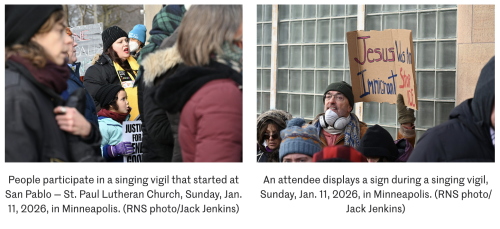
People participate in a singing vigil that started at San Pablo — St. Paul Lutheran Church, Sunday, Jan. 11, 2026, in Minneapolis. (RNS photo/Jack Jenkins)
The Israelites resisted the Egyptians, she said, which Chatman labeled as a kind of empire. The Roman Empire killed Jesus. And now, she argued, the United States is a form of empire, too, and Christians should respond with a “prophetic word” that challenges those in power — including, she said, the thousands of Immigration and Customs Enforcement officers patrolling the streets of Minneapolis as part of President Donald Trump’s mass deportation effort.
“I think the church is invited into imagining what kind of world we want,” said Chatman, who was serving as a guest preacher for the day. “We want a world where we don’t have to worry about people in brown uniforms with guns and gas spray and masks coming in our yard. We want a world where we don’t have to worry about not having our rights.”
She added: “We want a world where people don’t get killed for saying, ‘It’s okay, sweetie. I ain’t mad at you.’”
The line was a reference to the last known words of Renee Good, a 37-year-old mother, spoken to the ICE agent last week shortly before he shot and killed her. The federal government has sought to frame the killing of Good, who was reportedly acting as an observer of ICE at the time, as an act of self-defense by the officer, but her death has spurred a wave of protests and outrage among residents of Minneapolis and others across the country.
Yet as ICE agents continued to roam the streets of Minneapolis on Sunday, worshippers and others took a moment to pause, mourn, and sing, even as they continued to organize resistance efforts against ICE’s escalated presence in their city.
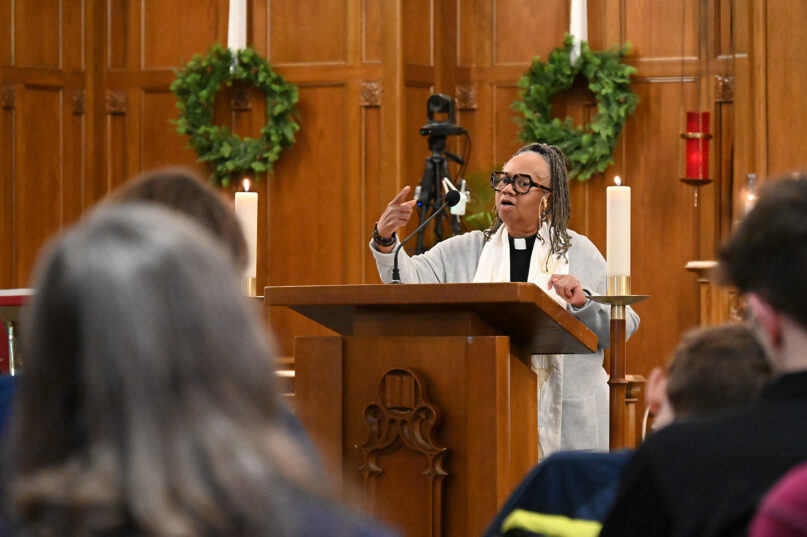
The Rev. Babette Chatman preaches at Calvary Lutheran Church, Sunday, Jan. 11, 2026, in Minneapolis. (RNS photo/Jack Jenkins)
Calvary Lutheran, a church affiliated with the Evangelical Lutheran Church in America, is well acquainted with protest. The side of the church is adorned with a visage of George Floyd, the man who was murdered by a police officer in 2020. When protests broke out in the aftermath of his killing, the church was one of several at the epicenter of the demonstrations.
Chatman, for her part, suggested in her sermon that she saw another wave of action coming, one in which Christians could play a leading role. She hoped the effort would shift the views of Christian nationalists and others she suggested are “not reflective of the way.”
“I believe 2026 is going to be so prophetic that it’s going make those non-believers believers,” she said.
The sentiment was different but no less defiant a few minutes away, where another ELCA church, St. Paul’s-San Pablo, kicked off its bilingual worship service with songs in English and Spanish. Lutherans are plentiful in Minnesota, but St. Paul’s-San Pablo is one of the only Lutheran churches in the region with a heavily immigrant congregation. So when Trump targeted the city as part of his mass deportation campaign, concern for its worshippers has ballooned: Before the service began, two local volunteers unaffiliated with the congregation — both wearing whistles — stood outside the church, ready to raise the alarm should they spot ICE agents in the area.
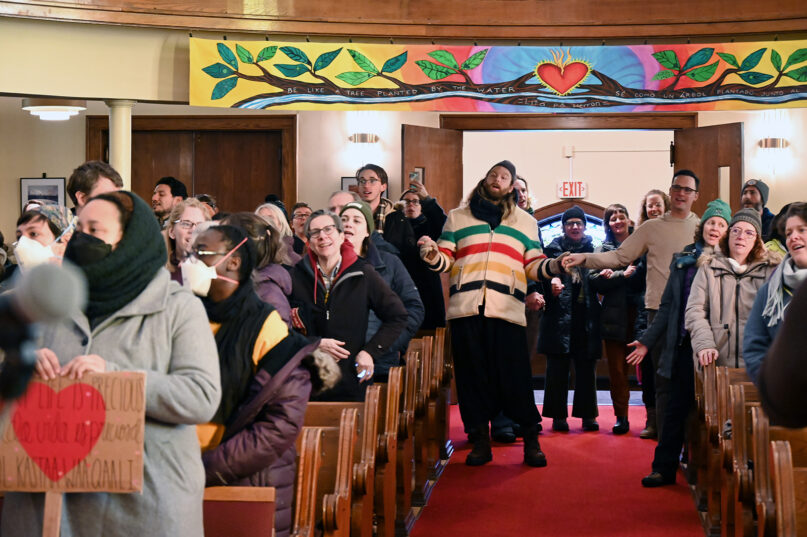
People participate in a singing vigil at San Pablo — St. Paul Lutheran Church, Sunday, Jan. 11, 2026, in Minneapolis. (RNS photo/Jack Jenkins)
The church’s pastor, the Rev. Hierald E. Osorto, said the observers have been showing up for weeks to offer a “supporter presence.” He noted the church is also situated in between two mosques in the neighborhood — which serve many Somali Americans, another group targeted by the Trump administration — and that the general area is home to a number of immigrant families.
“What’s happening on the ground here in Minneapolis,” Osorto said, is “neighbors are showing up for one another.”
Osorto said ICE has also been highly active in the area and that some members of his church have provided rides to worshippers to help them feel safer coming to church. Others, he said, are forgoing getting prescriptions “because they’re afraid of going and potentially being stopped and detained,” and children have been traumatized by a variety of ICE activities.
But the pastor rejected the notion that the immigrant community is operating solely out of fear. Osorto said his congregation and the surrounding neighborhood are highly organized, even if their work is less public than those of other activists.
“I think it’s always been risky to make a choice to be part of a faith community and to show up,” Osorto said. “What I’ve been saying is that nothing has changed in that risk that we’ve been willing to take, it just feels a little bit more heightened now. But as a faith community, what we’ve claimed is in terms of who we believe in, and how we profess to live that out in our lives, can and does carry risks. It carries, sometimes, consequences that we are prepared to face.”
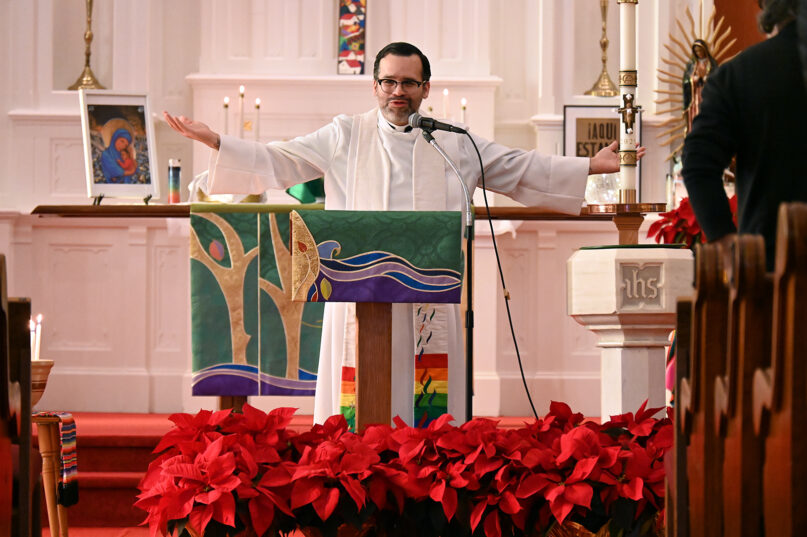
The Rev. Hierald E. Osorto speaks at San Pablo — St. Paul Lutheran Church, Sunday, Jan. 11, 2026, in Minneapolis. (RNS photo/Jack Jenkins)
He added: “I think it takes a lot of courage to say, ‘In spite of that persecution, I’m still gonna show up for my neighbor.’”
Courage in the face of adversity was also a theme of St. Paul’s-San Pablo “‘Lament and Hope” worship service on Sunday. In lieu of a sermon, Jose Luis Villaseñor, a local community member and urban farmer, offered a reflection centered on bravery. Speaking by turn in English and Spanish, he said members of the congregation were brave for coming to the U.S. and leaving behind loved ones, as well as for even coming to church.
“It is a moment to reclaim our bravery,” he said. “It is a moment for us to become louder. It is our moment to reconnect with our community, and keep our communities safe.”
He then led the congregation in a call and response, saying, “I am brave because we are brave” and “Yo soy valiente porque somos valientes.”
St. Paul’s-San Pablo role in facilitating efforts to help the immigrant community was evident immediately after the end of worship, when hundreds of people flooded into the sanctuary to participate in a singing vigil. Although organized by an outside secular group, the church played host to the event, and leaders said many of the attendees were members of local church choirs. A Unitarian Universalist minister sat on the front pew, and another man held a large sign that read “Jesus was an immigrant.”
Organizers kicked off the event with a brief version of ICE observer training, helping attendees walk through what they should do if they encounter federal agents active in the area. They then rehearsed songs they planned to sing, all of which leaned heavily on chanting and harmonies.
As one leader banged a drum, the packed church sang: “This is for our neighbors who are locked inside, together we will abolish ICE.”
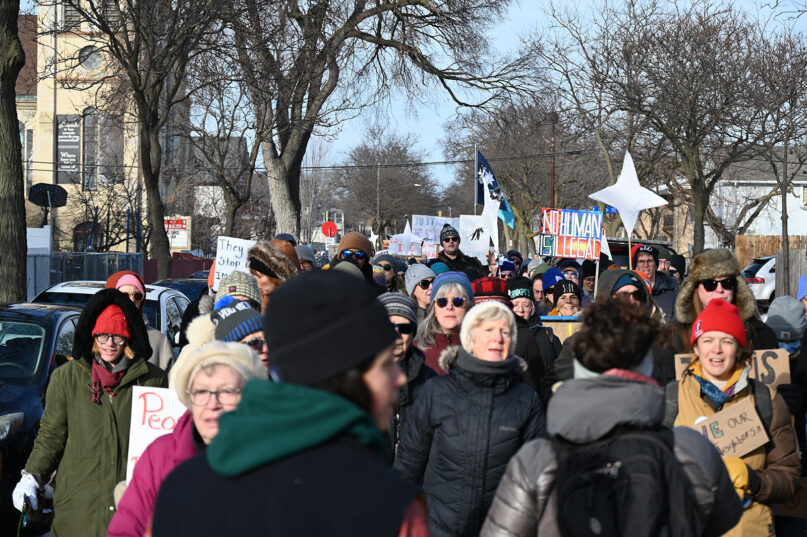
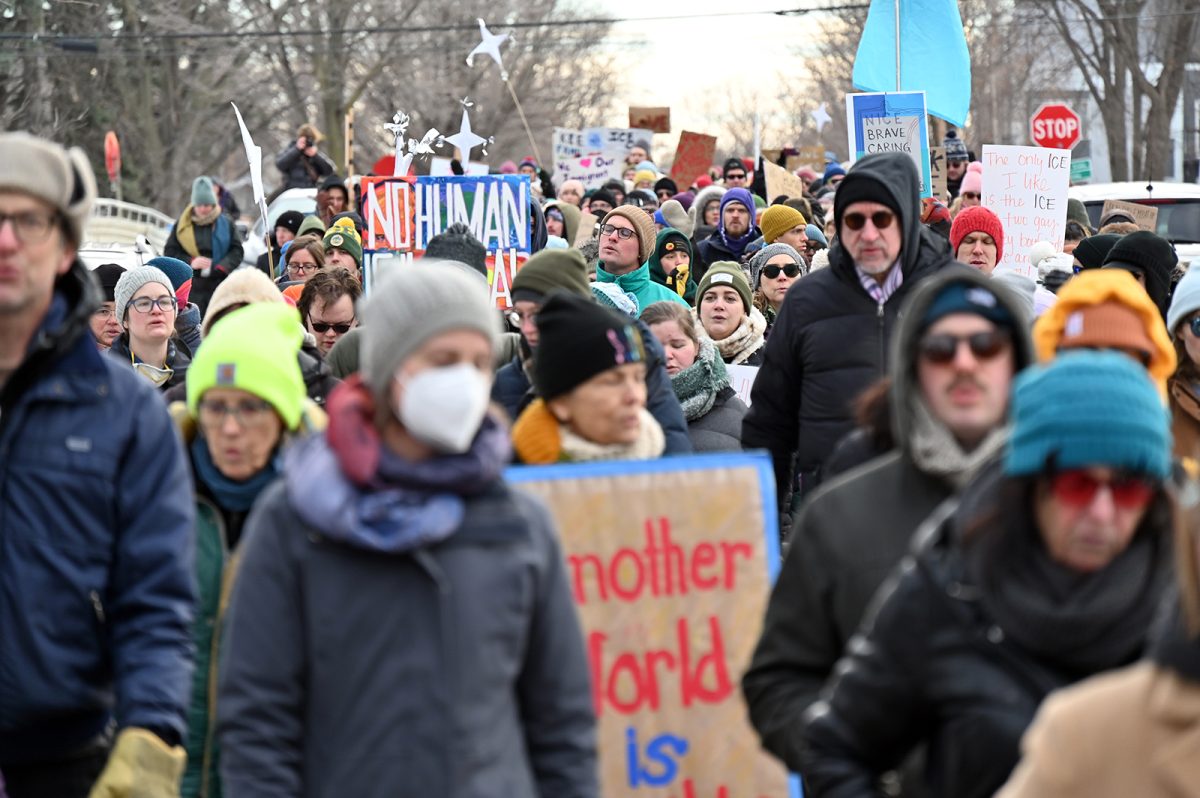
People march in a singing vigil, Sunday, Jan. 11, 2026, in Minneapolis. (RNS photo/Jack Jenkins)
The group then left the church to march slowly through the streets, singing all the while. Passersby frequently stopped, honked, and waved in support, sometimes sparking cheers from the group.
For many at the vigil, resistance to ICE was described as a reflexive response to the needs of their neighbors. One of the participants, a local resident, later told the group that as they walked among the houses, she waved to a neighbor whose family member was recently detained by ICE.
Indeed, the presence of ICE hung heavy over the gathering. As the group turned onto a side street to begin marching back to the church, honking could be heard at the other end of the block. This time, it wasn’t the sound of support: the car horns were soon joined by the shrill of whistles, the telltale sound of community members tailing unmarked vehicles they believe are being used by ICE agents.
As the caravan of vehicles sped by, the marchers — one of whom carried a sign reading “Do unto others…” — continued to sing, their voices rising and intertwining in a yawning range of harmonies.
They sang: “We grieve together. We grieve together. We grieve together. Stop the deportations.”