TOPEKA —Before delivering a petition to the Kansas governor’s office Tuesday, faith leaders criticized the death penalty as immoral and inhumane and implored Gov. Laura Kelly to grant life without parole to people on death row.
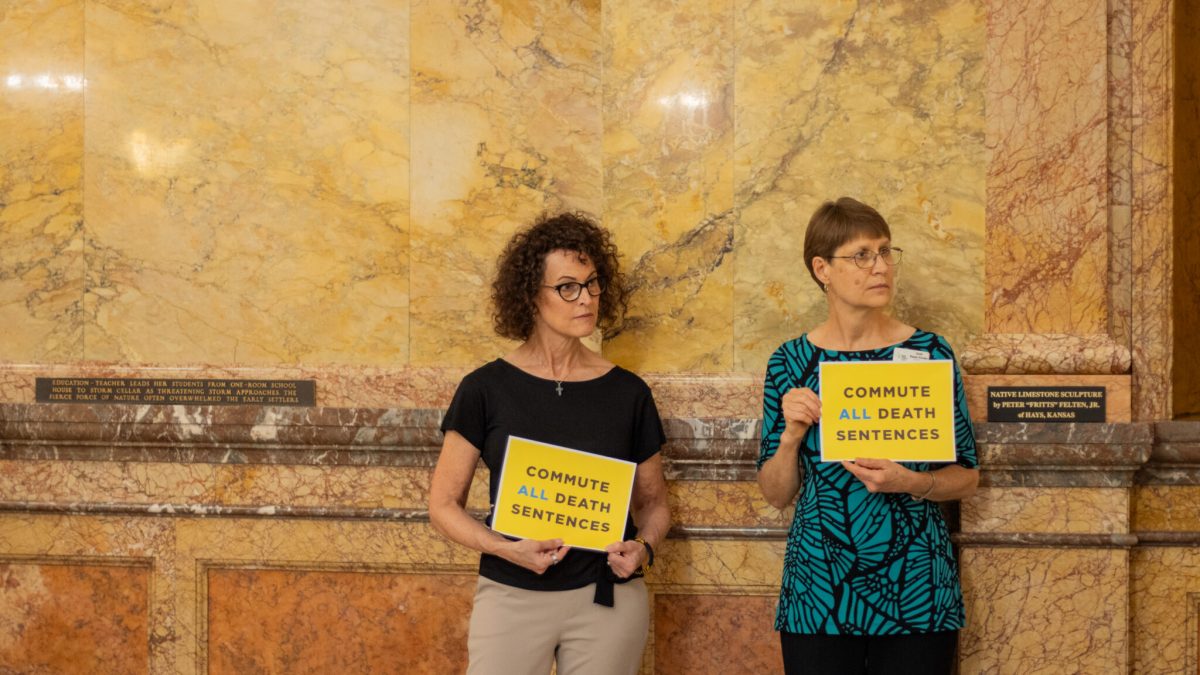
Faith-based activists Jennifer Montgomery, left, and Heidi Regier Kreider call the Kansas governor to accept the clemency requests of death row inmates at the Statehouse in Topeka on July 14, 2026. (Photo by Baya Burgess/ Kansas Reflector)
Steven Becker, a retired Kansas district judge, former state legislator and active Mennonite, said on Tuesday the government has no right to execute someone.
“How arrogant that is,” he said. “Who do we think we are that we can end divinely granted life?”
An hour before the faith leaders gave remarks to reporters at the Statehouse, Kelly denied clemency requests from brothers Reginald and Jonathan Carr. They were responsible for the “Wichita massacre,” a nine-day spree of violent crimes in 2000.
Kelly also denied a request in June from John Robinson, a serial killer convicted of killing eight women. Eight of Kansas’ nine death row inmates filed clemency requests in May, according to the Kansas Attorney General’s Office.
Despite her decision, Kelly called the death penalty impractical and burdensome in a Tuesday statement.
“A sentence of life in prison with no chance of parole makes much more sense for all concerned,” she said. “However, the death penalty is current law in Kansas, and if ever there were a situation in which the death penalty is justified, it is that of the unspeakably heinous acts of torture and murder committed by Reginald and Jonathan Carr.”
The Kansas Supreme Court unanimously agreed last month to uphold the Carr brothers’ death sentences, declining to revisit details in their cases.
Donna Schneweis, chair of the Kansas Coalition Against the Death Penalty, hand-delivered to the governor’s office the petition that contained signatures from 50 faith leaders. They requested that the governor commute the death sentences of anyone who requests clemency.
She said clemency, like the death penalty, is also a part of Kansas law.
While Kansas has upheld the death penalty since 1994, the state has not carried out an execution since 1965. The most recent death sentence was imposed in 2016. The American Civil Liberties Union in 2024 attempted to abolish the death penalty in Kansas, citing its ineffectiveness in deterring crime and propensity for racial biases.
The Rev. Kyle Reynolds, a pastor at St. Paul’s United Methodist Church in Lenexa, called the death penalty unjust. Someone who kills a white woman is most likely to receive a death sentence in Kansas, according to the ACLU’s 2024 court filings.
“We know that it isn’t imposed fairly,” he said. “We know that legal representation is underfunded, and bias is well documented.”
Kansas Attorney General Kris Kobach supports the death penalty. He said it provides justice to victims’ families, and he urged the governor in June to deny the clemency requests.
“As the maxim holds: mercy to the guilty is cruelty to the innocent,” he said in a statement. “The victims and their families deserve justice.”
Sister Therese Bangert of the Sisters of Charity of Leavenworth said Tuesday capital punishment isn’t always a source of comfort for victims’ families.
“I have walked with victim family members,” she said, “listened to their journeys, and witnessed some of them go from intense grief to an ability to, at times, forgive and to live and love through the anger and the grief.”
Kansas Reflector is part of States Newsroom, a nonprofit news network supported by grants and a coalition of donors as a 501c(3) public charity. Kansas Reflector maintains editorial independence. Contact Editor Sherman Smith for questions: info@kansasreflector.com.