NOTE: This piece was originally published at our newsletter A Public Witness.
According to documents filed in federal court this week, the U.S. Department of Homeland Security sent undercover agents into church buildings to track activists attending events at Lutheran, Baptist, Episcopal, and Universalist churches in Minnesota’s Twin Cities (and an event featuring Minnesota activists at a church in Michigan). A surveillance incident at a Baptist church particularly raises questions since the congregation’s building is covered by a federal injunction blocking warrantless DHS actions there.
The case in Minnesota involves 15 individuals accused of “conspiracy to impede or injure federal officers” and efforts to allegedly “violently oppose immigration law enforcement” earlier this year during DHS’s “Operation Metro Surge,” which saw federal agents kill Renée Good and Alex Pretti. Days after the killing of Pretti, federal officials opened an investigation not into his death but into liberal activists protesting Immigration and Customs Enforcement actions. That investigation led to the charges against the defendants, known as the “Minnesota 15.” The individuals pleaded not guilty after being arrested in June and insist they are being prosecuted for speech and not any actual acts of violence.
In a development first reported by Talking Points Memo, a defense attorney for one of the defendants on Thursday (Aug. 13) alleged “abuses” by ICE and other DHS agents that showed “the political animus driving this case.” The filing notes that “undercover agents posing as protesters surveilled community meetings at churches, parks, libraries, schools and union halls.”
“These agents surreptitiously recorded dozens of conversations with ordinary people who were simply exercising their First Amendment right to protest ICE’s lawless rampage in our state,” defense attorney Kevin Riach argued in the filing. “None of these individuals did anything other than engage in protected First Amendment speech in a church meeting room. Yet now their personal information is memorialized in a DHS dossier.”
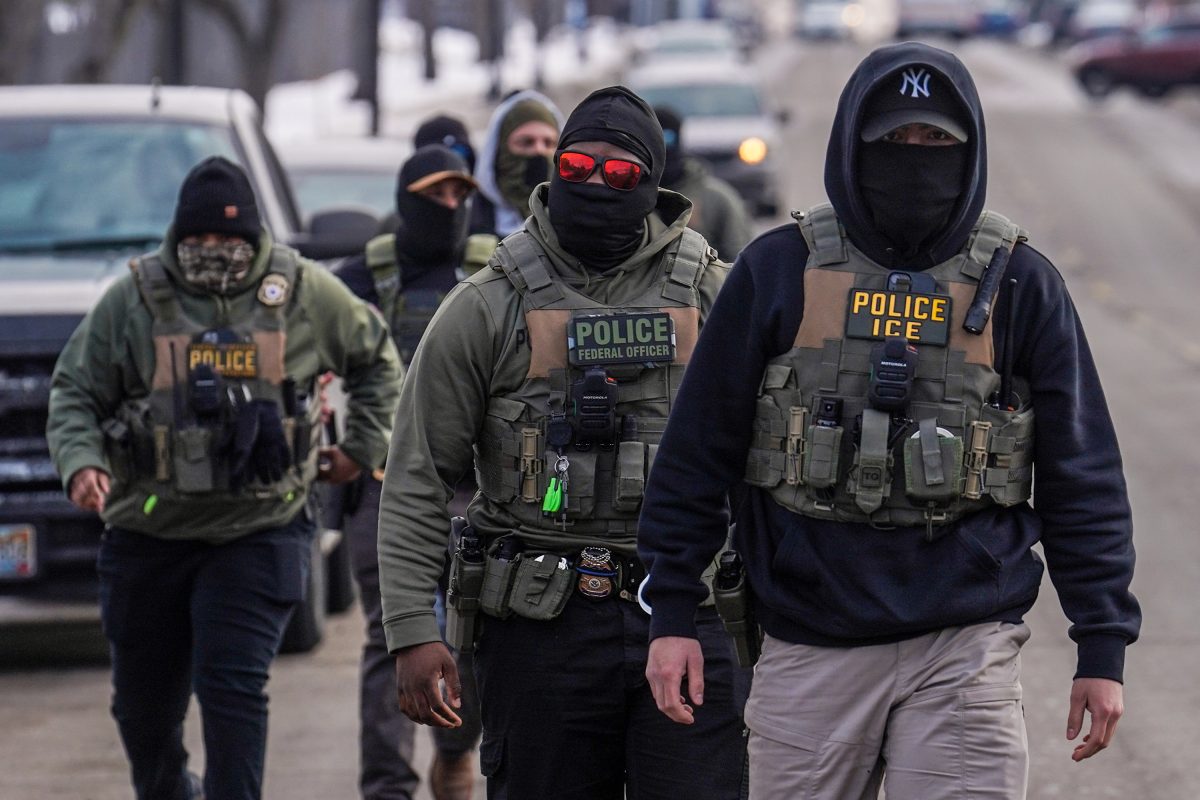
Federal agents walk down a street while conducting immigration enforcement operations in Minneapolis, Minnesota, on Feb. 5, 2026. (Ryan Murphy/Associated Press)
Official DHS documents detailing various surveillance incidents were included in the court filing as evidence to support the claim. The DHS reports show that undercover agents entered at least four churches in the Twin Cities and another in Michigan:
- On Dec. 13, an undercover agent attended a “how to stop ICE” meeting that was hosted by Sunrise Movement – Twin Cities at First Universalist Church in Minneapolis. The agent’s report notes the meeting highlighted that the group is “a nonviolent, direct action group” and discussed ways to publicly challenge ICE’s presence in the Twin Cities.
- On Feb. 1, an undercover agent attended a meeting sponsored by the Twin Cities Direct Action that was held at Prince of Peace Lutheran Church, an Evangelical Lutheran Church in America congregation in the suburb of Roseville. Beyond detailing who attended the meeting of “approximately 10 people,” the agent described the meeting as “democratic in nature,” unorganized, and focused on social media strategies and fundraising since the group only had about $5,000. The agent emphasized that the group talked about trying to “stop and abolish ICE” and how there was “a civil war” going on as ICE agents were in the community.
- On April 8, an undercover agent attended an event in the sanctuary of Zion Lutheran Church, an ELCA church in Ann Arbor, Michigan. Part of the national speaking tour, the “Breaking the ICE: Lessons from the Resistance in Minnesota” event featured stories about how people had responded to Operation Metro Surge. The agent’s report includes information on Michigan church members who were not part of the targeted Minnesota activist group but who attended the event because they opposed ICE.
- On April 14, an undercover agent attended a Direct Action Minnesota meeting at St. John the Evangelist Episcopal Church in St. Paul. Other federal agents collected the license plate information of vehicles parked in a nearby lot — even though they may not have all belonged to people attending the targeted meeting.
- On May 28, an undercover agent attended a Mixed Martial Arts class led by a progressive group and held at University Baptist Church in Minneapolis. The agent spoke with people and participated in the training, which led to a moment described in the report: “Due to the physicality of the event, [the agent’s] concealed body-worn audio recorder erroneously fell to the floor of the gymnasium near the end of the training. [The agent] briefly left the gymnasium, realized she no longer had the device, and returned to the gymnasium to retrieve the device” three minutes later.
The incident at University Baptist Church could raise additional legal issues beyond those mentioned in the court filings or sparked by the other church surveillance incidents. The church has been covered since Feb. 13 by a federal injunction blocking DHS from conducting warrantless actions on its property.
UBC is part of the American Baptist Churches USA and the Alliance of Baptists. Both denominations are among the dozens that sued last year to challenge the Trump administration for removing the rule that barred DHS immigration enforcement actions at sensitive locations like houses of worship. So far, only a few groups have won a federal injunction to protect their congregations. In the first case, a judge barred such DHS actions at churches in the Cooperative Baptist Fellowship and several regional Quaker groups in addition to at a Sikh Temple in California. In another case, a different judge granted an injunction to protect churches in the ABCUSA, Alliance, Metropolitan Community Churches, and several ELCA regional synods.
“In substance, the preliminary injunction will prohibit warrantless enforcement actions — absent exigent circumstances — inside a church, at the entrance to a church, at a religious education facility (such as a Sunday school), at a religious social-service facility (such as a day-care center), or on adjacent church property (such as a parking lot),” Judge Dennis Saylor IV wrote in his ruling granting the injunction. “It will also prohibit such enforcement within 100 feet of the entrance to a church, absent exigent circumstances or supervisory approval. And it will prohibit law enforcement from knowingly setting up checkpoints to interrogate persons on their way to or from a church.”
While the case involved the issue of immigration enforcement actions, Saylor made it clear that his ruling was not merely reinstating the old rule but instead “imposes a new set of restrictions” that “is broader than” the previous policy. Additionally, the purpose of DHS’s surveillance at UBC was to support DHS’s immigration enforcement efforts in the Twin Cities. The action at UBC targeted a liberal activist instead of someone from another country, but it was ultimately part of the administration’s ICE agenda.
The DHS documents do not indicate whether they considered if the injunction applied to this surveillance action. But in addition to UBC being doubly covered by both its denominational affiliation, the church is also specifically cited in the judge’s ruling as an example of why the injunction was granted. The judge noted that on Jan. 11, the church’s pastor learned just before the Sunday worship service that ICE was parked less than a half mile away so he warned people from the pulpit. As a result, a month later the judge granted the injunction to protect UBC and other churches. Yet, three-and-a-half months after that ruling, an undercover DHS agent entered the church and recorded people engaged in lawful activity.
The Department of Justice’s Joint Task Force Vanguard that brought charges against the “Minnesota 15” is co-directed by a man who marched in the pro-Trump crowd outside the U.S. Capitol on Jan. 6, 2021. Meanwhile, mainline Protestant clergy have been among those leading anti-ICE protests in the Twin Cities — even before learning ICE and other agents secretly spied on events inside mainline churches.
As a public witness,
Brian Kaylor
A Public Witness is a reader-supported publication of Word&Way. To receive new posts and support our journalism ministry, subscribe today.