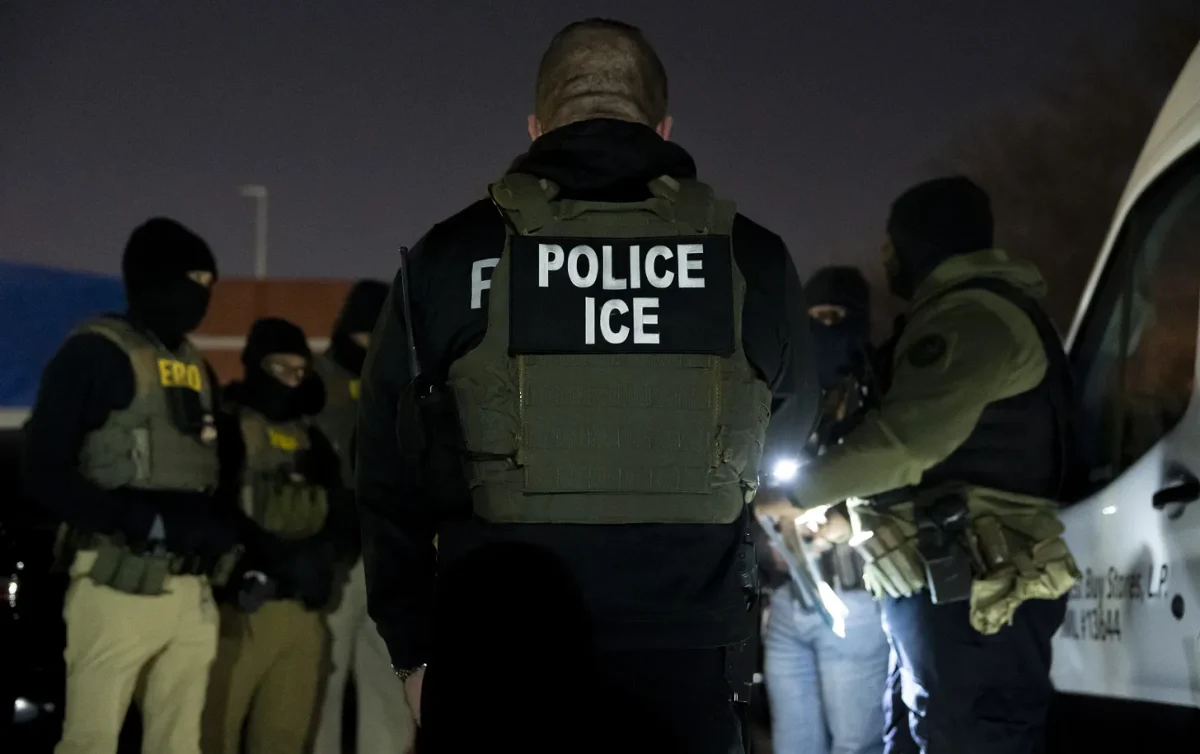
(RNS) — In recent days, faith leaders across the Minneapolis-Saint Paul area have organized to protect Somali communities and houses of worship as U.S. Immigration and Customs Enforcement agents launched an operation targeting undocumented Somali immigrants.
The community expects a heavy presence of ICE agents at mosques in the Twin Cities during Jummah prayers (Dec. 5), said Khalid Omar, an organizer with the interfaith group Isaiah. He said local lay and faith leaders plan to gather outside mosques in the area to show solidarity with Muslim immigrants.
The Department of Homeland Security’s latest immigration enforcement operation began Wednesday (Dec. 3), the day after President Donald Trump denigrated Minnesota’s Somali community at a cabinet meeting, saying, “I don’t want them in our country, their country is no good for a reason. Their country stinks.” The president also criticized Democratic U.S. Rep. Ilhan Omar, a U.S. citizen of Somali origin who represents part of Minneapolis.
“People are extremely fearful, and what Trump and his administration are doing is extremely dangerous to our community,” Omar, the Isaiah organizer, told Religion News Service. “He’s terrorizing our community.”
Over the past two days, the Minnesota chapter of the Council on American-Islamic Relations has hosted community events to educate leaders on best practices for dealing with ICE agents at houses of worship, said Suleiman Adan, CAIR Minnesota’s deputy executive director.
Nearly 130 people, including imams, clergy members, and community leaders, attended an event on Tuesday (Dec. 2) that also discussed how to send a “unifying message in the pulpit on Friday.”
News of ICE agents at the Karmel Mall, a Somali mall in south Minneapolis, and in Cedar-Riverside, a Somali neighborhood in Minneapolis, has disrupted the community’s daily life, Adan said. Officials at the Riverside Academy High School told him they feared ICE agents would infiltrate the school where many students are recipients of the Deferred Action on Childhood Arrivals Act program.
The city’s Somalians have witnessed “a sharp rise in threats, a sharp rise in harassment and openly hostile rhetoric, directed at the Somali and Muslim community,” following the president’s comments, Adan said, adding that some members of the community, most of whom arrived in the 1990s fleeing the East African country’s civil war, have begun carrying passports and other identification out of fear of being wrongly targeted.
In previous days, the president and other federal officials drew attention to an ongoing federal investigation into social services fraud, mostly involving members of the Somali diaspora in Minnesota. Republican lawmakers from Minnesota claimed that U.S. tax dollars may have been diverted to the terrorist organization Al-Shabab by the alleged fraudsters. Treasury Secretary Scott Bessent launched an investigation, pointing on X to “the feckless mismanagement of the Biden Administration and Governor Tim Walz.”
In the fraud scheme, the Feeding Our Future nonprofit received billions of dollars in grants from Minnesota’s education department to provide meals to schoolchildren. Following an FBI investigation that identified 78 suspects, 50 pleaded guilty to wire fraud and other charges. Seven suspects were found guilty at trial, including Aimee Bock, Feeding Our Future’s leader.
Adan said incriminating the entire community for the wrongdoings of a few was “dangerous” and “evil.”
“This language has consequences. It travels into our classrooms, our mosques, our workplaces, in our neighborhoods. It creates fear. It emboldens extremists and it puts people in danger,” he said.
An estimated 260,000 people of Somali descent were living in the U.S. in 2024, according to the Census Bureau’s annual American Community Survey. Almost 58% of the Somalis living in Minnesota were born in the U.S. The majority — 87% — of foreign-born Somalis in Minnesota are naturalized U.S. citizens.
In recent days, Trump also said he would end temporary protected status for the group. Currently, 700 U.S. residents from Somalia are protected from deportation under the program, which allows people from countries with unsafe or unstable conditions to live legally in the U.S.
On Thursday, a group of Muslim, Jewish, and Christian clergy convened for a press conference organized by Isaiah at the Umatul Islamic Center in Minneapolis to denounce hateful speech against Somali Americans.
Yusuf Abdulle, executive director and imam of the Islamic Association of North America, said the president’s comments and recent deployment of ICE agents prompted deep fears in the community.
“It does not stay just words,” he said. “It becomes permission, a permission of harassment, a permission for profiling, and a permission for violence. We as Muslims in Minnesota know exactly what the consequence looks like.”
He was referring to a 2017 bomb attack against the Dar al-Farooq Islamic Center in Bloomington, Minnesota, intended to “terrorize Muslims into believing they are not welcome in the United States and should leave the country,” according to a U.S. Justice Department brief.
The Rev. Paul Graham, a pastor in the Evangelical Lutheran Church in America, urged the crowd to support immigrant communities as they were being “harassed by masked ICE agents.”
“In the name of Jesus, I rebuke those hateful words,” he said. “Christian teaching could not be clearer. My faith teaches that all people, all people, are created in the image of God.”
Minneapolis Mayor Jacob Frey touted the city’s diverse population and rejected the president’s comments against Somali Americans. The mayor said immigration enforcement targeting Somali immigrants could separate many families across the state.
Other speakers included Rabbi Adam Stock Spilker of the Mount Zion Temple, Imam Asad Zaman, executive director of the Muslim American Society of Minnesota, and Tony Aarts, a leader with Unídos, a Latino civil rights advocacy group.
Isaiah’s Omar said community gatherings are an antidote to Trump’s rhetoric, which he said is meant to divide communities and distract from what he says is an affordability crisis in the country.
Last week, a potluck facilitated by Isaiah drew members of the Somali community and their neighbors in a show of solidarity, and Omar said more will be held in the coming weeks. “We’ve been reaching out to our churches and other faith communities to come and stand by their neighbors in solidarity with their Muslim community here in Minnesota,” he said. “That’s been the strategy.”