“How does God’s love abide in anyone who has the world’s goods and sees a brother or sister in need and yet refuses help?” (1 John 3:17)
I don’t remember if it was with my youth group or Boy Scouts — both met at the United Methodist Church I was a member of at the time — but as an adolescent, I found myself volunteering at a local food pantry. What would have otherwise been a routine day became something that has stuck in my memory because it was the first time I saw poverty face-to-face.
In my rural hometown, it was easy not to know who might be going to bed hungry. You could of course guess whether someone was better or worse off from what part of town they lived in or the clothes they wore, but I always thought of true poverty as an abstract concept that applied outside my world. So it was truly shocking to me when I recognized some of my classmates in line to pick up the food I had just unloaded out of a donation truck.
This is a stark contrast from my life now, where living in the biggest city in my state means I see homelessness on a daily basis. It is routine for my walk to the library or grocery store to include someone asking if I could spare a dollar. Population density has some incredible benefits, such as my wife taking the streetcar to work. But it also means it’s more difficult to sweep systemic problems under the rug.
Neither rural nor urban poverty is necessary. Feeding America estimates it would cost about $32 billion per year to solve food insecurity in the United States. For some recent reference points via our ultra-wealthy, Facebook’s Mark Zuckerberg lost $70 billion through his failed metaverse project, DOGE’s Elon Musk purchased Twitter for $44 billion and devalued it to approximately $9.4 billion, and the Yale Budget Lab estimates that the richest 1% are responsible for $205 billion in unpaid taxes every year.
The bottom line is it’s not really money keeping 47 million people, including at least 7 million children, experiencing food insecurity. It’s the failure of our political system to constrain the greed baked into our economic system.
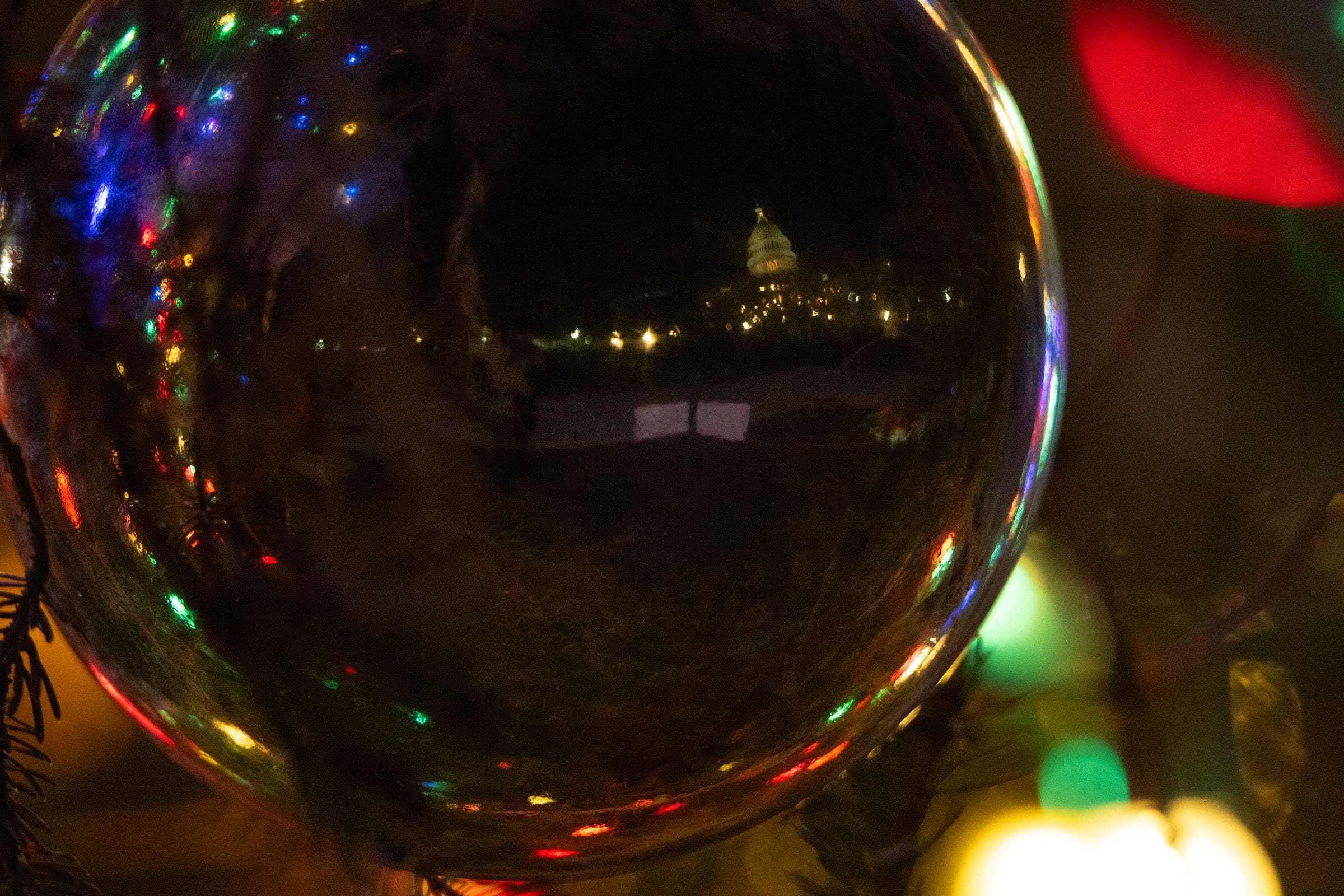
The U.S. Capitol is reflected in an ornament on the Capitol Christmas tree in Washington, D.C., on December 3, 2024. (Mattie Neretin/CNP/MediaPunch/Alamy)
People in my life who don’t generally fall prey to Trumpian talking points often tell me to watch out for the “dangerous” downtowns of places I love to visit like Seattle, Detroit, or Chicago. I think what they mean is simply that they have seen striking images of a significant unhoused population in those places. I don’t think they mean I would be physically in danger — mostly that I might be made to feel uncomfortable. It’s literally a dangerous feeling just to confront our current reality.
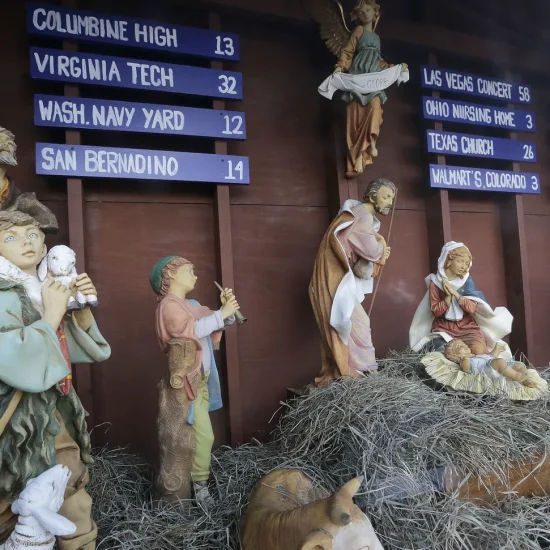
We would certainly prefer not to see difficult things. But obscuring our homeless neighbors obscures our connection to a homeless savior. Advent teaches us that a shiny, gilded facade only serves to cover up the other side of the story. If we keep our focus on the child sleeping in an animal feeding trough, we might be unsettled — but the truth we see will compel us to live differently.
So as we mark this Advent in a time of increasing starvation, let us remember both the burden and the blessedness of being awake.
Jeremy Fuzy is the digital editor at Word&Way and a resident of Kansas City, Missouri.

NOTE: This is part of our Unsettling Advent devotionals running Nov. 30-Dec. 24. You can subscribe for free and receive them each morning in your inbox.