NOTE: This piece was originally published at our Substack newsletter A Public Witness.
Shortly after the 2003 U.S. invasion of Iraq, a leader for the Southern Baptist Convention’s International Mission Board praised the new mission field being opened up by the U.S. military, insisting it was “a pivotal moment in history, a unique opportunity to share with a people we have prayed for a long time.” So the IMB launched “Operation Iraqi Spiritual Freedom” as they planned to follow the U.S. military into the nation.
But the prophesied revival never occurred. The IMB’s efforts at food distribution ended after just weeks in 2003 amid concerns about violence. The deaths of four IMB aid workers in a drive-by shooting in March 2004 canceled upcoming trips by others, and the much-touted evangelistic opportunities quietly disappeared from their websites and news reports before the second anniversary of the invasion. The war brought not a great awakening but a great decimation of the historic Christian community in Iraq.
Some MAGAchurch leaders haven’t learned the lessons of history. After the Trump administration attacked Venezuela and captured Venezuelan President Nicolás Maduro and his wife on Saturday (Jan. 3), Christian Nationalist preacher Greg Locke proclaimed on Elon Musk’s X platform: “The situation in Venezuela will open the way for the biggest revival that Latin America has ever experienced.” Locke is a fundamentalist pastor near Nashville, Tennessee, who gained notoriety in recent years by defying COVID-19 public health measures and becoming a regular preacher at the MAGA worship services known as the ReAwaken America Tour. So his cheerleading of anything Trump does isn’t surprising.
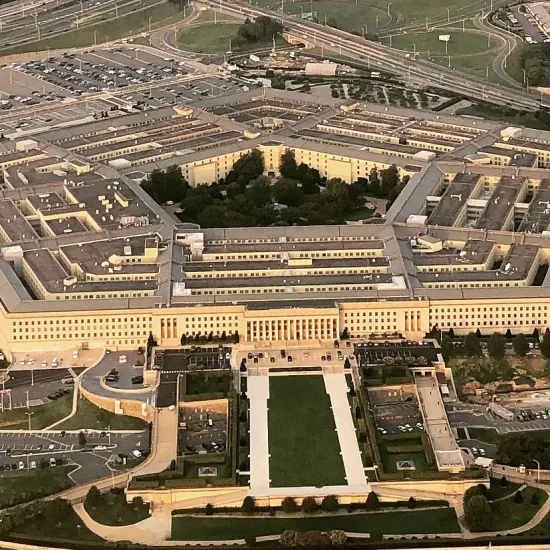
Another Trump-backing pastor, Troy Brewer, offered a similar prediction: “This will kick off a global revival!” A Christian Nationalist pastor/musician in the United Kingdom who has been supporting far-right anti-immigrant efforts declared, “Thanks to Trump church is legal again in Venezuela. Get ready for the biggest revival that Latin America has ever seen!” And evangelist Franklin Graham, who helped lay the theological foundation for the strikes by proclaiming a “God of war” during the Pentagon’s Christmas service, also praised Trump for the military action. Of course, unlike with Iraq, most people in Venezuela already identify as Christian.
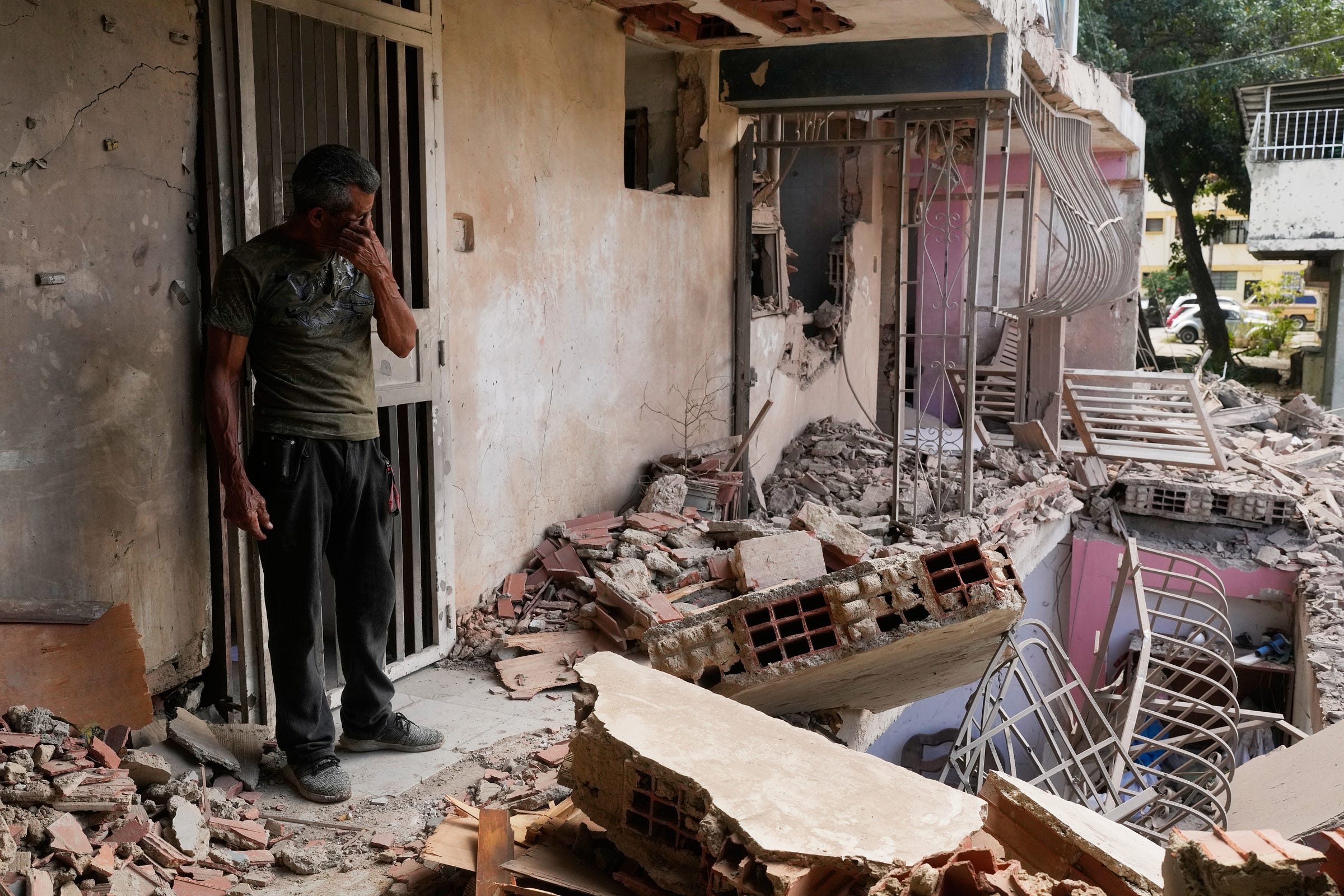
Wilman Gonzalez stands at his home in Catia La Mar, Venezuela, on Jan. 4, 2026, which was hit during U.S. military operations to capture Venezuelan President Nicolás Maduro. (Matias Delacroix/Associated Press)
Despite the predictions of a coming revival, not much has actually changed yet in Venezuela. The strikes on Saturday, which killed more than 80 people (including civilians), removed Maduro from office. But his ally and vice president, who has condemned Trump’s actions, is now in charge. While Trump said the U.S. will “run the country” now, Secretary of State Marco Rubio walked that back by arguing the U.S. would merely exert pressure on the government. Trump seems much more interested in obtaining Venezuelan oil than in promoting democracy or human rights. And since Trump acted without congressional authorization, and without even notifying Congress ahead of time, it remains unclear what plans, if any, his administration actually has moving forward.
But while some MAGA figures lined up behind the administration, many Christian leaders across the country and around the world were swift in condemning the operation as unlawful, dangerous, and undermining peace. So this issue of A Public Witness looks at mainline Protestant and Catholic criticism of the Trump administration’s actions in Venezuela and the pleas for peace by Venezuelan Christian leaders.
Mainline and Global Condemnation
On Saturday, the World Council of Churches quickly condemned the attacks on Venezuela and the detention of Maduro and his wife as “stunningly flagrant violations of international law.” The WCC is a fellowship of more than 350 denominations and groups in more than 110 countries. In the U.S., it includes as members various mainline, Black, and peace church denominations in addition to the Orthodox Church.
WCC General Secretary Jerry Pillay, a Presbyterian theologian from South Africa, added that Trump’s actions “set a dangerous precedent and example for others who seek to shrug off all constraints against the use of armed aggression and brute force to achieve political objectives.” In his WCC statement, he urged “dialogue and diplomacy” as well as “respect for the principles of international law and sovereignty of States.”
“In these dangerous and uncertain times, the world needs wise and courageous leaders for peace, rather than the proliferation of conflicts and the normalization of international illegality risking a deeper descent into chaos,” Pillay added.
In the U.S., several mainline Protestant denominations that are part of the WCC issued similar statements condemning the military actions by the Trump administration.
The United Church of Christ and the Christian Church (Disciples of Christ) released a joint statement on Sunday condemning the “unlawful” attack in Venezuela and Christmas Day airstrikes in Nigeria. The statement, which was signed by the two denominational presidents and leaders of the bodies’ global ministries, insisted the Venezuela operation “stands in direct contradiction to the principles of international law enshrined in the United Nations Charter.”
“We condemn all forms of government aggression — whether directed at one’s own people or imposed upon another country. When fundamental rights are threatened, nonviolent, lawful, and consensus-based solutions must take precedence,” the UCC and Disciples statement adds. “As churches committed to the gospel of peace, we grieve the loss, fear, and instability these actions have caused globally. These actions do not create the conditions for a safer or more peaceful world.”
In addition to affirming the World Council of Churches statement, the Disciples and UCC leaders also condemned the suggestion by Trump that the U.S. would “run the country” after removing Venezuela’s ruler. The statement rejects such “a colonial narrative and U.S. occupation,” instead affirming “the right of countries and communities to shape their own futures without coercion or military intervention.”
“We call for truth, rejecting simplistic narratives provided by those who benefit from war and extraction of natural resources,” the UCC and Disciples statement explains. “We seek discernment, praying for the Holy Spirit to grant the church the wisdom and courage to see and refute systemic evils and the adversity of Empires. … May our collective witness and vision for peace inspire leaders to choose diplomacy over domination, cooperation over coercion, and peace over war.”
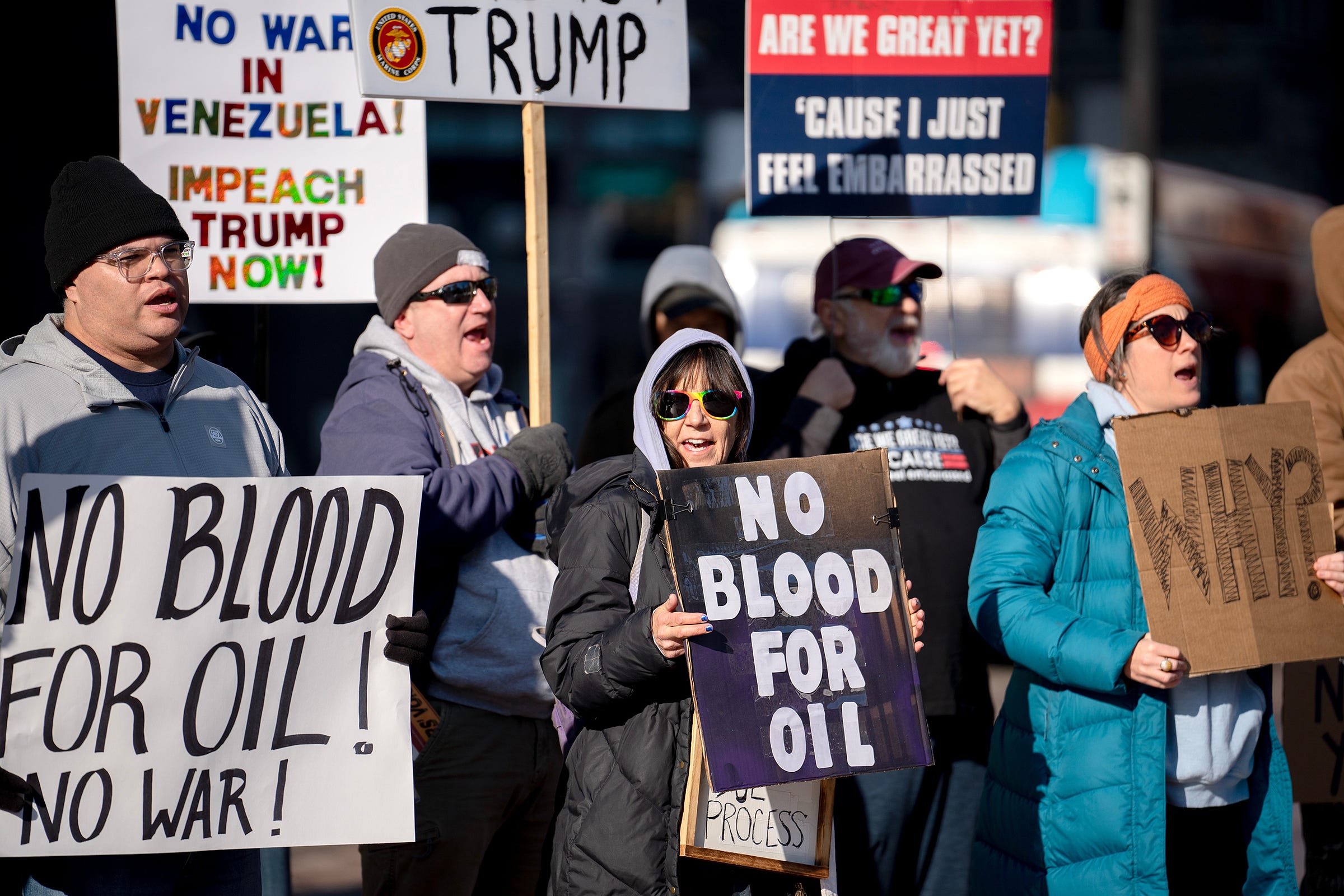
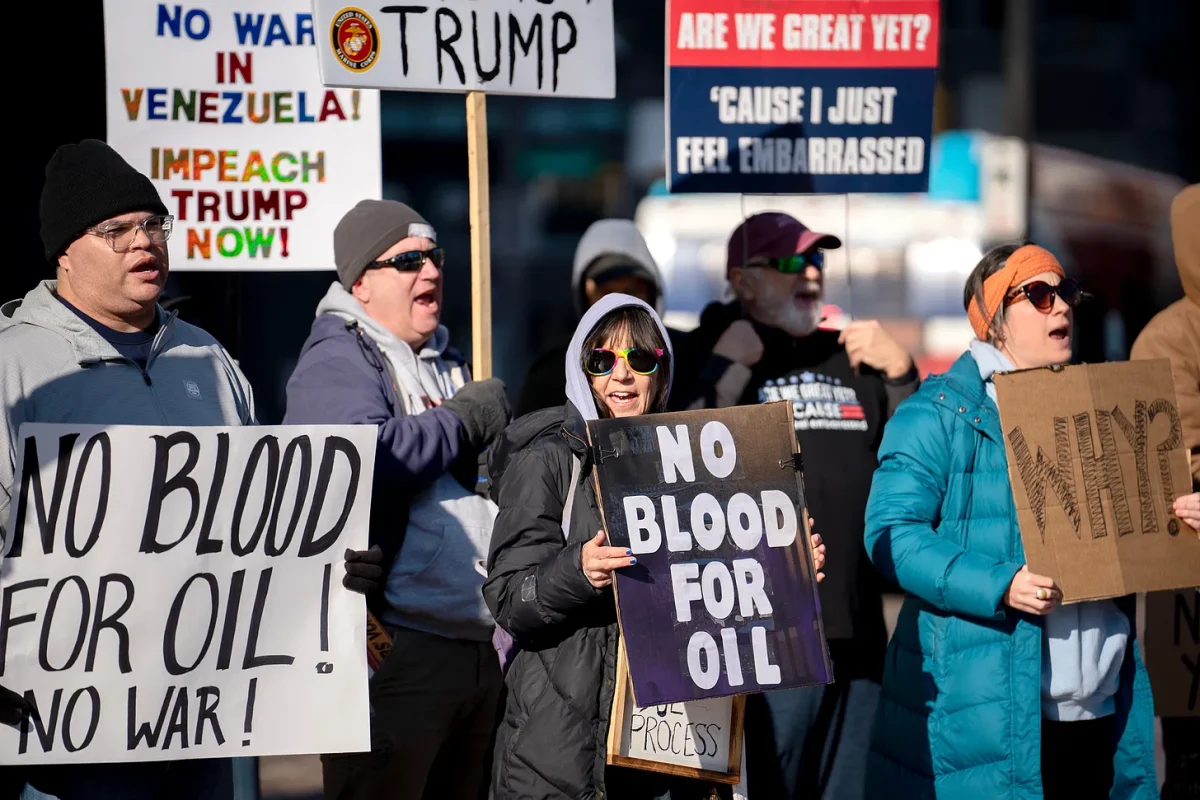
Protesters rally in front of the Ohio Statehouse in Columbus on Jan. 4, 2026, after the U.S. captured Venezuelan President Nicolás Maduro and his wife in a military operation. (Jessica Phelps/Associated Press)
The Episcopal Church’s Office of Government Relations similarly condemned the attacks on Saturday while also offering solidarity with Episcopalians in Venezuela. The statement also reaffirmed the Episcopal Church’s General Convention policy against pre-emptive strikes for non-imminent military threats.
“Episcopalians in Venezuela carry out vital ministries in increasingly challenging conditions, and we fear for their well-being and their church community if these military interventions, and any form of U.S. occupation, lead to more instability and violence,” the Episcopal statement explained. “We urge Congress to call for an investigation and accountability for this most recent unauthorized operation, as well as the related military actions carried out in recent months. We urge all regional parties to support a peaceful transition that respects the rule of law and the will of the Venezuelan people.”
The Presbyterian Church (U.S.A.), which is part of the WCC and the World Communion of Reformed Churches, shared a statement from the latter body on Saturday. The WCRC includes 230 denominations in 108 countries, and its current president is Rev. Karen Georgia Thompson, who as general minister and President/CEO of the UCC also signed the joint statement with the Disciples.
In its statement, the WCRC declared it “strongly condemns the illegal act of aggression” and called for “an immediate end to military interventions and for international law to be respected by the United States.”
“Such actions are an affront to human dignity and a direct challenge to God’s justice,” the WRCR’s statement adds. “We are reminded that imperial systems that prioritize occupation, domination, control of resources, and the preservation of global privilege over human dignity are theological and moral challenges. They are not neutral, and faith communities are called to name, resist, and transform them.”
Pope Leo XIV also expressed “deep concern” about the U.S. actions in Venezuela as he spoke Sunday morning in St. Peter’s Square. Leo, who last month urged Trump to choose non-military ways of addressing Venezuela, on Sunday emphasized the importance of justice and peace, respecting national sovereignty and human rights, and giving “special attention to the poorest who suffer because of the difficult economic situation.”
Help sustain the journalism ministry of Word&Way by subscribing to A Public Witness!
Venezuelan Christians Pray for Peace
The World Communion of Reformed Churches statement included insights from two Presbyterian leaders in Venezuela. Rev. María Jiménez de Ramírez, executive secretary of the Synod of the Iglesia Presbiteriana de Venezuela (Presbyterian Church of Venezuela), noted “the lived experience of communities as marked by anger, confusion, anguish, and indignation.” She highlighted the need for justice and the long-term struggles in their communities because of “rising fuel prices, daily uncertainty, and confusion about unfolding events.”
Berla Andrade from the same Presbyterian group recounted hearing the bombings and helicopters on Saturday while feeling the ground shake. She added that while local churches are offering pastoral care, solidarity from churches across the world helps strengthen their “resolve to organize, resist despair, and feel part of a wider body beyond Venezuela’s borders.”
The Catholic Bishops’ Conference in Venezuela issued a statement Sunday urging prayer and rejecting violence.
“We stand in solidarity with those who were injured and with the families of those who died. Let us persevere in prayer for the unity of our people,” the bishops wrote to Catholics in their country. “We make an appeal to the people of God to live more intensely in hope and fervent prayer for peace in our hearts and in society; we reject any kind of violence.”
The Convención Nacional Bautista de Venezuela (National Baptist Convention of Venezuela), which includes about 725 churches and 48,000 members, released a statement on Saturday urging prayer and peace. (Word&Way has partnered with Luminar Bautista, the convention’s news publication, to provide media and communication training in Venezuela).
“[We] call upon the Baptist people in particular, and Christians in general, to remain in prayer before the throne of grace, imploring our God for a climate of peace and tranquility that will allow Venezuelan society to overcome the current national situation,” the statement from the convention’s president and general director reads. “Christians are called to be a blessing to others.”
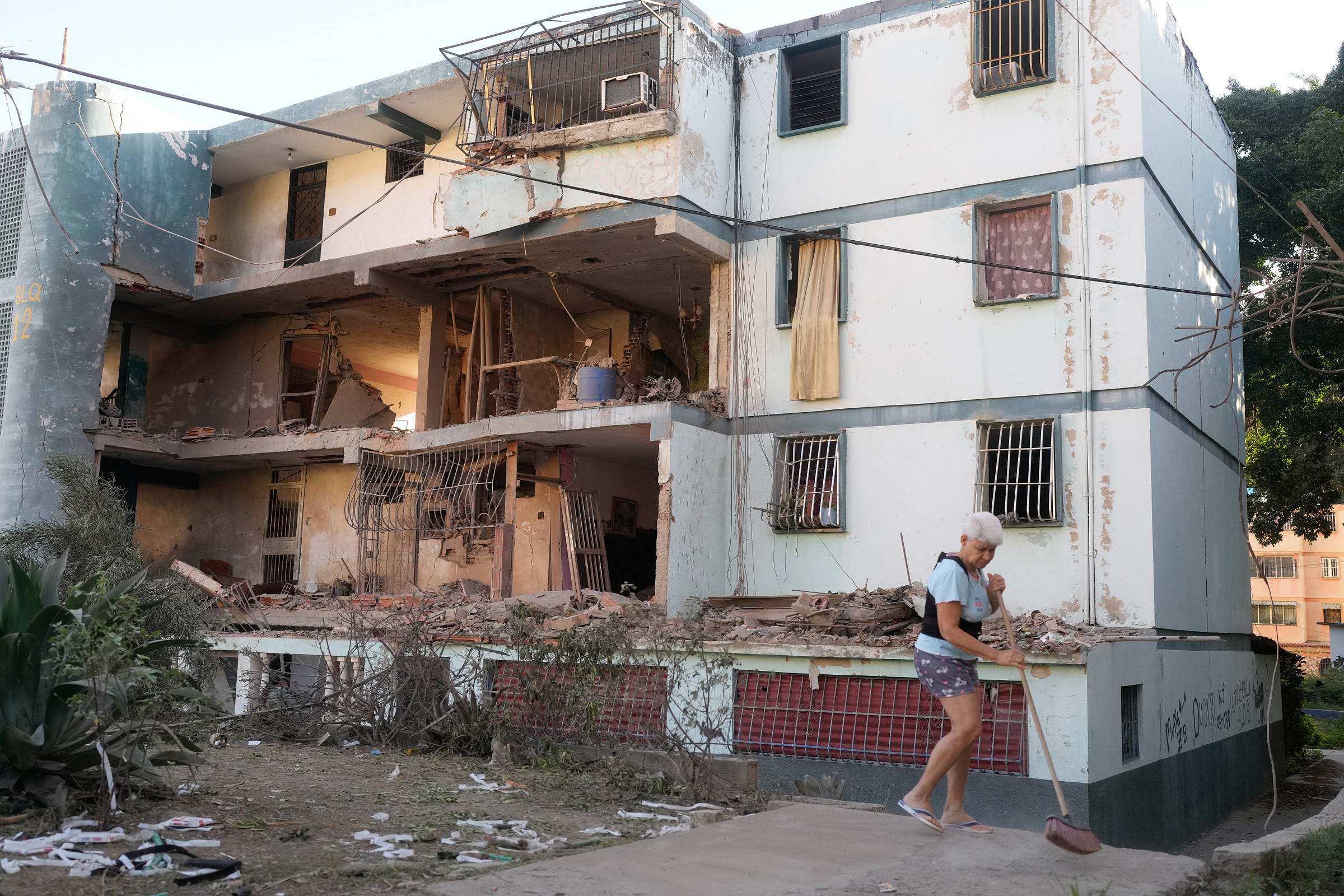
Carmen Mejias sweeps in front of a damaged apartment complex in Catia La Mar, Venezuela, on Jan. 4, 2026, which was hit during U.S. strikes to capture Venezuelan President Nicolás Maduro. (Matias Delacroix/Associated Press)
Similarly, the Consejo Evangélico de Venezuela (Evangelical Council of Venezuela) issued a statement also urging caution and peace.
“We extend our prayer and solidarity to all our brothers and fellow citizens going through moments of uncertainty or fear,” the group’s executive director wrote. “We pray for peace in the country and for a true and lasting transformation that honors justice, truth and dignity of every citizen. … May the Lord grant us wisdom, temperance and courage to be light in the midst of darkness.”
Nicolás Maduro was a dictator who made life difficult for people in Venezuela. He didn’t care about the people, instead looking to enrich himself. When he lost reelection in 2024, he simply claimed victory and shut down protests — all while holding up a Bible to present himself as righteous. Imagine that: an authoritarian leader who holds up a Bible and claims to have won an election he actually lost!
But just because Maduro was an illegitimate, corrupt, and dangerous leader, that doesn’t mean Saturday’s operation was right. The toppling of the evil dictator Saddam Hussein should have taught us the geopolitical folly of thinking two wrongs make a right. May we join Venezuelan Christians in praying for peace, justice, and economic improvements. And may we join mainline Protestant and Catholic leaders in prophetically speaking out against an unlawful and dangerous operation that undermines peace.
As a public witness,
Brian Kaylor
A Public Witness is a reader-supported publication of Word&Way. To receive new posts and support our journalism ministry, subscribe today.