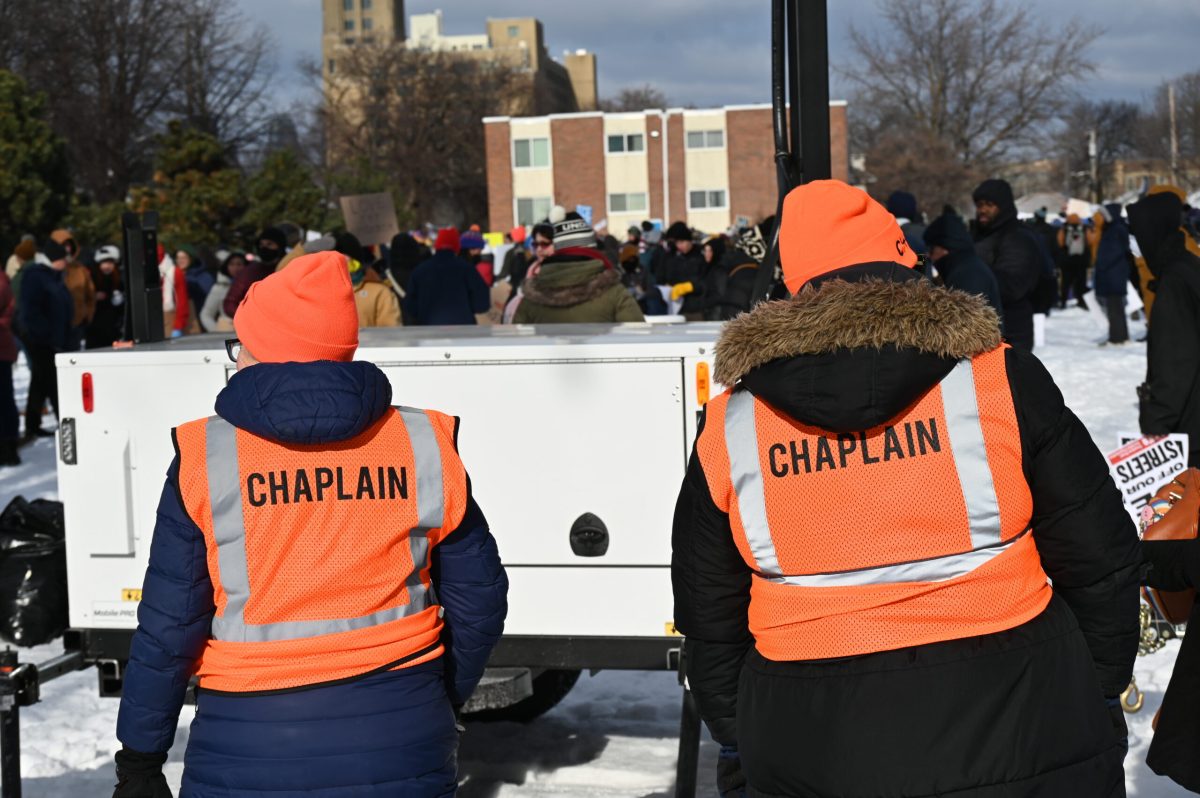
MINNEAPOLIS (RNS) — As tens of thousands trekked over the snow and ice in Powderhorn Park on Saturday (Jan. 10) to protest last week’s fatal shooting of a woman by an Immigration and Customs Enforcement officer, the crowds were greeted by a group of faith leaders who called themselves “movement chaplains.”
In Minneapolis’ Powderhorn Park on Saturday, Jan. 10, 2026, tens of thousands gathered to protest U.S. Immigration and Customs Enforcement’s presence in the city and the fatal shooting of Renee Good. The crowds were greeted by “movement chaplains,” wearing bright orange hats and vests. (RNS photo/Jack Jenkins)
Wearing bright orange hats and vests emblazoned with the word “chaplain,” the group, made up of mostly pastors, was led by Shari Seifert, a member of Calvary Lutheran Church and a self-described “street theologian.” Seifert said movement chaplains — who seek to “tend to people’s spiritual needs” at protests and de-escalate tensions as they arise — were last heavily active during headline-making demonstrations in the city after the murder of George Floyd by a police officer in 2020.
But looking out at the sprawling crowd, Seifert said the groundswell of outrage and organizing that has followed the killing on Wednesday of Renee Good by an ICE agent has renewed the need for protest chaplains.
“There’s a lot of hurting people right now,” Seifert said.
Religious leaders and groups that mobilized during the Floyd protests have reemerged as key organizers in Minneapolis’ sprawling resistance to the thousands of ICE agents deployed as part of President Donald Trump’s mass deportation campaign. The faith-based networks, which developed organizing infrastructure and relationships during the Floyd era, are joined by newcomers as resistance efforts have intensified since the killing of Good, which federal officials called self-defense but which eyewitnesses and residents have condemned as murder.
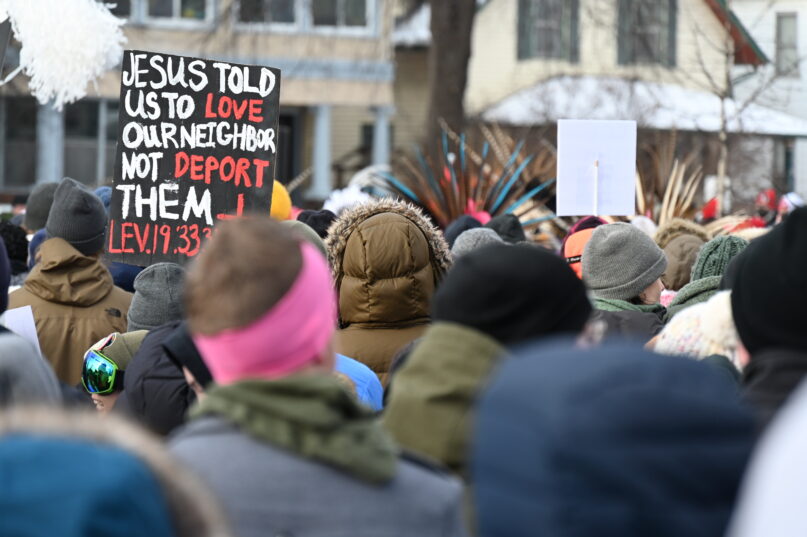
Tens of thousands gather Saturday, Jan. 10, 2026, in Minneapolis’ Powderhorn Park to protest the presence of U.S. Immigration and Customs Enforcement in the city and the fatal shooting of Renee Good. (RNS photo/Jack Jenkins)
Religion and spirituality were easy to find at Saturday’s massive protest, where thousands rallied and marched against ICE. A group of Indigenous leaders kicked off the event with a dance, and Rachel Dionne-Thunder, vice president of the Indigenous Protector Movement, told the crowd ICE agents threatened her with arrest the day before when she was acting as an observer — the same activity Good was reportedly doing when she was killed.
“These are fascists, and they have invaded our city,” said Dionne-Thunder, who also noted that the American Indian Movement, a grassroots Indigenous rights collective, was founded in Minneapolis in the 1960s. “They have invaded this land. They have desecrated this land. We have spilled blood on this sacred Dakota unceded territory of this land. We have a message as the native community here: ICE needs to leave immediately.”

A group of Indigenous leaders was among the tens of thousands gathered in Minneapolis’ Powderhorn Park on Saturday, Jan. 10, 2026, to protest the presence of U.S. Immigration and Customs Enforcement in the city and the fatal shooting of Renee Good. (RNS photo/Jack Jenkins)
Standing a few feet away in the crowd was the Rev. Jill Sanders, a pastor who joined the protests after driving hours from Alexandria, Minnesota, where she serves First Congregational United Church of Christ.
“We need to do something,” she said. “I am heartbroken at the way so many churches are applauding the kinds of abuses that we’re seeing. And it just seems to me like it’s important for the faith community to show up and show that we’re not all Christian nationalists.”

The Rev. Jill Sanders, right, joined the protests in Minneapolis on Saturday, Jan. 10, 2026, after driving from Alexandria, Minnesota, where she serves First Congregational United Church of Christ. (RNS photo/Jack Jenkins)
Other signs of religious resistance to ICE in Minnesota were visible throughout the crowd, especially among Christians in Minneapolis, where Lutherans are an especially prominent faith group. One man dressed like Jesus held a sign that read “Jesus didn’t die for these sins.” Some carried images of Our Lady of Guadalupe and depictions of the Virgin Mary alongside the slogan “Hail Mary, full of Grace, kick ICE out of this place.” Others held signs that read “Jesus was an immigrant” or referenced Scripture passages such as the biblical Book of Matthew’s call to “welcome the stranger” as well as Jesus’ command to “love thy neighbor as thyself.”
The religious pushback was also evident the night before, when thousands gathered for a vigil on the Capitol grounds in nearby St. Paul to listen to a litany of religious speakers. Among them was Imam Asad Zaman, who was there representing the Muslim American Society of Minnesota. He noted Muslims are also well represented in the city, particularly among Somali Americans, a community that has been targeted by the Trump administration amid allegations of fraud.

Thousands gather at the Capitol in St. Paul, Minnesota, on Friday evening, Jan. 9, 2026, for a vigil to honor Renee Good, who was shot earlier in the week by an Immigration and Customs Enforcement agent. (RNS photo/Jack Jenkins)
In an interview with Religion News Service, Zaman said fear has gripped the Muslim community in the city, and he estimated that anywhere from 5% to 10% of those being detained by ICE are Muslims.
“This is very, very scary, and that is not the America most of us signed up for,” he said, later adding, “Almost every mosque has seen a 20% drop in attendance.”
Another speaker at the vigil, the Rev. JaNaé Bates Imari, who co-leads Isaiah, a local multifaith organizing group, said Isaiah helped organize the vigil because the group wanted to help “make space for people to be able to publicly grieve,” but also to help inspire activism.
“We have now witnessed Renee Good be shot in the street because she wanted to be a legal observer, a moral witness for her neighbors,” Bates Imari said. “She was being a good neighbor and was murdered for it. We cannot just sit by.”
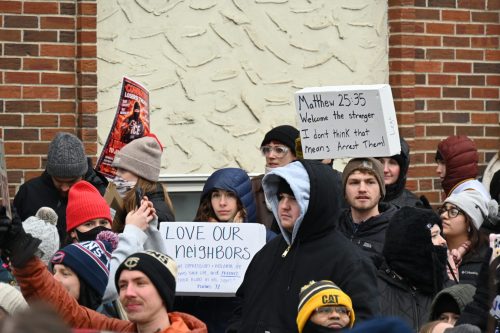
Religious signs were abundant as tens of thousands gathered Saturday, Jan. 10, 2026, in Minneapolis to protest U.S. Immigration and Customs Enforcement. (RNS photo/Jack Jenkins)
The practice of serving as a legal observer, sometimes also called constitutional observers or ICE monitors, has become common in cities where ICE and Department of Homeland Security agents have shown up in force. The idea, activists say, is to observe ICE’s actions, document them, and alert the surrounding community to their presence, often by blowing whistles.
Clergy and people of faith are among those acting as observers in the city — and according to a recent statement released by her wife, Good herself was a Christian (so, too, according to family members, is the agent who killed her). Also patrolling the streets in Minneapolis are Ben Luhmann, a high schooler from the Chicago suburbs, along with his brother Sam, who have tracked ICE’s actions for months as observers.
Luhmann, a homeschooler whose family is rooted in a conservative Christian tradition, has said he believes pushback to ICE should be a priority for Christians. While the killing of Good rattled him and his brother, the pair felt compelled to drive to Minneapolis to assist observers there.
“This just feels like where we should be working and where we should be spending every day, day in and day out, just trying the best we can to keep people safe and keep people with their human rights,” he said.
Luhmann said the killing of Good doesn’t appear to have reduced the number of observers operating in the city, which he said were so plentiful it was difficult to get to know any of them. Even so, he said, the response from ICE to their presence has been more intense than what the two brothers have experienced in Chicago: Luhmann said DHS agents have already threatened arrest of multiple observers in recent days, including repeated threats to arrest him and his brother. Agents have also, he said, threatened the duo with tear gas and pepper spray.
“They’ve been very aggressive compared to what I’m used to,” Luhmann said. “That’s just a little bit terrifying, because they don’t have checks and balances. So it feels like you’re just fighting against the people with all the power, and they don’t have to know or care about anybody’s safety.”

The Rev. Ingrid Rasmussen pastors Holy Trinity Lutheran Church in Minneapolis, which teamed up with a nearby brewery and bookstore to offer a free drink to U.S. Immigration and Customs Enforcement protesters who showed up wearing a whistle. (RNS photo/Jack Jenkins)
Yet religious advocates in Minneapolis appear largely undeterred by the government’s efforts to discourage observing the actions of DHS agents. Also among those who have served as observers is the Rev. Ingrid Rasmussen, who pastors Holy Trinity Lutheran Church in the city. On Saturday evening, her church teamed up with a nearby brewery and bookstore to offer a joint event: Anyone who came to the brewery and showed their whistle would get a free drink, alcoholic or otherwise.
Standing in the packed bar Saturday night, Rasmussen said the patrons surrounding her — of all ages and most of whom proudly wore whistles around their necks — included a number of her parishioners. Her church, she explained, was at the “epicenter” of protests surrounding the murder of George Floyd five years ago and was quick to organize pushback to the ongoing mass deportation effort.
“This is a place where people love one another, where churches, bookstores, and breweries share one thing in common, at least: that we love where we serve and we want this to be a place of belonging for many people,” she said.
Rasmussen said she was acting as an ICE observer herself around the time she learned of Good’s killing and was one of several faith leaders who rushed to the scene shortly after. Amid the ensuing outrage that has gripped the city, she said, she has been reflecting on Jesus’ parable of the mustard seed.

Some Minneapolis protesters carry images of Our Lady of Guadalupe and depictions of the Virgin Mary alongside the slogan “Hail Mary, full of Grace, kick ICE out of this place” on Jan. 10, 2026. (RNS photo/Jack Jenkins)
“I see those mustard seeds on display all over the place, whether it’s neighbors bringing groceries to one another, or constitutional observers standing two by two on every street corner in this neighborhood, people moving their feet day and night to attend protests,” she said.
“When I get discouraged I just have been sort of saying, kind of like I did in 2020: Lower your gaze and look for like the tiny mustard seeds, that have the power to be organized into something larger.”