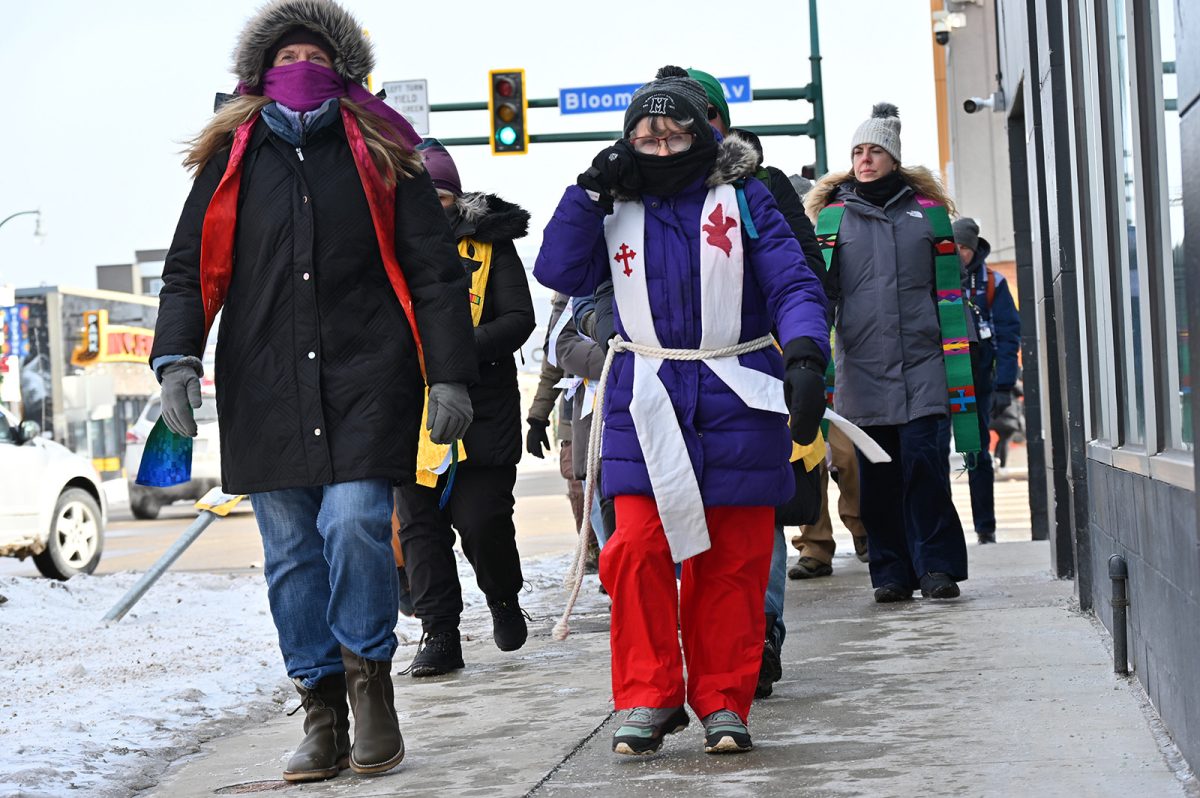
MINNEAPOLIS (RNS) — Around 200 faith leaders fanned out across the city on Thursday (Jan. 22) to observe and document the actions of Immigration and Customs Enforcement, with some clergy confronting Department of Homeland Security agents, adding a visible religious presence to widespread efforts to counter the president’s mass deportation campaign in the region.
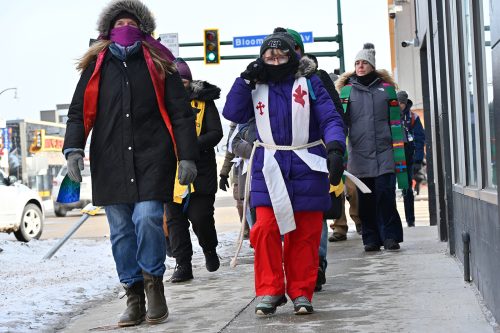
Clergy observe and document the actions of immigration enforcement agents, Thursday, Jan 22, 2026, in Minneapolis. (RNS photo/Jack Jenkins)
The faith leaders, who are in Minneapolis as part of a larger convening focused on religious pushback to ICE, deployed to neighborhoods with significant immigrant populations, where DHS agents have been most active during an ongoing campaign known as Operation Metro Surge. The clergy, who hail from a range of traditions and worship communities across the country, sang on the buses as they ventured out into the street. They belted out hymns and songs popular during the Civil Rights Movement, such as “Woke Up This Morning.”
For the Rev. James Galasinski, who leads a Unitarian Universalist congregation in Canton, New York, it was only a few minutes after he arrived at his designated neighborhood before he and two of his clergy colleagues encountered ICE agents.
“I noticed an SUV with Wisconsin license plates and tinted windows,” he said, referring to what activists say are telltale signs of unmarked ICE vehicles. “There were four men inside, and some of them had masks. I was like: ‘That’s ICE.’”
Galasinski and another Unitarian Universalist minister, the Rev. Lise Adams Sherry of Anchorage, Alaska, called over the Rev. Dan Brockway, an American Baptist minister who serves a congregation in Brockport, New York. The trio staked out the vehicle in front of a strip mall for several minutes, observing quietly, until three women walked past them to enter a minivan.
“All of a sudden, the car that we had been watching pulled up behind them to block them,” Sherry said. “Then two more cars came in.”
Galasinski added: “In just seconds, 12 ICE agents came out.”
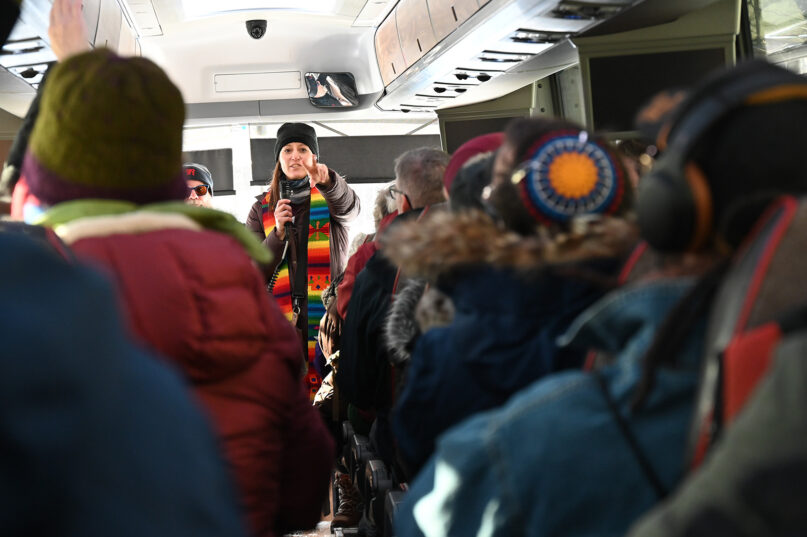
The Rev. Susie Hayward speaks to clergy on a bus as they move out to observe and document the actions of immigration enforcement agents, Jan. 22, 2026, in Minneapolis. (RNS photo/Jack Jenkins)
The ministers — all wearing clerical stoles — began blowing whistles, attempting to alert the nearby community. ICE agents surrounded one of the women from the minivan and instructed the pastors to get back. Brockway, standing behind the other faith leaders, began livestreaming the encounter to his church’s Facebook page.
Ultimately, the encounter was brief: The woman, who the pastors said appeared to be pregnant, had citizenship papers with her. She showed them to the officers — something activists have argued doesn’t always dissuade federal immigration agents, who have detained U.S. citizens on multiple occasions. But in less than two minutes, the agents left the scene.
The woman, the pastors said, was shaken. It was impossible to tell whether the presence of clergy had staved off a potential detention, but the pastors said the woman thanked them profusely before leaving.
The faith leaders — none of whom had previously encountered ICE — said they, too, were left unsettled.
“I’m becoming radicalized,” Galasinski said, his voice rising. “I’m seeing our nation become more and more fascist before my eyes — I saw it. I saw it. I mean, demanding papers? I never thought I would live in a country like this.”
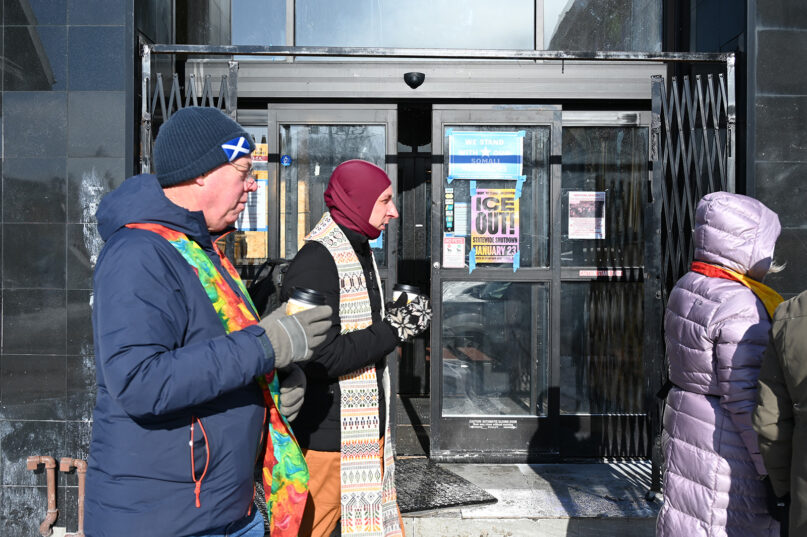
Clergy observe and document the actions of immigration enforcement agents, Jan. 22, 2026, in Minneapolis. (RNS photo/Jack Jenkins)
The sentiment was less dramatic but no less melancholic in another neighborhood, where a different group of about 50 clergy patrolled a major street lined with businesses owned by Hispanic and Somali Americans — groups that have been targeted by ICE.
Among them was Rabbi Diane Tracht, who serves a Reconstructionist community in Indiana, and the Rev. Joshua Shawnee, who serves what he called an Inclusive Catholic Church in Tulsa, Oklahoma.
Shawnee, who wore a whistle around his neck as well as a stole, said he has encountered ICE before in Oklahoma.
“You can only preach against ICE for so long before God calls you to get out of the pulpit and get to the streets,” Shawnee said.
When Tracht was asked why she had come to the faith convening in Minneapolis, she recalled the Holocaust, saying it reminds her of the “literal genocide that authoritarian governments can do.”
As she was speaking, a car with tinted windows drove by slowly. Two DHS officials sat in the front seat, looking over at the pastors. The rabbi finished her thought as she and Shawnee hurried back down the street to follow the car, expressing concern about people they had just met in that area.
“What did we learn from the Holocaust? We have to act and we have to resist,” Tracht said, running out of breath as the car turned the corner. “If I’m not going to act and resist now, then I shouldn’t call myself a rabbi and I can’t be a proud Jew.”
While most of the clergy in the group appeared not to be from Minneapolis, locals seemed to welcome their presence all the same. As a Lutheran pastor and a Unitarian Universalist passed by a restaurant while on patrol, the apparent owner stepped out holding two steaming cups of spiced tea — a common drink among Somali Americans.
“She said, ‘Here. If you’re watching ICE, I just want to thank you,’” recalled Meagan McLaughlin, who serves an Evangelical Lutheran Church in America congregation in St. Louis.
The effort was part of a broader groundswell of faith-based organizing designed to resist President Donald Trump’s mass deportation agenda. Faith-led efforts to support immigrants and push back the administration have become common in cities across the U.S. over the past year as DHS has launched a series of targeted enforcement campaigns. This week, hundreds of religious leaders have come to Minneapolis as part of a convening organizers hope will further strengthen religious resistance across the country.
After the religious leaders returned from their patrols, several prominent faith leaders held a press conference in a church to denounce ICE in theological terms. Standing behind a podium that read “Do justice. Love Kindness. Abolish ICE,” the first to speak was Bishop Mariann Budde, the Episcopal bishop of Washington, who made headlines almost exactly a year ago when she delivered a sermon to Trump in which she implored the president to “have mercy” on immigrants and other groups.
“Join us in sending a message to all our elected officials that no agency should have license to arbitrarily arrest and detain people without due process,” said Budde, who noted Minnesota is her home state. “To harm and even kill those who bear witness to what is happening. This is a bright-line moment for our country and our values. In our varied and united faith traditions, love of neighbor is not optional.”
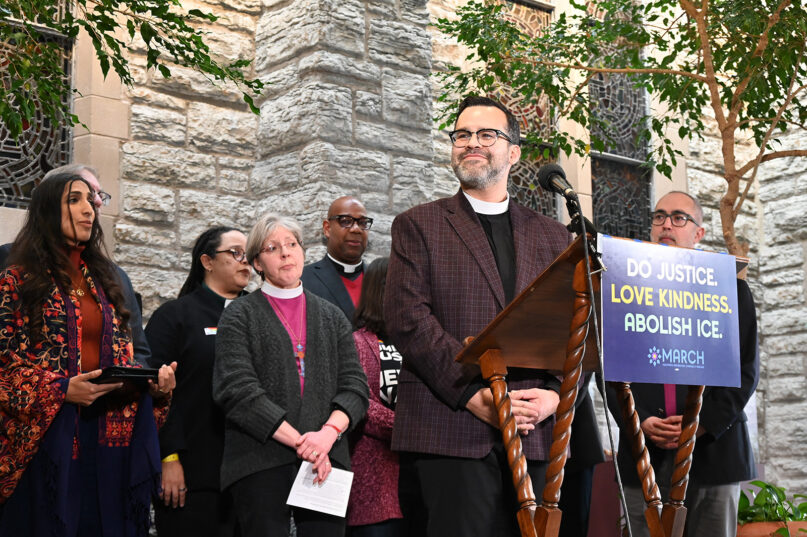
The Rev. Hierald E. Osorto speaks at a press conference, Jan. 22, 2026, in Minneapolis. (RNS photo/Jack Jenkins)
She was followed by the Rev. Hierald E. Osorto, a local ELCA pastor who serves a majority immigrant congregation. Osorto noted that immigrant communities like his are also heavily active in pushing back against ICE, even if much of it is less public.
“For more than a year we have prepared for this moment,” he said. “Our families drew up paperwork — delegation of parental authority forms — so that if they were put in detention, their children would not be alone. We found people lawyers, so they could navigate the legal system where no one else is looking out for them.”
He added: “We anticipated this time of trial, but we still pray: líbranos del mal — deliver us from evil.”
The press conference happened not only the same day the federal government arrested anti-ICE activists who staged a controversial protest in a local church where an ICE official allegedly serves as a lay pastor, but also occurred at the same time Vice President JD Vance was leading his own press conference on the other side of the city. The vice president, who has sometimes turned to theological arguments to defend the administration’s hard-line immigration policies, appeared to criticize the rash of anti-ICE activism in the city, arguing that some ICE agents were in the city not “to enforce immigration laws, but to protect people from the rioters.”
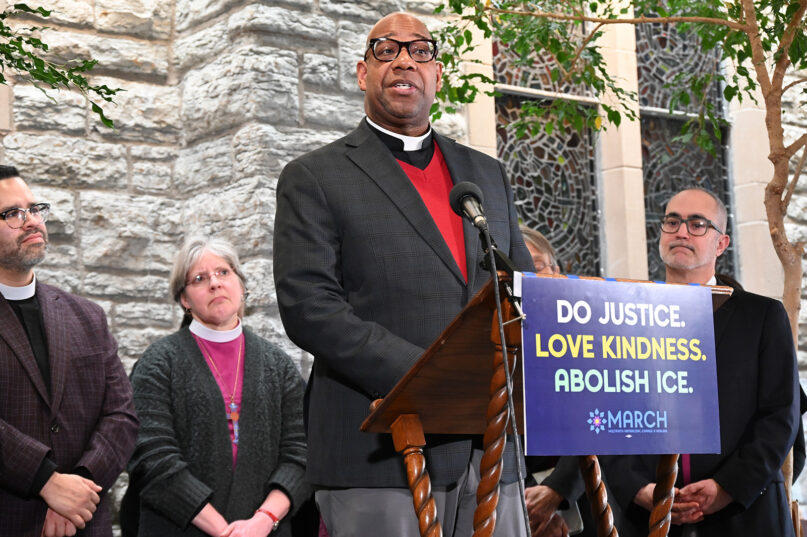
The Rev. DeWayne Davis addresses a press conference, Jan. 22, 2026, in Minneapolis. (RNS photo/Jack Jenkins)
But at the faith-led press conference, the Rev. DeWayne Davis, a trustee of the United Theological Seminary of the Twin Cities, argued the federal government had “made a mistake” by targeting Minneapolis. Recalling the city’s past experiences with organizing, particularly the activism that followed the murder of George Floyd by a police officer in 2020, Davis argued the federal government should have expected the intense grassroots resistance that has emerged in the city — including from local faith leaders.
“You messed up. You didn’t understand what we went through,” he said. “We didn’t do all that because we are heroes and saviors. We did it because we understand the meaning of our faith: that we are all connected. We join together. We are a part of a people, a body of humanity that is made in the image of a loving and beautiful God that wants all God’s children free.”