NOTE: This piece was originally published at our newsletter A Public Witness.
For the second time in a year, a federal judge has issued an injunction to block the Department of Homeland Security from conducting warrantless immigration enforcement actions at some houses of worship. In a 62-page ruling on Friday (Feb. 13), U.S. District Judge F. Dennis Saylor IV protected churches in the American Baptist Churches USA, Alliance of Baptists, Metropolitan Community Churches, and several regional synods of the Evangelical Lutheran Church in America. An earlier ruling by a different judge barred ICE actions at churches in the Cooperative Baptist Fellowship and several regional Quaker groups in addition to at a Sikh Temple in California.
“As people of faith, our sacred spaces must remain places of safety, refuge, and worship,” the plaintiffs protected by Friday’s injunction said in a joint statement. “For decades, our congregations have opened their doors to all, regardless of immigration status, and carried out ministries grounded in dignity, compassion, and community. Today’s ruling affirms a simple but profound principle: religious freedom belongs to everyone. We are grateful the court recognized that truth and protected the rights of our communities.”
The ruling came in one of several cases filed by religious groups seeking to protect houses of worship from immigration raids after the Trump administration rescinded a policy barring operations by ICE or border patrol agents in “sensitive” or “protected” places like houses of worship, hospitals, and schools. Saylor, who was appointed to the bench by President George W. Bush, limited his ruling just to the plaintiffs in the case before him who he found showed an impact on a congregation and thus established standing.
He did not include three regional Quaker groups who were part of the suit in his injunction since he ruled they did not show that the rescission of the sensitive locations policy had yet harmed their congregations. The ELCA groups protected are the New England Synod, Greater Milwaukee Synod, Southwest California Synod, Southwest Texas Synod, and Sierra Pacific Synod.
The injunction blocks warrantless immigration enforcement actions not just in the groups’ houses of worship and social-service facilities (like daycare centers) but also on adjacent church property (like parking lots) and within 100 feet of a church’s entrance. Additionally, law enforcement officials are not allowed to set up checkpoints designed to catch people traveling to or from a protected church building.
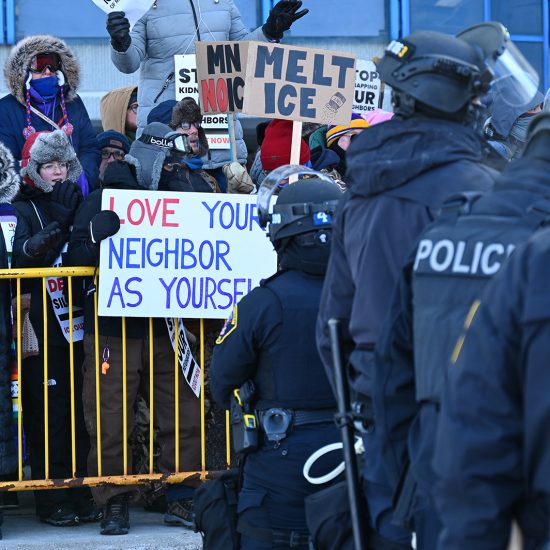
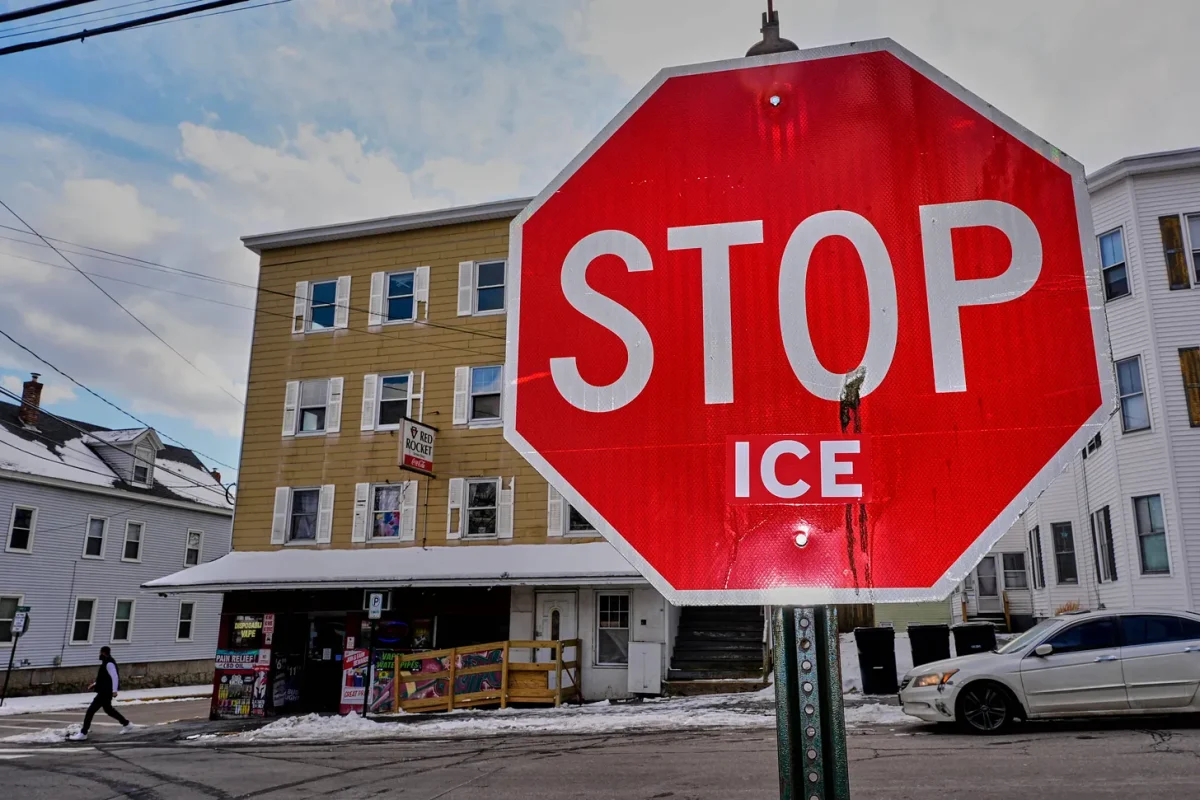
Anti-ICE sentiment is expressed on a traffic sign in Biddeford, Maine, on Jan. 23, 2026. (Robert F. Bukaty/Associated Press)
Saylor noted that the Trump administration’s 2025 policy regarding “sensitive locations” did not merely allow the apprehension of immigrants in houses of worship but also “the disruption of church services and functions and the interrogation or seizure of anyone who may be on church property, citizen and non-citizen alike.”
“The prospect that a street-level law-enforcement agent — acting without a judicial warrant and with little or no supervisory control — could conduct a raid during a church service, or lie in wait to interrogate or seize congregants as they seek to enter a church, is profoundly troubling,” Saylor wrote in his ruling. “Indeed, according to the new policy, agents could conduct a raid, with weapons drawn, at any type of church proceeding — including a regular Sunday service, a wedding, a baptism, a christening, or a funeral — subject only to the exercise of their ‘discretion’ and ‘common sense.’”
“It hardly requires mentioning that freedom of religion is both a core American value and a basic liberty protected by the First Amendment and laws of the United States. That freedom encompasses not merely the freedom to believe, but the freedom to worship, including the freedom to attend church and to participate in sacraments, rituals, and ceremonies,” the judge added. “If government interference with those freedoms is ever justifiable, it is only in relatively extreme circumstances, such as an immediate threat to public safety. The routine enforcement of the immigration laws does not involve such a threat, and cannot justify the harm to religious freedom posed by the new policy.”
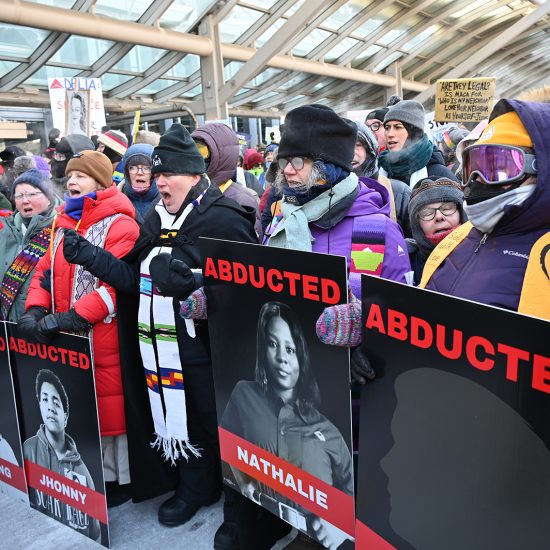
In his ruling, Saylor noted that several congregations in the plaintiff groups had reported declines in worship believed to be a result of ICE actions and the rescission of the “sensitive locations” policy. He added that “because of the vital importance of communal worship to plaintiffs’ religious exercise, their member congregations suffer a concrete injury-in-fact when attendance at religious services declines.” Among the churches cited as evidence is a congregation in Minneapolis, Minnesota, that is affiliated with both the Alliance of Baptists and American Baptist Churches USA. That church cited an example of ICE activity near their church last month amid the surge of ICE and other DHS federal agents in the city.
Saylor rejected DHS’s arguments that “effectively enforcing immigration law” meant he should rule against the religious plaintiffs. He explained that “there are many other means by which to enforce the nation’s immigration laws other than conducting enforcement actions at houses of worship — including, of course, enforcement of immigration laws in those vast portions of the nation that are not places of worship.”
Mixed Results in Other Cases
Friday’s ruling came in just one of the cases by religious groups challenging the rescinding of the “sensitive locations” policy. Several Quaker groups sued first in January 2025 and were quickly joined in their suit by the Cooperative Baptist Fellowship and a Sikh Temple in Sacramento. A judge quickly granted those groups a preliminary injunction last February. CBF created posters for churches to download so that federal agents would know the church is covered by the injunction.
That suit was followed by another in February 2025 with 27 religious groups making similar arguments. The second suit includes several mainline Protestant groups like the African Methodist Episcopal Zion Church, Christian Church (Disciples of Christ), Church of the Brethren, Episcopal Church, General Assembly of the Presbyterian Church (U.S.A.), Mennonite Church USA, and some regional United Church of Christ and United Methodist Church bodies. Additional plaintiffs include a Hispanic Baptist convention in Texas, multiple Jewish groups, the Unitarian Universalist Association, and the state council of churches for Massachusetts, New York, North Carolina, Rhode Island, and Wisconsin. The judge in that case refused to issue a preliminary injunction, thus leaving the houses of worship in those groups still vulnerable to ICE actions. The case is ongoing.
The suit leading to Friday’s ruling was filed in July 2025. The plaintiffs are represented by Democracy Forward, Washington Lawyers’ Committee for Civil Rights and Urban Affairs, and Gilbert LLP.
“This is the second federal court to confirm what we have long known: the Trump-Vance administration’s attempt to turn sacred houses of worship into houses of fear for immigrant communities is unlawful,” Skye Perryman, President and CEO of Democracy Forward, said after Friday’s injunction. “Religious liberty and the ability of all people to worship freely is a core democratic value.”
Hours after Saylor’s ruling, a partial government shutdown started that only impacts DHS. While Congress passed funding measures to keep the rest of the federal government open, negotiations over DHS funding have stalled amid the growing unpopularity of ICE after federal agents executed two people in Minneapolis last month, in addition to other controversial and violent actions by officials.
As a public witness,
Brian Kaylor
A Public Witness is a reader-supported publication of Word&Way. To receive new posts and support our journalism ministry, subscribe today.