SÃO PAULO (RNS) — Once hailed by evangelical Christian leaders of different stripes for his support of their churches, Venezuela’s former President Nicolás Maduro, currently awaiting trial in a Brooklyn jail along with his wife, Cilia Flores, has apparently lost most of his Christian backers in his native country.
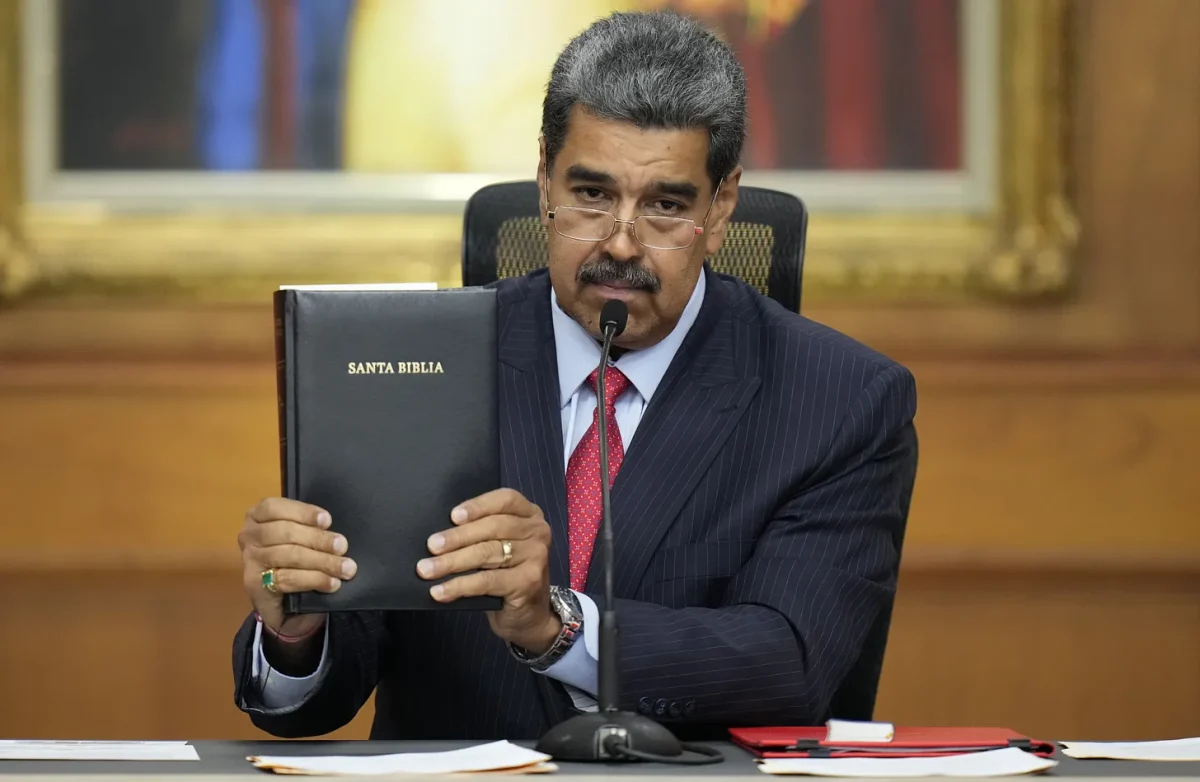
Venezuelan President Nicolás Maduro holds a Bible during his news conference at Miraflores presidential palace in Caracas, Venezuela, on July 31, 2024, three days after his disputed reelection. (Matias Delacroix/Associated Press)
While evangelical groups have come out for pro-Maduro demonstrations since Jan. 3, when U.S. troops bombed Caracas and other locations and abducted Maduro and Flores, most churches have remained silent, and most Christian leaders have not issued public statements. At least one evangelical movement has opted to leave the movement known as Chavismo, whose name is a nod to its founder and Maduro’s predecessor, Hugo Chávez.
Since Chávez took office in 1999, the Venezuelan government and the Catholic Church, whose followers make up least 63% of the population, have famously warred over autonomy and alleged political interference, beginning with the constitution approved shortly after Chávez assumed power. It removed privileges historically enjoyed by the church and established freedom of worship and religion, and was received by many Catholics as a direct blow to its hegemony.
“This way, we finally could have access to schools and universities. He expanded our social space,” said Bishop Gamaliel Lugo, of the Venezuelan Evangelical Pentecostal Union, known by the Spanish acronym UEPV. The union has been close to Chavismo from the beginning.
But if Chávez managed to win over some evangelical backers with policies that were designed more to reduce the power of the Catholic Church than for their benefit, Maduro, who became president when Chavéz died in March 2013, directly appealed to evangelicals, hoping to secure their loyalty. One of the landmarks in that process occurred in March of 2024, when Maduro held a massive meeting with Christian leaders from across the country in the city of Puerto Cabello.
An estimated 17,000 delegates took part in the event, including ministers from international megachurches such as the Brazilian Universal Church of the Kingdom of God, whose acronym in Portuguese is IURD. In Brazil’s 2022 elections, IURD, like many evangelical denominations, opposed leftist President Luiz Inácio Lula da Silva’s Workers’ Party but failed to secure victory for far-right President Jair Bolsonaro. In Venezuela, however, the church has openly voiced support for Maduro, who on paper is a socialist, though his programs of anti-imperialism and wealth distribution have dissolved into a general authoritarianism.
IURD Bishop Ronaldo Santos, the leader of the church in Venezuela, not only fervently prayed for Maduro in Puerto Cabello, but also asked God to lift all U.S. economic sanctions imposed on Venezuela.
After the Puerto Cabello gathering, Maduro established a program called Bono El Buen Pastor (Good Shepherd Bonus), which provides a monthly payment to Christian ministers funded by the regime. His government also launched Mi Iglesia Bien Equipada (My Well-Equipped Church), a program that provides audio equipment and other goods for churches in need. In some cases, the government paid for the church renovations. “I receive a monthly payment today, as do numerous ministers. Such a thing had never been possible, not even under Chávez,” Lugo said.
The Rev. Elida Quevedo, a minister at the Evangelical Pentecostal Church Genesis in Caracas and a UEPV member, recalled that Maduro also created Pastors’ Day, to be celebrated every Jan. 15. “Even so, anti-Chavista propaganda never stopped claiming that Chavismo is against Christianity. The idea is to silence people like us,” Quevedo said.
When Maduro was arrested and spirited out of the country in January, UEPV issued a letter repudiating the “imperial U.S. aggression” and the “kidnappings” of Maduro and Flores. But the numerous statements from other evangelical leaders that they expected never appeared.
In a January interview, Moisés García, leader of another once strongly pro-Maduro association, Christian Evangelical Movement for Venezuela, or MOCEV, said he had spoken with the new president, Delcy Rodríguez, although MOCEV and other associations were not certain at that point about their role in the future government.
Now García, who served in Venezuela’s legislature but left office in January after losing his reelection bid, said: “We spoke with Delcy two days after the incident and told her that we were at her disposal. But we haven’t received any response,” García said, adding, “She is not fond of Christianity and hasn’t said anything about the churches since she took office.”
But MOCEV’s cooling relationship with Chavismo, García said, stems from the 2024 meeting with Maduro in Puerto Cabello, which likely caused many smaller evangelical churches to change their views of the regime. “Only the megachurches were invited and the popular evangelical groups were left out,” said García. “That led to the 2024 electoral results.”
While Maduro was declared the winner that year, with 51% of the votes, an opposition coalition claimed that its candidate, Edmundo González, had received 67%. The government has never presented the complete voting records, prompting Maduro’s adversaries, notably Nobel Peace Prize winner María Corina Machado and her allies, to insist the elections were fraudulent.
While no ally of Machado or González, García said: “We think a political reset is necessary. New elections must be held this year or next, and economic change needs to be felt by the people.”
While the UEPV and a few other Christian organizations still advocate for “an ideological Chavista stance” and others remain silent, MOCEV “supports a third way, without Delcy Rodríguez and without María Corina Machado,” said García. “Those are extremists rejected by the people,” he said.
According to political analyst Johel Orta Moros, Maduro astutely realized that evangelicals were growing among popular sectors of Venezuelan society and managed to attract them to Chavismo. “The current silence of that segment in the face of the changes imposed by the United States in Venezuela may seem awkward, but the reality is that everybody is planning their next steps,” he told RNS.
Lugo and Quevedo support a religion and worship bill introduced by the Chavismo party that, in their view, will expand evangelicals’ rights. They hope it will be approved and that UEPV will return to its role as an evangelical power broker in the coming years. “We think Maduro’s kidnapping ended up uniting Venezuelans,” Lugo said.
But Orta Moros believes the current uncertainty will continue for a long time, arguing that Venezuela is at the center of a major geopolitical transformation. “We have a new kind of polarization centered on Russia, China, and the United States. Energy resources are the target.” As the dust settles, he said, along with García, that new elections are the country’s “only hope.”