(RNS) — Influenced by a prominent pastor and a layman who led a prison ministry, George W. Bush in his first presidential administration embarked on an ambitious goal: to partner the federal government with faith-based groups.
The concept already existed during the Clinton administration through a federal welfare reform provision known as “charitable choice” that permitted religious organizations to receive government funding if they allowed their beneficiaries to receive social services without religious coercion. But Bush codified it with what was initially called the Office of Faith-Based and Community Initiatives in the White House that included 11 Cabinet-level departments.
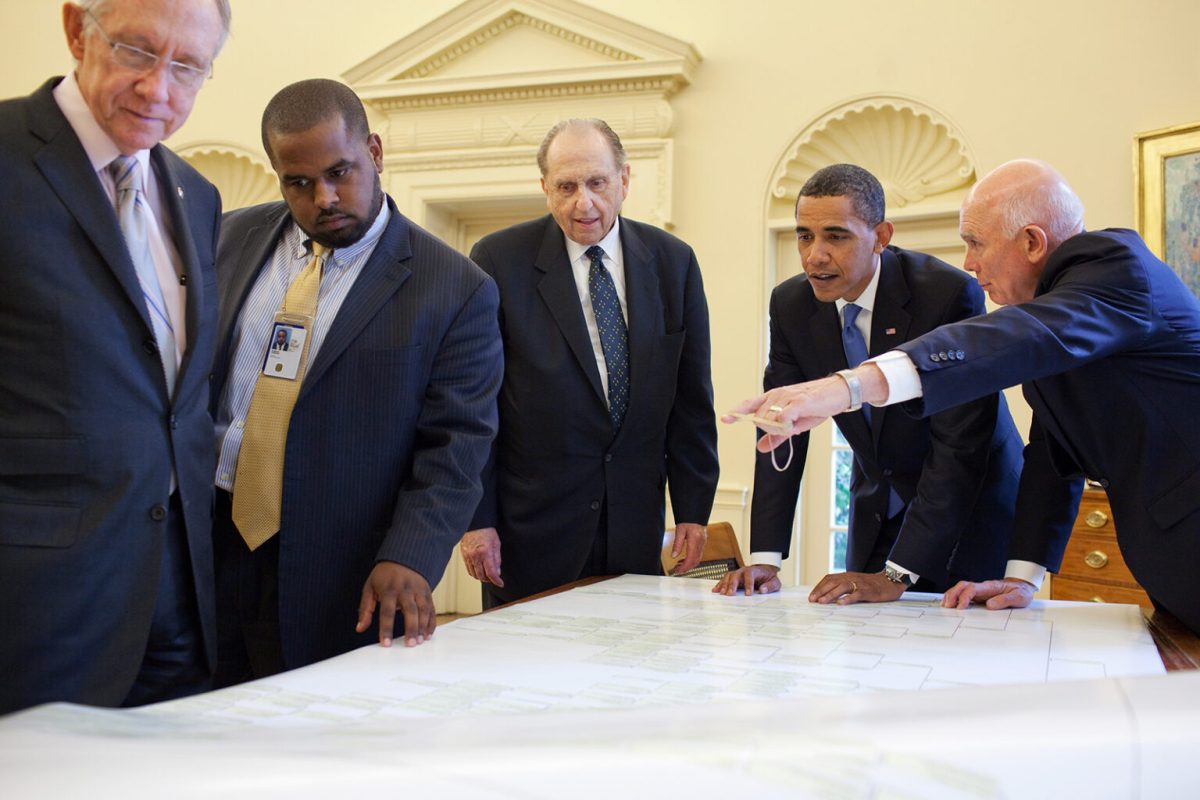
President Barack Obama meets with (from left) Senator Harry Reid, Joshua DuBois, Director of the White House Office for Faith-Based and Neighborhood Partnerships, LDS Church President Thomas Monson and Elder Dallin Oaks in the Oval Office, July 20, 2009. (Official White House Photograph by Pete Souza)
“Government can hand out money, but it cannot put hope in a person’s heart or a sense of purpose in a person’s life,” became a Bush mantra.
In his 2010 memoir “Decision Points,” the former president credited Tony Evans, then the pastor of a predominantly Black church in Dallas, and Chuck Colson, Watergate felon-turned-evangelical advocate for prisoners, with helping him see the value of faith-based programs receiving government support.
Now, 25 years later, all the Democratic and Republican presidential administrations that have followed included some form of the so-called White House faith-based office.
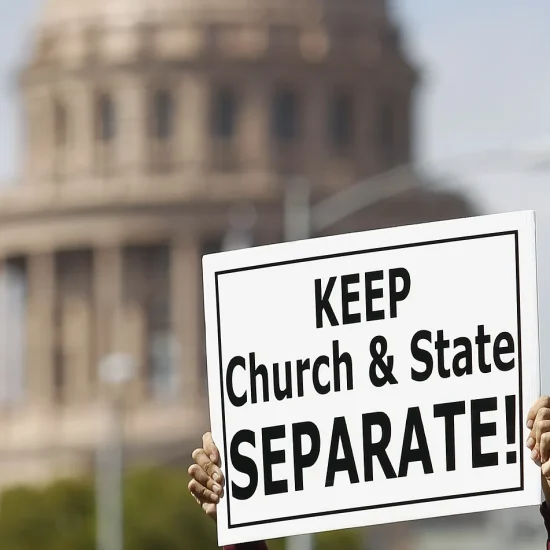
Though some critiqued the office as inappropriate mixing of church and state, Bush argued in his memoir that “government need not fear religion” even as it “should never impose religion.” The Republican president aimed to create a nonpartisan initiative, choosing Democrats as the first two leaders appointed to direct the office: John DiIulio, a University of Pennsylvania professor, and Jim Towey, a former lawyer for Mother Teresa.
“It made the faith-based communities feel welcomed because they had been pushed out,” Towey said regarding access to government funding under the Bush administration to organizations with connections to a specific religion. “President Bush was very careful to be respectful of the Constitution, so he made it clear in the instructions that you couldn’t preach on Uncle Sam’s dollar. You couldn’t discriminate on the basis of whom you served. So you couldn’t say we only serve Christians here or Muslims here.”
But from Bush through the Trump administrations, complex politics have been a factor, with many of the presidential faith-related initiatives being established through executive orders — not through passing a bill.
Despite political divides, Melissa Rogers, who directed the faith-based office in President Barack Obama’s second term and again during the Biden administration, said the office has long had bipartisan support.
“It’s unusual for a president to continue a signature White House office of his predecessor of a different political party,” she told Religion News Service in a statement. “But that’s what President Obama did in 2009 — he ensured that the effort got bipartisan buy-in. And when President Joe Biden re-established the office in 2021, he also commended President Bush for creating it and continued this effort.”
Obama retained the initiative but renamed it the Office of Faith-based and Neighborhood Partnerships and chose onetime assistant pastor Joshua DuBois as its first director.
The Obama administration focused on extending interfaith cooperation on college campuses and developing new partnerships in local communities where faith-based organizations worked with schools to feed hungry children during the summer, DuBois said. It expanded the number of Cabinet-level offices and created the first president’s advisory council with leaders from inside and outside religious circles guiding the legal and constitutional limits of the office’s work.
“It was also really, really important to ensure that that partnership never crossed into government sponsorship of religion, not just for the benefit of the government, but for houses of worship as well,” DuBois said in an interview.
However, the Obama administration also maintained a rule that angered church-state separation activists in allowing government-funded religious organizations to hire based on faith. And many who supported that hiring rule disagreed with his 2014 executive order providing sexual orientation and gender identity protections to LGBTQ employees of companies that do federal government work.
Rogers noted the Obama administration’s faith-based office worked with federal agencies such as the United States Agency for International Development and humanitarian leaders to reduce and contain the Ebola virus crisis in West Africa. Likewise, the Biden administration worked with congregations and multifaith groups to address the COVID-19 pandemic, including by establishing pop-up clinics at houses of worship for vaccine distribution.
Between Obama and Biden, President Donald Trump in his first term announced what he called the Faith and Opportunity Initiative and chose Pentecostal preacher Paula White-Cain, his longtime adviser, to oversee that initiative in 2019, two years after his presidency began.
About a month after his second inauguration in 2025, Trump announced that White-Cain would be senior adviser of the White House Faith Office and Jennifer S. Korn would be its faith director. Korn is former chair of the National Faith Advisory Board, which was founded as an attempt to continue work done by the faith office during Trump’s first term.
Americans United for Separation of Church and State has long been a watchful observer and frequent critic of the office. Rachel Laser, its president and CEO, told RNS she sees merit in outreach to neighborhood and religious groups, such as the Biden administration-era efforts in the height of the COVID-19 pandemic, but she said the initiative should have strict limits.
“There’s some power in the government having partnerships,” she said. “Where things go awry is when the government is favoring religion over nonreligion. That’s unconstitutional, according to the first 16 words of the First Amendment of our Constitution. When the government is favoring one religion over others, that’s also unconstitutional.”
Over the quarter century, the White House has played a key role in determining rules around services provided by religious groups and whether beneficiaries of federally funded social services can seek or be referred to alternative services to avoid unwanted religious obligations — for example, an LGBTQ+ atheist or a Muslim who is homeless may feel uneasy at a federally funded Christian-run shelter. Obama established rules for aid beneficiaries to avoid unwanted religious obligations. The first Trump administration did away with the rules, and Biden’s put them back.
Americans United anticipates that the second Trump administration also could remove those regulations. It has opposed the Department of Labor’s December request for information about “barriers” that affect faith organizations’ ability to deliver services. In February, it joined with two dozen other members of the Coalition Against Religious Discrimination in urging the director of the Department of Labor’s Center for Faith to leave the rules as they are.

President Joe Biden meets with advisers to prepare remarks for the National Prayer Breakfast, Feb. 1, 2023, in the Oval Office of the White House. Seated clockwise from the president are Domestic Policy Council Director Susan Rice; Melissa Rogers, director of Faith-Based and Neighborhood Partnerships; and Director of Legislative Affairs Louisa Terrell. (Official White House photo by Adam Schultz)
“Current regulations protect the religious freedom of beneficiaries while ensuring faith-based providers have the same opportunities as other community-based providers to partner with the government,” the groups wrote. “These rules do not need to be overwritten.”
Trump has noted that his year-old White House Faith Office is located within the actual building, in its West Wing, a historic move. But both DuBois and Towey said access and effectiveness were more important than the location of the office, which previously had been next door in the Eisenhower Executive Office Building or across the street overlooking Lafayette Park.
Lack of access to the White House has been a criticism by some faith leaders over the last decade. Last month, religious officials described to Axios what they considered a “closed door” policy for groups not aligned with conservative Christianity. And in 2018, the first-term Trump administration was accused by some religion-related advocacy groups of giving selective access to the White House, claiming they were never invited as conservative Christians were the most visible religious visitors.
In February, Korn posted on her X account to describe the faith office’s achievements: “In just ONE YEAR, we have reached 100,000 faith leaders in person through meetings, policy briefings, and Presidential events at the White House.”
Asked for further details about her statement and other aspects of the newest version of the office, the White House responded to RNS by pointing to a link to a page on its website titled “President Trump’s Top 100 Victories for People of Faith.” It lists the establishment of the new office and Cabinet-level offices with directors or liaisons, and the issuing of executive orders related to religion. It also noted a dozen ways it had honored “Religious Days of Remembrance,” including a National Day of Prayer event in the Rose Garden, and Easter and iftar dinners at the White House.

President Donald Trump meets with faith leaders in the Oval Office of the White House, March 5, 2026. (Official White House photo by Molly Riley)
In early March, a short video clip was posted on White-Cain’s Facebook page of an office briefing that opened with a Christian worship performance, saying “Thank you @potus @realdonaldtrump for giving people of faith a seat at the table of government and bringing prayer at worship back to the White House!”
Towey, who recalled Bush announcing new programs of his faith-based initiative during State of the Union addresses, said he thinks there has been “a gradual downscaling of the office.” Even its name has been shortened.
“I think you judge a tree by its fruit, and we’ll see what the fruit of all this outreach actually is,” Towey said. “President Bush’s focus was on results and on removing barriers against discrimination and on empowering the armies of compassion. … I don’t really know what the Faith Office’s goals are. A revival of faith? I don’t know.”