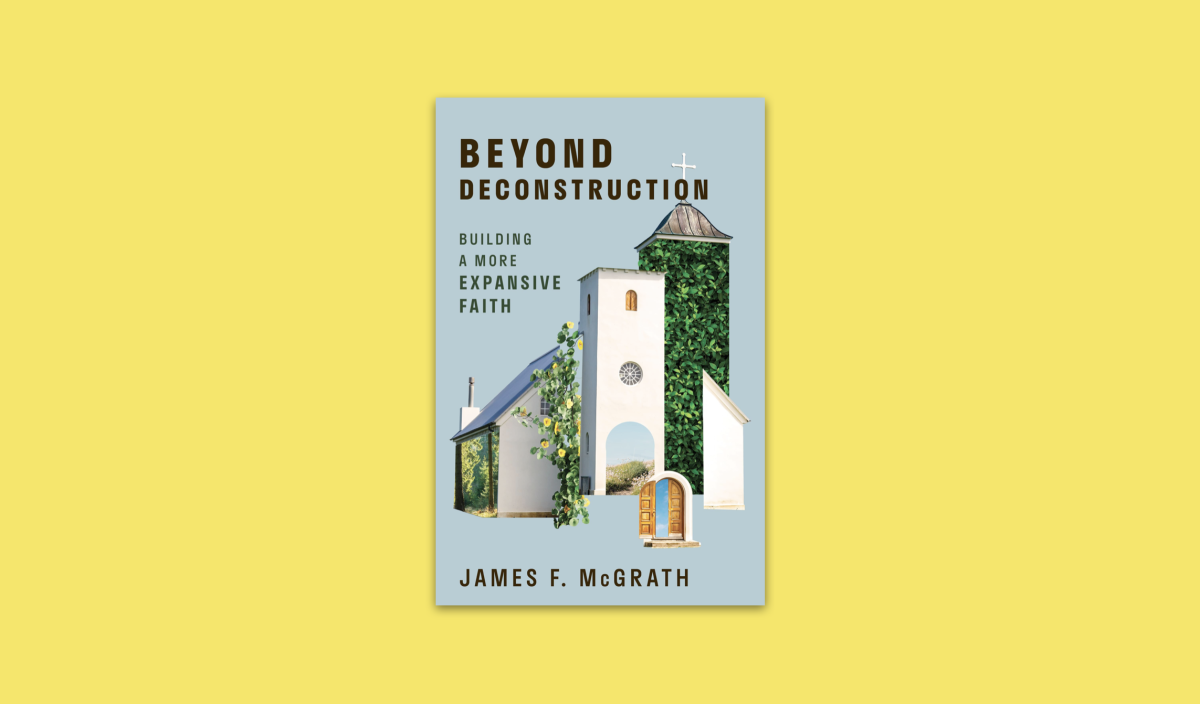
BEYOND DECONSTRUCTION: Building a More Expansive Faith. By James F. McGrath. Grand Rapids, MI: Wm. B. Eerdmans Publishing Co., 2026. 143 pages.
What might life after religious deconstruction look like? Is it atheism? Perhaps, but not necessarily. Indeed, some people will simply walk away from their previous belief systems and not look back. While this is true, many others who undergo deconstruction seek to reconstruct their faith so that it is more open and expansive. I have witnessed and even experienced this process. Now, when I underwent this process, we didn’t have these terms at our disposal, but people have been moving from rigid belief systems to more open ones for millennia. The end result may look similar to what was left behind, or it might not. Each person is different. However, deconstruction need not be the end of the story. What happens after deconstruction depends on a number of factors, including what events or experiences led to this journey through deconstruction. For those who suffered deep hurt, the process of reconstruction is more difficult than it might be for those, like me, who simply found the old faith insufficient even if it did not cause suffering. Wherever one is on the journey through deconstruction to reconstruction, it is helpful to have experienced guides to help one find a way forward.

Robert D. Cornwall
When it comes to finding experienced and trustworthy guides, I believe James McGrath is someone I would trust if I were going through such an experience. McGrath is a New Testament scholar, author, and blogger who has experienced both deconstruction and reconstruction. With that experience behind him, he wrote a book that offers helpful guidance. That book is titled Beyond Deconstruction: Building a More Expansive Faith. The subtitle offers an important clue as to what McGrath envisions taking place once a person has moved through deconstruction and desires to experience something new when it comes to their faith experience. Because he underwent this process, moving from a more rigid conservative Christian belief system to a more progressive one, McGrath knows about the challenges and the possibilities that lie in front of a person moving into a period of reconstruction. In Beyond Deconstruction, McGrath doesn’t provide easy answers to readers, but he does offer possible paths people might take.
Although James McGrath is a well-regarded religious studies scholar who serves as the Clarence L. Goodwin Chair of New Testament Language and Literature at Butler University in Indianapolis, he also speaks effectively to lay audiences. He envisions this reconstruction process as a do-it-yourself project. That is because he believes the process of reconstruction requires a person to take responsibility for the process and not leave it to others. Nevertheless, he also recognizes that people need experienced and knowledgeable guides. So, while reconstruction might lead to something new, a person need not re-invent the wheel. This reconstruction process, should one embark on it, involves both risks and rewards. But what emerges from such a process may be something worth the risks involved. So, if one chooses to rebuild their faith into something more expansive, McGrath offers himself as a possible guide. Not only does he offer himself as a guide, but he also tells us why he might be a good guide. It is not because his experience of deconstruction involved a catastrophic collapse of faith. Rather, his journey involved what he describes as a halting evolution (something I can identify with). Besides, he is a very knowledgeable bible scholar!
McGrath begins with an introductory chapter that he titles “Faith that Collapses (and What to Do Next). I’ve already shared some of what he writes in this introduction about his experiences of deconstruction and reconstruction. What emerges is something very different from what he started with. Nevertheless, he is very comfortable with where he finds himself today. With that introduction in place, he begins addressing the primary concerns that people might have about the reconstruction process. The first chapter is titled “Faith that Works.” In this chapter, he addresses concerns that many have about what an expansive faith might look like after experiencing deconstruction from fundamentalism. Fundamentalism tends to focus on narrowly defined doctrines, which can lead to spiritual and intellectual problems. Therefore, McGrath suggests the reader move toward a more practical faith, one that focuses on living in a way that expresses connection to Jesus. Theologians might call this embracing orthopraxis (right practice) over orthodoxy (right belief). It’s not that belief is irrelevant, but for many post- evangelicals it is a question of finding a way of life that is in accord with Jesus’ teachings, including the command to love God and neighbor.
McGrath titles Chapter 2 “Faith that Explores.” Another way of putting this might be something like what the medieval theologian and bishop Anselm of Canterbury proposed. That involves “faith seeking understanding.” Here, McGrath invites the reader to ponder how they might envision God in such a way that they can break through narrowly defined barriers. He believes they can do this by using their spiritual imaginations so they can ask questions of faith, including the Scriptures. One important resource that seekers might want to make use of is science, something that they may have been instructed in their pre-deconstruction life to treat with suspicion or perhaps outright rejection (think here of young-earth creationism). Among the questions addressed in this chapter are the nature of prayer and how one envisions/understands God. This process will also require a person to read scripture with new lenses, as well as being open to encounters with other faith traditions besides Christianity.
In his third chapter, McGrath discusses “Faith that Experiences.” While the previous chapter focused on intellectual concerns, which are often a catalyst for deconstruction, in Chapter 3, he focuses on religious experience, including mysticism. Like McGrath, I spent some time within Pentecostalism, so I understand how experiential religion works. Like him, I also found the Pentecostalism I was involved with too restrictive, especially intellectually. That said, people have spiritual experiences that can come in a variety of forms, including music or even in the midst of suffering. These experiences can be quite moving and revelatory when it comes to faith. However, drawing upon spiritual or religious experience, as valuable as it might be, does not mean that everything and anything goes. People can follow paths that seem attractive but end up destructive. Nevertheless, spiritual experience can offer an important entry point in the process of moving toward something new.
The fourth and final chapter is titled “Faith that Connects.” Here, McGrath focuses on various forms of community. He reminds us that the word “church” is rooted in Hebrew and Greek words that speak of assemblies of all types. While we think of church involving Sunday morning gatherings, religious community can take many different forms, including traditional religious forms. The point here, I believe, is that as one moves toward a more expansive faith, that journey is best accomplished within a community. While this is true, a person should be careful not to end up in the same kind of situation as before. Although there is value in returning to the basics, including the study of the Bible, it is wise to do so critically and humbly. The key to success is finding people who are able and willing to accompany a person along the road to a new and more expansive faith. If necessary, create a new community of fellow travelers. Sometimes, in pursuit of inclusiveness, there is a need to set boundaries. But, as McGrath suggests, when it comes to community: “Define your identity as a unifying core rather than with boundary walls. Define your identity in terms of who you are and what you stand for, rather than what you are not and what you are against” (p. 140).
As someone who went through a form of deconstruction and then reconstruction many decades in the past, I understand the challenges that a person faces as they move toward what McGrath calls a “more expansive faith.” I also recognize the value of fellow travelers, including those who have gone on the journey before you, because this is a journey that requires us to take responsibility for our own faith development, but is best undertaken with others. My own journey was not all that traumatic, but I did face my share of challenges. Nevertheless, I believe the journey, which is still ongoing, was worth the effort. We live at a time when increasing numbers of people are undergoing spiritual deconstruction. Many who have undertaken this journey do not know how to move forward. Therefore, having a person like James McGrath to accompany them, while providing important resources and guidance, will be a great blessing. In my view, McGrath’s Beyond Deconstruction is a brief, accessible, and encouraging book that I highly recommend to those seeking to build a more expansive faith.
This review originally appeared on BobCornwall.com.
Robert D. Cornwall is an ordained minister in the Christian Church (Disciples of Christ). Now retired from his ministry at Central Woodward Christian Church (Disciples of Christ) of Troy, Michigan, he serves as Minister-at-Large in Troy. He holds a Ph.D. in Historical Theology from Fuller Theological Seminary and is the author of numerous books, including “Eating With Jesus: Reflections on Divine Encounters at the Open Eucharistic Table” and “Second Thoughts About Hell: Understanding What We Believe” coauthored with Ronald J. Allen. His blog Ponderings on a Faith Journey can be found here.