(RNS) — A federal judge rejected a settlement that would have lifted an IRS ban on pastors endorsing candidates, saying the court had no authority to approve an agreement, in a surprising end to a decades-long battle.
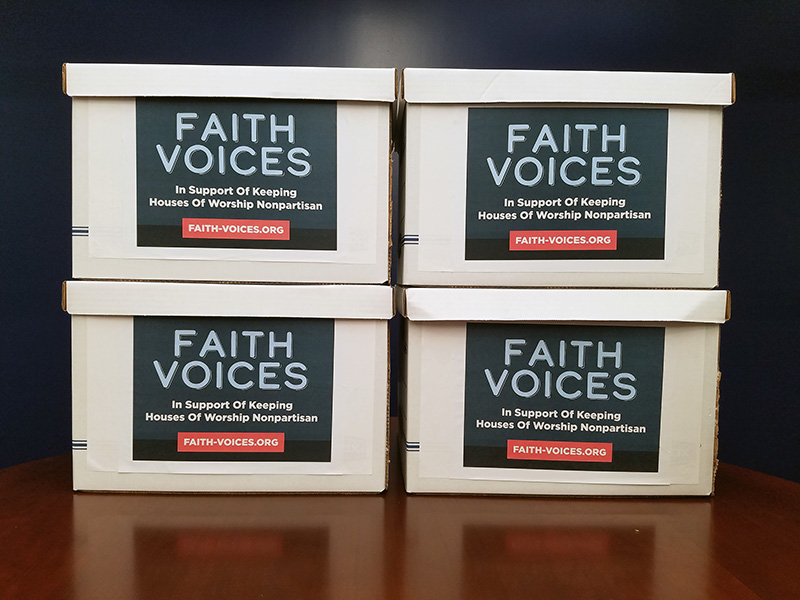
Boxes of letters from clergy who are opposed to repealing the Johnson Amendment, a federal law that bars tax-exempt houses of worship from engaging in partisan politicking, prior to delivery on Capitol Hill. Photo courtesy of Americans United
Judge J. Campbell Barker of the U.S. District Court for the Eastern District of Texas also dismissed the lawsuit filed by the National Religious Broadcasters, a Christian communicators group, and two Texas churches that was at the heart of the anticipated settlement. The plaintiffs had argued that the ban on endorsements violated their religious liberty. Under the IRS’s political campaign activity ban, also called the “Johnson Amendment,” tax-exempt nonprofits are barred from taking sides in political campaigns.
In dismissing the case on Tuesday (March 31), Barker said courts are barred from “providing declaratory relief with respect to federal taxes,” and therefore the court could not approve the settlement, as it required the court to make a decision that affected the plaintiffs’ tax status.
“The Johnson Amendment exempts organizations from taxes if they do not participate or intervene in political campaigns. If credited, then, plaintiffs’ claims would restrain the assessment or collection of a tax based on certain activity,” he wrote.
Barker also wrote that it is ”not obvious that the government will ever assess an income tax against plaintiffs or impose any other tax consequence under the Johnson Amendment.”
He also wrote that there was a simple solution for churches that wanted to avoid being penalized for endorsing candidates: “Put differently, if the plaintiffs here gave up their 501(c)(3) tax-exempt status, none of the harms they allege could occur.”
Michael Farris, general counsel for the National Religious Broadcasters, said the plaintiffs were surprised by the ruling and planned to appeal the decision. He said the judge’s ruling would require the plaintiffs to violate the law to get their case heard.
“We think that is an error,” he said. “I think the judge was trying to do his very best as he understood the law. But I just disagree.”
Americans United for the Separation of Church and State, which had opposed the settlement and sought unsuccessfully to intervene in the case, cheered the decision.
“Tax-free giving to charities should fund charitable work, not partisan politics,” said Rachel Laser, Americans United president and CEO, in a statement posted to the group’s website. “The proposed settlement agreement to exempt only houses of worship and not secular nonprofits would have been unfair and a violation of church-state separation. It also would have been unhealthy for our democracy because it would allow churches to become unaccountable political action committees.”
The IRS rule has banned nonprofits, including houses of worship, from endorsing political candidates and taking sides in campaigns. In 2024, National Religious Broadcasters and the pair of Texas churches filed their lawsuit seeking to overturn the amendment named after President Lyndon B. Johnson, who pushed for the ban when he was a U.S. senator from Texas.
News of a proposed settlement was first made public in the summer of 2025, when it was filed in the U.S. District Court for the Eastern District of Texas. But approving the settlement was delayed, in part because Americans United for the Separation of Church and State tried to intervene in the case to defend the ban.
The decision by Barker is a setback in a decades-long battle by conservative religious legal groups against the Johnson Amendment, which they say restricts the religious freedom of pastors. For years, pastors had mailed sermons with endorsements to the IRS, hoping to prompt a legal battle without success. President Donald Trump long promised to get rid of the Johnson Amendment and signed an executive order limiting its use during his first administration.
While some churches, including First Baptist Church in Dallas, led by Trump supporter Robert Jeffress, have been investigated for violating the Johnson Amendment in the past, only one church has ever lost its tax exemption for endorsing candidates. That church, the Church at Pierce Creek in Vestal, New York, took out an ad opposing Bill Clinton in 1992, leading the IRS to revoke the church’s tax-exempt status.
The NRB lawsuit was prompted in part by the rise of nonprofit newspapers. The plaintiffs argued that some nonprofit newspapers and magazines endorsed candidates and took sides in campaigns without IRS sanction and argued that churches were being treated unfairly.
During a session about the lawsuit at the NRB convention in February, the Rev. Ivy Shelton, pastor of First Baptist Church Waskom in Texas, said his church joined the lawsuit so that pastors would not have to fear that their congregation would be hurt by the government for what they preach.
“They need to be free and knowing that it doesn’t matter if the government’s looking over your shoulder,” he said. “You need to preach with boldness, whether your congregation likes it or not.”
Allen Jackson, pastor of World Outreach Church in Murfreesboro, Tennessee, said that no topic, including politics, is off-limits for pastors. The Bible, he said, is filled with examples of preachers taking on politicians, from the Hebrew prophets to John the Baptist, who was beheaded for criticizing King Herod.
“John the Baptist could have lived to be a very old man if he’d had no comments about current events,” Jackson said.