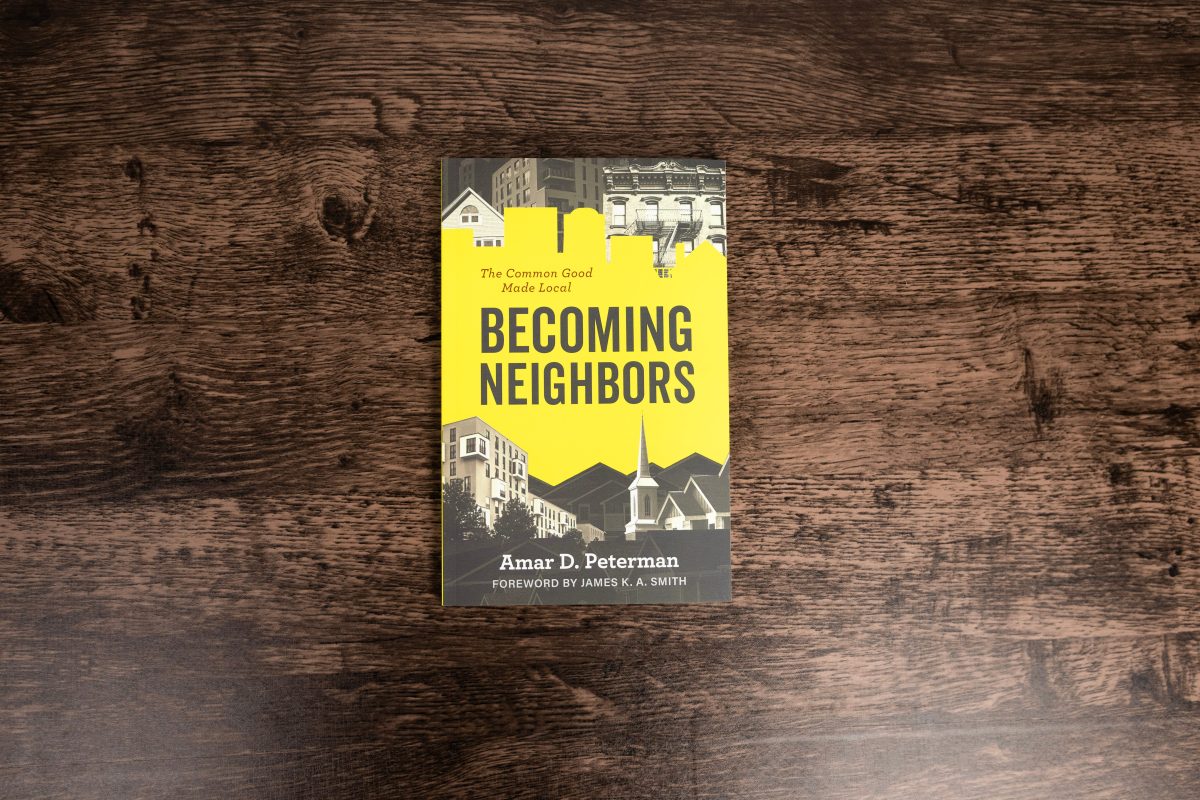
BECOMING NEIGHBORS: The Common Good Made Local. By Amar D. Peterman. Foreword by James K. A. Smith. Grand Rapids, MI: Wm. B. Eerdmans Publishing Company, 2026. Xii + 107 pages.
According to Scripture, we are called to love our neighbors as we love ourselves. According to Jesus, it is one of the two great commandments, the other being the command to love God. He drew that commandment from the book of Leviticus (Lev. 19:18). So, what does it mean to be a neighbor whom we are to love? What might loving that neighbor involve? When Jesus was confronted with this question, he offered a parable that spoke of the Samaritan who stopped to care for the man who had been left for dead in a ditch when two religious leaders passed him by. It seems that being a good neighbor involves something more than waving and saying hello. In fact, the identity of the neighbor likely needs to be expanded beyond those who live close by. It is worth noting that in that same Leviticus passage, the people are told to love the alien who resided among them because they had been aliens in Egypt (Lev. 19:33-34). Nevertheless, a good place to start might involve caring for one’s neighbor who is close by as we pursue the common good.

Robert D. Cornwall
When it comes to being a neighbor, Amar D. Peterman offers us a word of guidance in his book Becoming Neighbors: The Common Good Made Local. Peterman is the former assistant director of civic networks at Interfaith America and currently leads a program known as “Scholarship for Religion and Society.” He holds an MDiv from Princeton Seminary and is a PhD student at the University of Chicago Divinity School. This book is in many ways an expression of his work at Interfaith America.
Becoming Neighbors might be brief in pages, but it is deep in purpose. That is because Peterman writes at a time when we are witnessing a backlash against the kind of efforts that bring people together to pursue the common good. Consider the anti-DEI efforts underway that seem focused on protecting White hegemony, government efforts at mass deportation, along with people raising questions about what it means to be a true American. The Vice President has suggested that being a true American doesn’t involve holding to traditional American values, like those espoused in the Declaration of Independence, but instead it’s about heritage (by that he seems to mean European/Christian ancestry). If this is true, then everyone else who resides in the United States is a second-class citizen. Fortunately, this is not the only possible perspective available to us. With that in mind, Amar Peterson, who is himself of South Asian descent, offers us a very different picture. To make his point about the nature of identity, he borrows the image of the United States as a “potluck nation” from his former boss at Interfaith America, Eboo Patel. In laying out what being a “potluck nation” involves, Peterman focuses his attention on local expressions of neighborliness. By doing this, he keeps the conversation from becoming too abstract.
In his introduction to Becoming Neighbors, Peterman reminds us that pursuing the common good “is a deeply local task.” As such, he writes that “seeking the common good through this local practice of neighbor love is messy and complicated work” (p. 3). But, “our shared flourishing is impossible unless we enter into a common life where we are formed by and toward one another.” In line with the image of the United States being a “potluck nation” where we all bring our diverse dishes to the table, the idea of coming to the table is a thread that Peterman weaves throughout the book. He comes to the table as a committed Christian who recognizes that others come to the table with different belief systems. However, when we come to the table on equal terms, we put ourselves in a position to work together for the common good.
Appropriately, Peterman titles the first chapter “Coming to the Table.” He begins by describing the table, noting that it is a “tangible and salient image of the common good.” That is because tables serve a variety of functions in the community, ranging from a place to eat together to a place to stack books at the local library. It also represents for us the practice of “intentional hospitality.” I appreciate the way he brings Jesus’ table practices into the conversation (see my book Eating with Jesus: Reflections on Divine Encounters at the Open Eucharistic Table). Unfortunately, as he points out, Christians have often failed to live up to the table’s potential. So, we have work to do. That starts with desiring the table and wanting to be present at it. From there, we can join together at the table, not by dominating but by sharing with others in being formed by love of neighbor.
Having developed the image of the table, Peterman leads us forward on this journey to the common good. In Chapter 2, titled “Joining God in the Neighborhood,” he begins by acknowledging his own fear about coming to the table with persons outside his faith community. That is because he feared that in doing this, he might be leaving God behind. What he discovered was that God was already at the table. What this means, then, is that God is inviting us to come together at the table, bringing to it our distinctive beliefs. To do this, we must start by acknowledging that God is love, and because God is love, we are called to love God and one another. Not only are we called to love others, but we are called to goodness. That is because God is not only love but also good. When we speak in these terms, we’re not speaking simply of an attribute of God but God’s essence. We know this because what God does is good. Joining the God who is love and goodness also involves a call to being in community. As Christians, Peterman being in community reflects the doctrine of the Trinity. Therefore, “as creatures made in the image of God, humans reflect this desire to belong and be known by others. We are made to exist in community” (p. 37). With that, we return to the image of being part of the “potluck nation,” which is reflective of the diversity present at the table.
Chapter 3 speaks of “The Practices of Neighbor Love.” This is, after all, a practical book that focuses on living out neighbor love. So, this is an important chapter. The practices Peterman emphasizes start with compassion, which he believes (rightly) is revealed in the parable of the Good Samaritan. He notes three implications of the parable. The first is that the parable reveals a calling to radical compassion, such that we actually get involved in the lives of others in need. Secondly, he suggests that neighbor love is fused with enemy love (remember who the Samaritan is). Finally, we see that the command to love our neighbor involves loving the stranger. These are difficult callings, but this is our calling, nonetheless. He notes a second practice that emerges from neighbor love, which is humility. Following this practice, Peterman speaks of translation. This practice involves making “ideas and concepts understandable across communities.” Another practice that he speaks of is “resonance,” which involves making sure we are in tune with one another as we gather at the table in pursuit of the common good. It might be a bit of a surprise, but neighbor love also involves lamentation and finally accompaniment. The good news is that as we accompany others on this journey, we discover the presence of God.
In chapter 4, Peterman brings into the conversation a new metaphor, which is a call to become “A Community of Builders.” He suggests we are called to be builders because God is a builder. What he has in mind involves creating beautiful things. With this in mind, He brings into the conversation the three offices of Jesus, that of prophet, priest, and king. He develops each of these images for us, such that we might emulate Jesus in our own lives. Having developed the three offices, he turns to the idea of “buildings and builders.” We are called to build because God is a builder, starting with building community. This involves faithful presence.
The final chapter simply reminds us that “We Live as Neighbors” (Ch. 5). Here, Peterman introduces another image, which involves becoming a gardener. He suggests that the glue that holds us together involves having a “resurrected imagination.” Gardeners have a resurrected imagination because they understand the reality of death and resurrection, since plants “die” and then return to life under the careful guidance of the gardener. Ultimately, to live with this resurrected imagination is to “begin to live for the sake of others rather than for our own gain. We are drawn to the table because God and our neighbor are there. We give of ourselves for the good of the whole because this sacred perception acknowledges that my flourishing is intimately bound to my neighbor’s flourishing” (p. 86). There is much truth to this vision of living as neighbors.
Amar Peterman’s Becoming Neighbors: The Common Good Made Local is a brief book. Although it is less than one hundred pages in length, it is packed with images and ideas that can assist us in pushing back against the anti-neighbor agenda that has been taking hold of our communities. Rather than limiting access to the table, as some suggest, Peterman argues that we need to welcome everyone to the table. As we gather at the table, he emphasizes that this table is a potluck, so that we should bring our own beliefs and identities, because in doing so, we can pursue the common good.
This review originally appeared on BobCornwall.com.
Robert D. Cornwall is an ordained minister in the Christian Church (Disciples of Christ). Now retired from his ministry at Central Woodward Christian Church (Disciples of Christ) of Troy, Michigan, he serves as Minister-at-Large in Troy. He holds a Ph.D. in Historical Theology from Fuller Theological Seminary and is the author of numerous books, including “Eating With Jesus: Reflections on Divine Encounters at the Open Eucharistic Table” and “Second Thoughts About Hell: Understanding What We Believe” coauthored with Ronald J. Allen. His blog Ponderings on a Faith Journey can be found here.