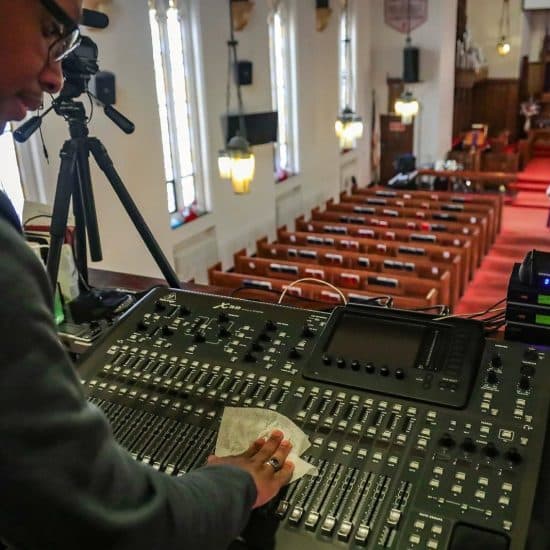
Somewhere in America this Sunday, a pastor will stand before their congregation and announce a capital campaign. The current building is too small. God is blessing this church with growth. The community needs more space to do God’s work. The pastor will say this with conviction, most of the people in the pews will nod, the offering plates will come around, and the cycle will continue.

Michael Mellette
Nobody will ask the obvious question: expanding toward what? I am a Kierkegaardian Christian, and that question is where my faith begins.
Søren Kierkegaard was a 19th-century Danish philosopher who watched the established church of his nation celebrate itself as the crowning achievement of Christian civilization — well-funded, socially respectable, politically connected, and spiritually hollow. He spent the last years of his life in open attack on it, arguing that the church had become Christianity’s greatest enemy. Not because it was openly wicked, but because it had become too comfortable. Too institutional. Too much like a going concern.
He called this Christendom: the fusion of Christian identity with cultural, political, and institutional power. And he argued, with mounting fury, that Christendom did not produce Christians. It produced the appearance of Christians, which was far more dangerous than producing none at all.
His diagnosis was precise. When Christianity becomes the default cultural identity of a society, the result is not faith but imitation. Faith, for Kierkegaard, is not a cultural inheritance. It is an individual act, made alone, at personal cost, against the grain of social guarantee. The crowd cannot believe. Only the individual can.
The heart of Fear and Trembling is a distinction between two figures he calls the Knight of Infinite Resignation and the Knight of Faith. The Knight of Resignation is admirable. He gives everything up. He renounces the finite, accepts the loss, and finds a kind of noble peace in his sacrifice. He wears the cross. He speaks of suffering. He is recognizable as religious. But he stops short. He never gets Isaac back.
The Knight of Faith is something stranger. Abraham does not merely resign himself to losing his son on Mount Moriah. He believes, by virtue of the absurd, that he will receive him back. He makes what Kierkegaard calls the double movement: full renunciation of the finite, and simultaneous trust in its return, not as reward, but as gift.
What makes this almost incomprehensible is that the Knight of Faith looks completely ordinary. Kierkegaard describes him as resembling a tax collector. Nothing visibly heroic. No mark of spiritual distinction. He cannot be identified by the crowd, because the crowd has no category for him. He will be banished. He knew he would be. And he made the leap anyway.
Here is where the institutional church in America requires honest examination, not as a theological abstraction but as a legal and financial reality. Churches in the United States occupy a unique position in the nonprofit landscape. Most tax-exempt organizations, such as charities, hospitals, universities, and advocacy groups, are required to file a Form 990 with the IRS annually. This is a public document. Anyone can examine revenue, expenses, executive compensation, and program spending. The accountability is imperfect, but it is real.
Churches are exempt from this requirement. They receive tax-exempt status without application and without any obligation to disclose their finances publicly. Oversight is limited, and routine financial transparency is not required. The result is a category of institution granted the benefits of nonprofit status without the informational obligations placed on other organizations of similar scale.
The original intent was to protect religious communities from state interference. But in practice, the effect is structural opacity — institutions that are financially significant but publicly unaccountable, sustained by trust that cannot be easily verified. This opacity does not exist in isolation. It becomes the enabling condition for a particular institutional logic: expansion.
The building gets too small. A capital campaign follows. A larger building rises. Then that one fills. Then a satellite campus. Then another. Then a brand. Then a media operation. Then a book deal for the pastor. Then the next campaign.
At some point in this cycle, the expansion becomes the mission. Growth is no longer a byproduct of ecclesial life; it becomes its justification. Attendance becomes evidence of divine favor. And the question of what the church is growing toward becomes not merely unasked, but unaskable, because to ask it is to appear unfaithful to the growth itself. This is what Kierkegaard would recognize as Christendom’s metabolism. It does not grow the Word; it grows itself, using the Word as fuel.
Financial opacity is not incidental to this process. It is structural. Expansion requires capital. Capital requires donor confidence. Donor confidence requires narrative control. And narrative control requires that institutional life remain largely unexamined. The system sustains itself by making scrutiny feel like doubt.
The result is not merely institutional scale. It is moral inversion. Practices that would otherwise be ordinary questions of accountability are reinterpreted as spiritual failures. To ask where money goes becomes, implicitly, to lack trust in God. Transparency is no longer a civic norm; it is reframed as a spiritual risk. At this point, the institutional logic has closed in on itself. The organization becomes not only the beneficiary of trust but the arbiter of what trust requires.

Image by Jeff Jacobs/Pixabay/Creative Commons
Kierkegaard’s deepest charge against Christendom was not that it was hypocritical, but that it had abolished the conditions under which genuine faith is possible. By making Christianity comfortable, socially rewarded, and institutionally managed, it had eliminated the leap. And without the leap, there is no faith. There is only membership.
The commercialized American church has, through different means, arrived at a structurally similar outcome: a form of religious life in which institutional maintenance and spiritual fidelity become indistinguishable, and where questioning the institution is easily recoded as questioning God.
The early church met in houses. It had no buildings to campaign for, no brand to protect, no institutional surplus to manage. Whatever else one says about it, it did not confuse expansion with faithfulness.
A genuine community of faith has no need to hide its life from the people who sustain it. Transparency is not an administrative burden imposed from outside; it is an expression of trust among those who belong to one another. When that transparency is absent, it is worth asking not only what is being protected, but what has become indistinguishable from what.
Kierkegaard died alone in 1855, having refused the last rites from a church he considered fraudulent. He had said what he believed. He made no accommodation. The establishment called him a problem. He called it Christendom.
I should be honest about the limits of my own framework. Kierkegaard would not have stopped where I stop. He would have seen my demand for institutional reform as still belonging to the world of institutional engagement. Reformer’s logic, not faith’s logic. He walked away entirely.
I have not done that. I remain inside the question, still asking whether the institution can be called back to itself. I cannot fully justify that stance within his philosophy. I have taken his diagnosis and resisted his conclusion.
Perhaps that is its own unstable form of faith: remaining in a structure you no longer idealize, continuing to ask questions you do not expect to be answered, and acting as though the confrontation itself still matters.
Michael Mellette is a philosopher and writer. Read more at michaelmellette.substack.com.