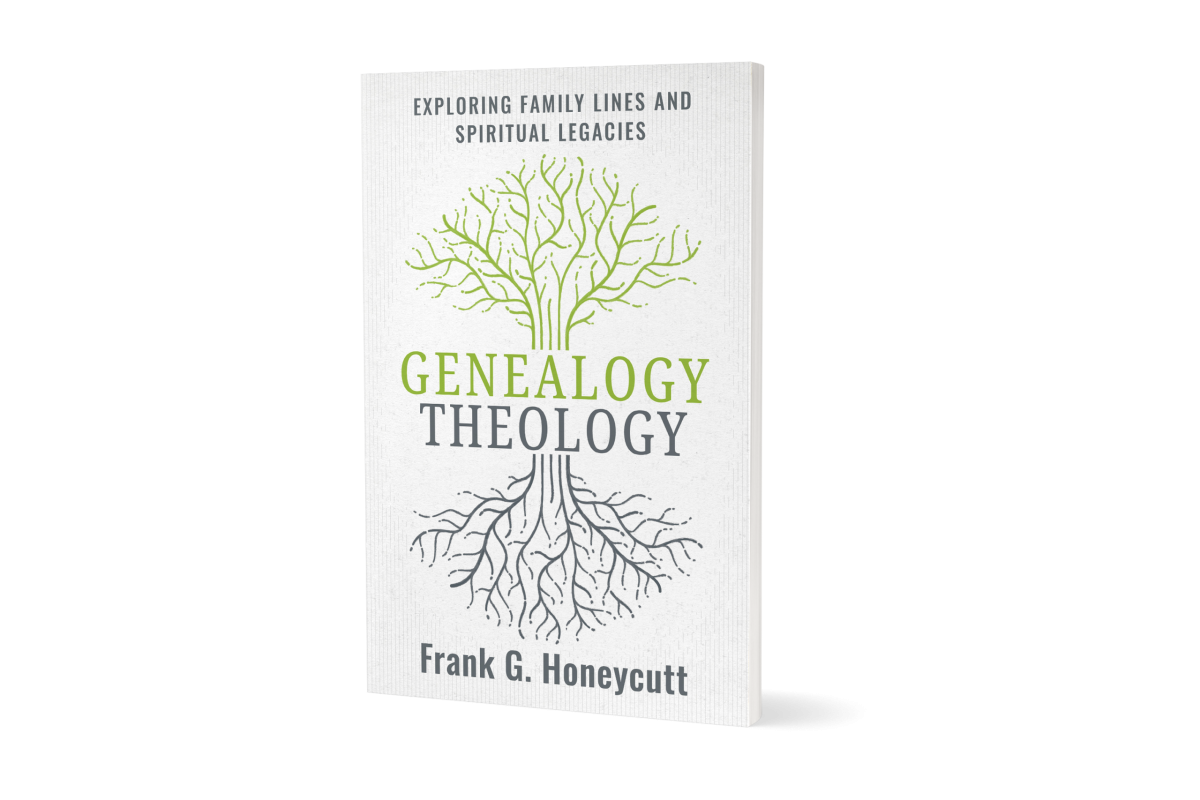
GENEALOGY THEOLOGY: Exploring Family Lines and Spiritual Legacies. By Frank G. Honeycutt. Grand Rapids, MI: Wm. B. Eerdmans Publishing Company, 2026. 149 pages.
When we ponder the question of our identity, our ancestry usually plays a part in the equation. That is because we are to some degree products of our genealogy. Since this is true, many people seek to trace their ancestry, even sending samples of their DNA to genealogical organizations so they can discover where they came from. Our Latter Day Saints friends have been doing this since their founding for religious reasons, but it seems that the rest of us began to get interested in our ancestry while watching the Roots miniseries back in the 1970s. Then, more recently, entities such as Ancestry.Com began to appear, making it easier to trace our ancestry. So, could this interest in ancestry and genealogy have implications for our theological perspectives? The fact is, we can trace the ancestry of our religious communities back through time. My denomination has roots in the Presbyterian and Baptist churches, which in turn have roots in the Reformation, which descends from the early church by way of the Latin (Roman) Church. And back through time we go.

Robert D. Cornwall
When it comes to the connection between genealogy and theology, Lutheran (ELCA) pastor Frank G. Honeycutt offers us a guidebook for exploring our spiritual ancestry. He titles this book Genealogy Theology: Exploring Family Lines and Spiritual Legacies. Honeycutt lives in South Carolina, where he has served Lutheran Churches and writes for publications such as the Christian Century. Among his books is Miracles for Skeptics: Encountering the Paranormal Ministry of Jesus (Eerdmans, 2024), which I reviewed here. He writes of the book that it is “about searching, both divine and human” (p. 3). He suggests that even as we search for God, God searches for us. When it comes to our search for God, he suggests that this involves, in part, figuring out how past decisions influence the present life.
Honeycutt introduces us to the conversation by telling the story of his great-grandfather, for whom he is named. Upon his election as sheriff in a small town in North Carolina, his grandfather was tasked with hanging a black man convicted of raping a sixteen-year-old girl, even though he may have been innocent. Honeycutt ponders how his great-grandfather’s Lutheran heritage might have influenced his engagement with this task, especially since there was talk that he opposed capital punishment. Honeycutt uses this story as an entry point into the conversation about ancestry and legacy. There is another story that Honeycutt draws upon to help further the conversation about legacy, and that involves his great aunt Eulie, who was institutionalized for mental illness, and never talked about by the family, his mother only finding out later in life after her father died. These two stories form a key element in what is an intriguing conversation.
Since this is a book about Genealogy Theology, it would be appropriate to begin the discussion by attending to the two genealogies of Jesus. That is what Honeycutt does here. While many Christians do not find these genealogies all that interesting, they are quite revealing, as Honeycutt notes. For one thing, they demonstrate Jesus’ humanity. But the presence of four women, each one of these women is different from the others, but the biblical authors do suggest that they are outsiders. When we examine these lists carefully, he believes that when it comes to legacy, each of these women reveals something about Jesus’ identity, including his teaching style, the radically inclusive nature of his pastoral style, his “penchant of taking less-traveled roads,” and the way he spoke truth to power. So, perhaps we should pay more attention to the genealogies of Jesus.
Honeycutt titles chapter 2, “Beholding Unformed Substances,” a chapter where he reflects on Psalm 139. This psalm speaks of God’s engagement with humanity, starting with knowing our thoughts, searching out our path while aware of our peculiar ways and habits, knowing what we’ll say, and discerning our favorite hiding places. Of course, this is the passage where the psalmist speaks of God weaving our genetic inheritance. So, yes, God knows us, even if we don’t understand God’s knowledge of our identities in a deterministic fashion.
Chapters 3 and 4 speak of things we might inherit from our ancestors. The first inheritance might involve illness (Chapter 3). Beyond inherited illness, we move to inherited incidents (Chapter 4). It is in chapter 3 that Honeycutt introduces us to the story of his Aunt Eulie and the question of inherited mental illness in his family line, including elements of his own life. When it comes to “Genealogy and Inherited Incident” (Chapter 4), he has in mind the legacy of his great-grandfather Frank, and the question of “how events from long ago, occurring in a specific regional context, are also unavoidable and an important part of us with the potential to shape future choices and vocational direction” (p. 74). In other words, he invites us to consider how families influence who we are and the choices we make.
When we turn to Chapter 5, titled “Destiny, Chance, and Free Will,” Honeycutt addresses the flip side of the previous conversations: What do chance and free will have to do with our destiny? This is a question that many ask, especially when it comes to how God might determine our destinies. I lean toward open theism, so in my understanding of the future destinies, that remains unknown. Nevertheless, genetics and ancestry do play a part in determining our identity, even as we make our own choices. But as Honeycutt notes, regarding Jesus’ actions, his “clear sense of identity — knowing ‘that he had come from God and was going to God’ (John 13:3) — gave him freedom to decide and actin the moment, avoiding any sense of some robotic ‘predestination’ controlling each day and movement, but also a certain freedom within a wider obedience to a vocation of denial of self and embracing a life on the road to Jerusalem that looked a lot like a cross even before he died” (p. 109). In other words, we have freedom of choice, but there are parameters in which choices are made.
Moving into Chapter 6, we find Honeycutt bringing baptism into the conversation. The chapter is titled “Baptism and the New Family Line.” While earlier chapters focused on our inheritances from family, here he speaks to the role that baptism plays in creating a different, spiritual family. For some, this is an important legacy because of estrangement from family or simply a lack of family. In any case, through baptism we enter a different kind of family, which creates its own legacy. Besides, as Jesus pointed out to the Sadducees, in the next life we neither marry nor are given in marriage, such that family is not a major concern in that context (though my LDS friends will point out that this is why many find their church attractive). I agree with the idea that baptism forms spiritual families, though my tradition practices believer baptism while Lutherans generally practice infant baptism. The end result, though, is the same; in baptism we find ourselves enveloped by a new ancestry.
Honeycutt closes Genealogy Theology with a chapter he titles “Our Speck of Life, Our Tick of Time” (Chapter 7). He begins this chapter by pointing us to the story in which Zacchaeus attempts to see Jesus by climbing a tree. Honeycutt raises an intriguing question about who is the short one in this story. We assume it’s Zacchaeus who is the “wee little man,” but what if it’s Jesus? Having planted this question in our minds, he moves into a conversation about the importance of interpretation, especially of small details to gain genealogical insight, reminding us that “we are all shaped by a complicated and astonishing genetic inheritance” (p. 134). That is true, which is why we sometimes ask those what-if questions.
I am assuming that most of us contemplate our identity and where we come from. Whether we engage in genealogical studies of our families or not, we all wonder about our ancestry. The same is true of our spiritual ancestry. Again, the faith we embrace has roots back in the past. Through baptism, we are joined to this spiritual ancestry. With these questions in mind, Frank Honeycutt invites us to engage in a bit of Genealogy Theology, as we explore our “family lines and spiritual legacies.” His guidebook to “genealogy theology” draws on biblical stories as well as his own family stories, inviting us to tell our own stories. The result is a vibrant and readable book that will help us seek answers to the question: “Who am I?”
This review originally appeared on BobCornwall.com.
Robert D. Cornwall is an ordained minister in the Christian Church (Disciples of Christ). Now retired from his ministry at Central Woodward Christian Church (Disciples of Christ) of Troy, Michigan, he serves as Minister-at-Large in Troy. He holds a Ph.D. in Historical Theology from Fuller Theological Seminary and is the author of numerous books, including “Eating With Jesus: Reflections on Divine Encounters at the Open Eucharistic Table” and “Second Thoughts About Hell: Understanding What We Believe” coauthored with Ronald J. Allen. His blog Ponderings on a Faith Journey can be found here.