FOND DU LAC, Wisconsin (RNS) — It’s just after 8 p.m. on Saturday night, and it’s time for Rev. Esdras Paredes’ sermon. But the pastor isn’t there.
“If the pastor is now connected, then we will …” a member of the pastoral team tells the members in Spanish, then stops to listen. “He’s not in place yet.”
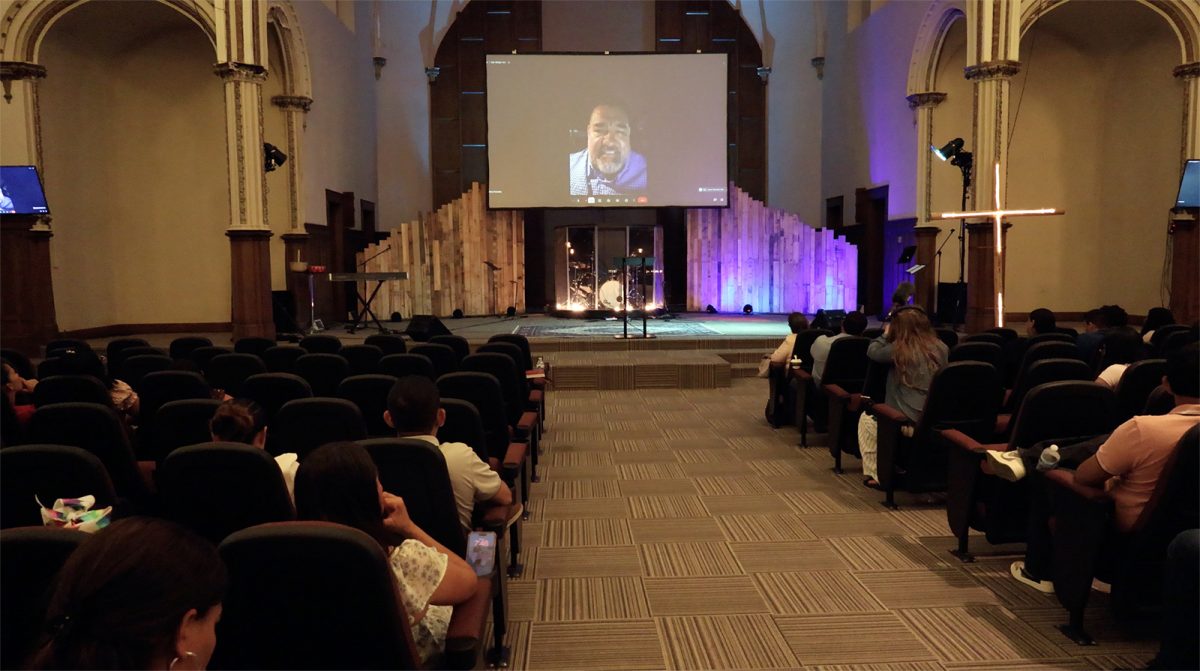
While the team at Ven y Descansarás (Come and You Will Find Rest) scrambles to fix Esdras’s internet connection, people at the Pentecostal church in Fond du Lac, Wisconsin, part of the Church of God denomination, are asked to get up and greet each other. Their preacher is more than 2,000 miles away in Guatemala.
Since August 2025, when Esdras was blocked from returning to the U.S., Esdras has been preaching and teaching remotely up to three times a week. He leads Bible studies, moderates a men’s WhatsApp group and keeps up with members’ lives. On nights like this one, the limits of leading his church remotely are evident.
“You don’t realize that things can change so drastically,” said Esdras’s wife, Rev. Wanda Paredes. “And when they do, you’re in shock. Like, how is that even possible?”
Now, his family and the congregation, where attendance can be as high as 150 people, are running food fundraisers to pay his expenses and praying he can return — all while they grieve the absence of their spiritual leader.
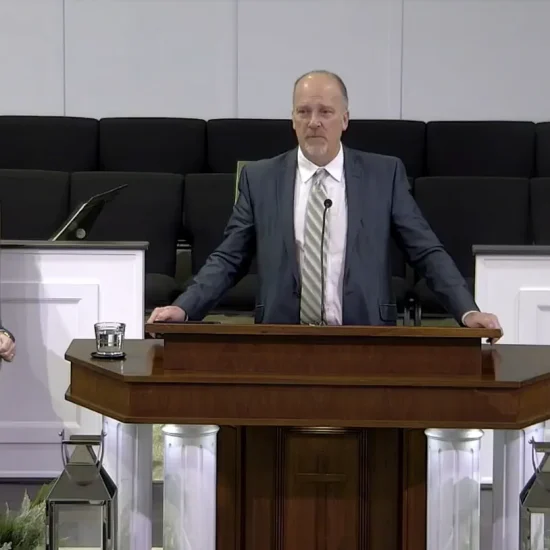
Rev. Esdras Paredes is projected on a screen, while preaching remotely from Guatemala, during a Ven y Descansarás Church service on Aug. 8, 2026, in Fond du Lac, Wisconsin. (Fiona Murphy/Religion News Service)
RNS has identified at least 25 publicly reported cases of immigrant pastors separated from their congregations during Trump’s second term. Most cases began with a detention. Esdras’ did not. In the summer of 2025, he flew to Guatemala to visit his mother, who had been critically ill in the hospital, and on his then-lawyer’s advice, apply for an immigrant visa at the U.S. Embassy. Soon after, he was notified by the U.S. government he was ineligible to apply to return to the U.S. until 2035 because of a 1991 deportation order.
His case shows how a deportation order can resurface decades later and how immigrant families, desperate for a positive resolution, can become easy marks. Esdras and his wife, Wanda, lost $1,350 when a lawyer connected them to a man posing as an immigration judge. And it also shows the toll a pastor’s separation can take, not only on a family, but a spiritual community.
Esdras’s immigration story began in Esquipulas, Guatemala, less than 10 miles from the Honduras border. He said his childhood was shaped by violence during Guatemala’s civil war. His father, an Assemblies of God pastor, had received death threats as religion became a flashpoint in the war, and he urged Esdras and his older brother to seek asylum in the U.S. The teenagers crossed the border without authorization and immediately turned themselves in to immigration authorities, Esdras said.
That’s where his memory and the immigration documents diverge.
His immigration case file, reviewed by RNS, shows that Esdras entered the U.S. in 1988 at age 15, left in 1989 and returned again in 1990. Esdras said he only remembers entering once in those years and raised the possibility the documents confused him and his brother. The file also shows that in 1991, his asylum application was denied. Immigration agents placed him on a flight to Houston for deportation when Methodist Legal Ministries intervened. A staffer from the law firm wrote that Esdras was eligible for a new asylum hearing because of a government settlement reached after accusations of government discrimination against Guatemalans. He was never deported. The file shows that Esdras did not show up for a 2004 appointment, and as a result was removed from the settlement class and then was vulnerable to deportation.
“I was never aware of a deportation order for me,” said Esdras, who also said he didn’t know about the 2004 appointment. “I got work permits. I have my Social Security number.”
Perhaps the most consequential mistake was leaving the U.S. in 2025. By law, if an individual is in the U.S. unlawfully for one or more years and then departs voluntarily, that person is barred from returning to the country for 10 years. Esdras “got bad (legal) advice,” said David Koelsch, a former immigration judge who now is a practitioner-in-residence at the University of Maryland’s law school. He reviewed Esdras Paredes’s case file for RNS. “That just seems to me just an incredible tragedy — for him, for his family, for his flock — but also for us as a country. This is somebody we should want to be here in the United States.”
After settling in the U.S., Esdras met the woman who would become his wife. Wanda, a Puerto Rican waitress who grew up in New Jersey, said she was immediately smitten. “I thought he was tall and handsome.” She wasn’t religious, but as she fell for Esdras, she says, she also “fell in love with Jesus.” The couple married, had children and after years of ministry became co-pastors of a church in Waukesha, Wisconsin. In 2020, the Church of God denomination tapped the couple to take over a struggling church whose burnt-out pastor was ready to leave. Membership had dwindled to just three families. When they arrived at Ven y Descansarás in Fond du Lac, they learned only one family would stick it out.
That family helped the Paredes rebuild. After his long shifts on a dairy farm, Isaac Morales and his wife, Gabriela, took Esdras to preach to their relatives and other people they knew. Over time, the congregation grew, and Esdras was able to give up his handyman work to focus on the congregation full time. Only 9% of pastors in the North Central Hispanic Region of the Church of God are able to pastor their congregations without working other jobs, according to Bishop Victor Artreche, who leads that region.
Many members spoke of how tight-knit the church community became. Esdras and Wanda both ministered throughout everyday life, from parent-teen squabbles to hospitalizations, from party planning to legal issues. As Esdras sees it, the church is family. “If you have a problem, we all have a problem. If you have a sickness, we all have a sickness,” Esdras said.
Pastor Esdras “is like my dad,” said Francisco Martínez Javier, 38, who began attending the church four years ago after his 4-year-old son drowned and Martínez was struggling with drug addiction and gambling. “I began to cry when (Esdras) began to preach the word of God,” he said in Spanish. Since then, he said he has replaced his partying with the church. He said he now misses hugging Esdras.
“We’re known as the huggy, huggy church,” said Wanda.
Esdras believes that God brings the church through difficult situations in order to prepare the community for greater trials ahead. He said before his 2025 trip to Guatemala, he had a dream that God was telling the church to prepare itself with prayer and fasting because “something harsh is coming to the church.” He never guessed that the next trial would be his absence.
The day before Esdras and Wanda left for Guatemala, Esdras baptized four church members. His daughter, Elba, the youngest of six, had recently moved back home and joined the church after a few “rebellious” years. Her decision to be baptized at 25 was a sign of her commitment to leading a life of faith in the Pentecostal tradition. The congregation waited out a rain storm before venturing toward the lake, where Esdras dipped Elba and the three others into the water and prayed over them.
The next day, Esdras and Wanda flew to Guatemala, never expecting that only Wanda would be able to return to the U.S.
“I just threw myself on the floor, kneeled by the bed and cried and screamed and cried,” after Esdras told her, said Wanda.
In the last year, the couple has struggled to find adequate legal representation. One lawyer seemed to offer hope, connecting them with a man who purportedly was an immigration judge. In a virtual hearing, this “judge” said Esdras could be forgiven and go home if he sent a letter and paid a fine. The congregation fundraised by cooking and selling Latin American dishes. The family paid $1,350 between the lawyer and judge and were told to wire another $2,000. Standing in the Western Union office, Wanda grew suspicious and tried to call the man she was supposed to wire, but he didn’t answer. She searched online and discovered that scams in which people pose as immigration judges are common.
“We’ve been had,” she remembers thinking before she broke down sobbing.
While the Church of God denomination has since provided a lawyer for them and covered his initial fee, Ven y Descansarás continues to fundraise to support Esdras, as well as cover other church expenses.
One Friday night in August, more than a dozen members gathered in a garage to wipe down banana leaves, prepare masa in a blender, and cook large pots of pork. They worked past midnight in order to make 360 tamales to sell the next day — $20 for five.
“Since he gave his all when he was here, his people remember that. And now they’re giving their all,” said Wanda.
The next morning, the second youngest Paredes, who goes by Elias in Spanish and Jesse in English, drove around to factories delivering the orders. Since his father became stranded in Guatemala, Elias, now 28, has tried to care for his parents, but there’s only so much he can do. Because of how hard Esdras has worked, Elias said, “he deserves to be treated like royalty.” And there are times he hears his mother crying in the shower and feels “helpless.”
“There’s nothing I can do to fix that — the pain, the hurt she feels. All I can do is pray and hope that God restores, heals her heart, helps her to stay strong,” he said.
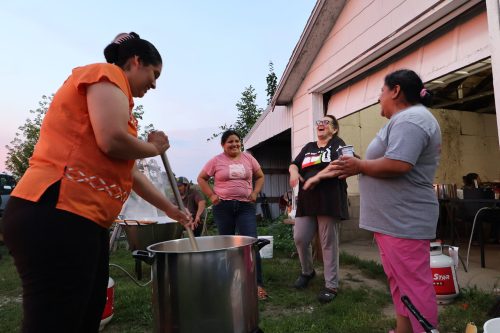
Ven y Descansarás Church members make tamales, which are sold to raise funds for their pastor, Rev. Esdras Paredes, on Aug. 7, 2026, in Fond du Lac, Wisconsin. (Fiona Murphy/Religion News Service)
Despite her heavy heart and pain from fibromyalgia and diabetes, Wanda said she’s more determined than ever and now carries out much of Esdras’ pastoral duties as well as her own. “I’m not a coward, and I’m not weak. I’m a warrior of the Lord,” she said. Even if she has to go crawling, she said, “I will be there. I will die behind the pulpit.”
In the last year, two members have been deported, and her son Elias lost his first serious girlfriend when she voluntarily returned to her home country, Nicaragua, due to an immigration issue. One member, Shelsy Suárez, was expecting her first child when her mother was detained and then deported.
A single detention impacts far more than one person, Elias noted. “This is something that is dividing families. It’s not just one person. It’s a network of people. It’s not just one family that gets affected.” In his father’s case, he said, “It’s hundreds of people.”
Wanda sees President Donald Trump as accountable. “He says, ‘I’m gonna protect the United States no matter what,’ but I just don’t see how that’s protecting the United States,” Wanda said. “My husband, what has he done wrong?”
A group of over 100 Pentecostal denominational leaders traveled to Washington, D.C., in September to oppose Trump’s mass deportation policies and bring attention to the pastors, including Esdras, who have been separated from their congregations during Trump’s second term. Koelsch, the former immigration judge, said that it would take an act of Congress to bring Esdras back to the U.S. before 2035.
Many at Ven y Descansarás told RNS they are praying for a miracle. Members Carla Paz and Jalon Parker hoped that Esdras will be back to marry them in May. Kender Silva, a 22-year-old ranch hand, compared Esdras to the Apostle Peter, who was miraculously released from jail.
The day after his congregation waited 40 minutes to hear Esdras preach, six more members were baptized. From his room in Guatemala, speaking on his cell phone, Esdras congratulated the baptismal candidates and prayed for them one by one, unable to see exactly where they were. With Wanda translating into Spanish by his side, Elias stepped into the role his father had filled a year earlier, dunking each person into the cold, green water.
“I should be the one doing that,” Esdras said. “They’re my sheep.”
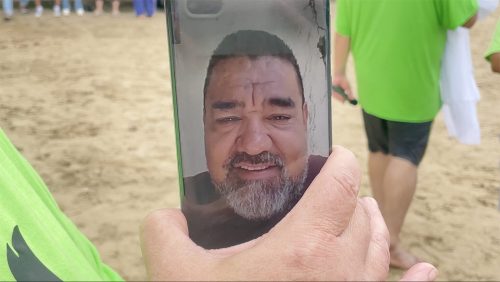
Rev. Esdras Paredes participates remotely in a Ven y Descansarás Church baptism, on Sunday, Aug. 9, 2026, in Fond du Lac, Wisconsin. (Fiona Murphy/Associated Press)