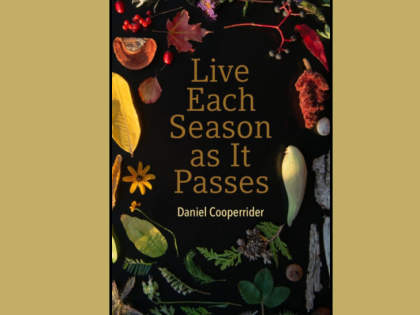
LIVE EACH SEASON AS IT PASSES: Re-earthing Spiritual Practice. By Daniel Cooperrider. Cleveland, OH: The Pilgrim Press, 2026. 204 pages.
I’m probably not what you would call an outdoors person, if by that one means going camping, fishing, or hunting. Nevertheless, I do enjoy being out in nature. In fact, I don’t have to go far to experience the natural world. Despite living in a suburb of Detroit, nature is all around me. We have a herd of deer, squirrels, rabbits, raccoons, opossums, groundhogs, foxes, and even a coyote or two. The seasons are prominent here as well. Therefore, I appreciate reading books that help us connect with nature. Now, having imbibed my share of Karl Barth’s theology, I understand that natural theology can have dangerous implications. So I take that counsel to heart as I read books that seek to explore the spiritual dimensions of nature. This includes Daniel Cooperrider’s Live Each Season as It Passes.
Cooperider is an ecotheologian, author, and an ordained pastor in the United Church of Christ (UCC). He is the Convening Pastor of Flicker Wild Church, which he often hosts alongside his spouse and Ritual Artist, Rev. Dr. Julia Burkey. He brings his experiences as an ecotheologian and pastor of this rather unique gathering that meets on the edge of the Driftless Area in Madison, Wisconsin, and in the Northwoods of Wisconsin. I read with appreciation his earlier book, Speak with the Earth and It Will Teach You: A Field Guide to the Bible, which takes us into Scripture so that we can read it with renewed eyes. In Live Each Season as It Passes, Cooperrider invites us to join him on a spiritual journey through the seasons of the year.
Although the Christian community marks the year liturgically with seasons beginning with Advent and taking us through the Christian story, Cooperrider offers us a parallel path that intersects with the liturgical calendar, but at the same time reflects his own experiences of the seasons of the year as he lives them in Wisconsin. Some readers might think that what he is doing in this book and in his ministry is rather syncretistic, but then even the most orthodox of theologies involves a bit of syncretism. It is worth remembering that any church that has a Christmas tree during Advent/Christmas or offers an Easter Egg hunt after church on Easter Sunday is incorporating a bit of pagan rites. But what Cooperrider is doing is more than incorporating what some would call pagan elements into a Christian theology; he is doing what theologians have always done. He is contextualizing his theology to reflect the ecological dimensions of faith.
What Daniel Cooperrider seeks to do here in Live Each Season as It Passes is draw spiritual meaning from nature, something many of us do when we spend time in natural settings, whether it’s the mountains, the oceans, forests, lakes, and streams. So in the interest of developing his ecotheology of the seasons, he draws in part on indigenous spirituality and experiences, reminding us that there are spiritualities other than Eurocentric ones. This is a very personal book in which Cooperrider invites us to enter into his own experiences, along with those of his family members, along with the communities he inhabits and leads. He notes that “whether we participate in organized religion or not, we often feel closest to God or the sacred when we’re outside and in rapport with the natural world” (pp. 3-4). He is correct. While we may have different favorites — a recent visit to Crater Lake National Park provided spiritual insight, as does every visit to Mount Shasta — when we spend time in nature, many of us will experience a sense of awe at the beauty and majesty of creation. At a time when some in our larger communities are denying our connection to the land, denying our existence as beings who have co-evolved with the rest of creation, a position that often leads to policies that desecrate the land. Therefore, it is good to be reminded of our connection to the land. As such, Cooperrider, who, as I noted, is a United Church of Christ minister who has pastored what he calls indoor churches, now feels called to ministry in a context more rooted in nature.
So in the course of thirteen chapters, we walk through nature, considering our connection to the land. We encounter animals, trees, fungi, and go ice fishing along with Cooperrider and his family. He also invites us to experience the seasons of the year as he experiences them. By my count there are not just the normal four — Autumn, Winter, Spring, and Summer, but an additional four seasons. The book’s title and his emphasis on the passing seasons draws on Henry David Thoreau’s call to “live in each season as it passes,” which Cooperrider believes was Thoreau’s credo. So Cooperrider writes: “To open to the influences of the seasons and to engage with their invitations is to find ourselves within the continuum of the stirrings of life — the cycles of the flora, the rhythms of the fauna, the fruiting of the fungi, the slow happenings of the mineral, and the sudden shifts of the atmospheric. The seasons offer a way of participating in a more-than-human sense of time and timing” (p. 7). As we ponder the spiritual dimensions of nature, we also encounter the community he helps lead, the “Flicker Wild Church,” which meets periodically to celebrate these eight seasons or markers of seasons. As we walk through the eight seasons of the year, celebrating them with Cooperider’s congregation, we experience the ebbs and flows of life and death, all of which is, he writes, “integral to the aliveness of the part and the whole” (p. 187).
As I read Live Each Season as It Passes, sitting there in the back of my mind was Barth’s Nein to natural theology. I understand Barth’s reasoning as he responded to a Nazi-infused natural theology that had dangerous implications. But as is always the case in life, there are seasons that demand a different response. We’re living in one of those seasons, a season in which an administration of the United States government not only calls climate change a hoax but is actively removing established guardrails that protect the environment and nature. So while my own theology may be a bit more traditional than Daniel Cooperrider, as I read these essays, I was reminded that God continues to speak in the context of nature and the ebbs and flows of the seasons. We see this present in Scripture when the trees of the field clap their hands in praise of God. What Cooperrider does here is take us deeper into nature so we can listen and experience that witness. It’s a witness we need to heed, considering the climate challenges we face as human beings.
This review originally appeared on BobCornwall.com.
Robert D. Cornwall is an ordained minister in the Christian Church (Disciples of Christ). Now retired from his ministry at Central Woodward Christian Church (Disciples of Christ) of Troy, Michigan, he serves as Minister-at-Large in Troy. He holds a Ph.D. in Historical Theology from Fuller Theological Seminary and is the author of numerous books, including “Eating With Jesus: Reflections on Divine Encounters at the Open Eucharistic Table” and “Second Thoughts About Hell: Understanding What We Believe” coauthored with Ronald J. Allen. His blog Ponderings on a Faith Journey can be found here.