(RNS) — More than 50 faith, civil rights, and other organizations launched a joint initiative to oppose the death penalty in the United States as the groups’ leaders say they have been alarmed by increases in its use over the past year.
Laura Porter, executive director of the new initiative, the U.S. Campaign to End the Death Penalty, announced the initiative to media in a virtual event on Wednesday (Dec. 3).
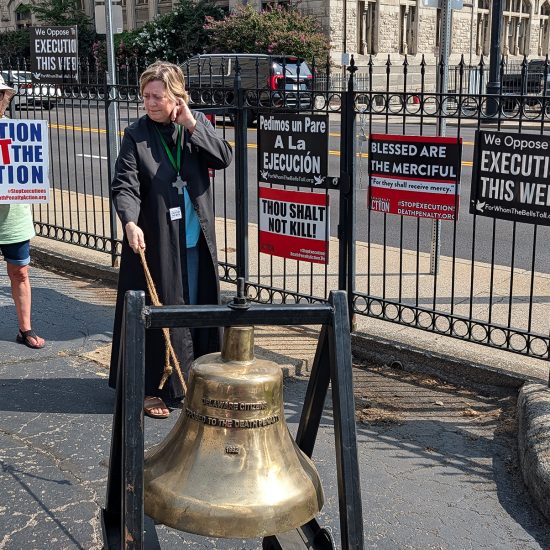
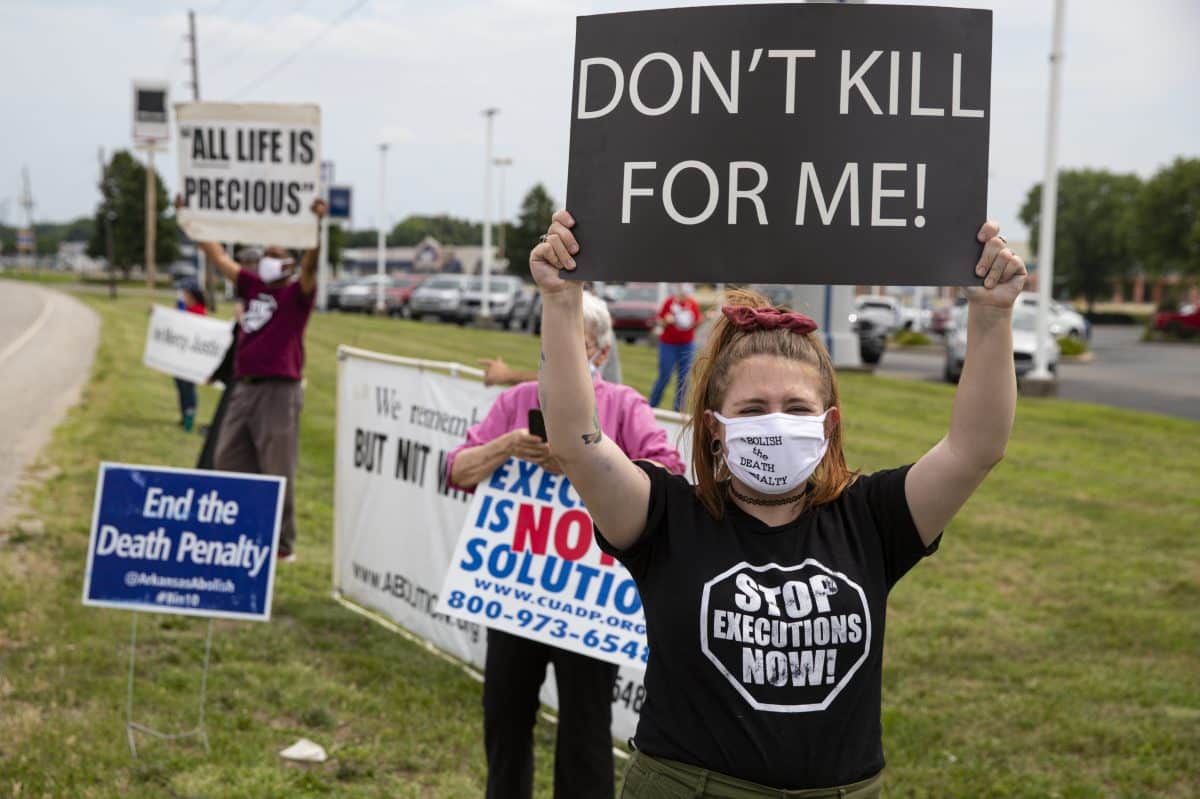
Protesters against the death penalty gather in Terre Haute, Ind., Wednesday, July 15, 2020. Wesley Ira Purkey, convicted of a gruesome 1998 kidnapping and killing, is scheduled to be executed Wednesday evening at the federal prison in Terre Haute. (AP Photo/Michael Conroy)
“In this moment, we see a very clear disconnect between the handful of politicians pushing for more executions and the expansion of the death penalty and current public sentiment on this issue,” she said, adding that those in the coalition will work to build joint advocacy and messaging strategies “to coordinate a national response to executions.”
Sister Helen Prejean, a longtime Catholic anti-death penalty activist and the author of the book “Dead Man Walking,” was one of several who spoke at the announcement.
“When you look at the death penalty itself, it epitomizes all the deep wounds in our society, and top-most among that is that you use violence and cruelty to solve social problems,” she said.
According to the Death Penalty Information Center, 44 prisoners have been executed in 11 states in the U.S. in 2025, an increase from 25 prisoners executed in nine states in 2024.
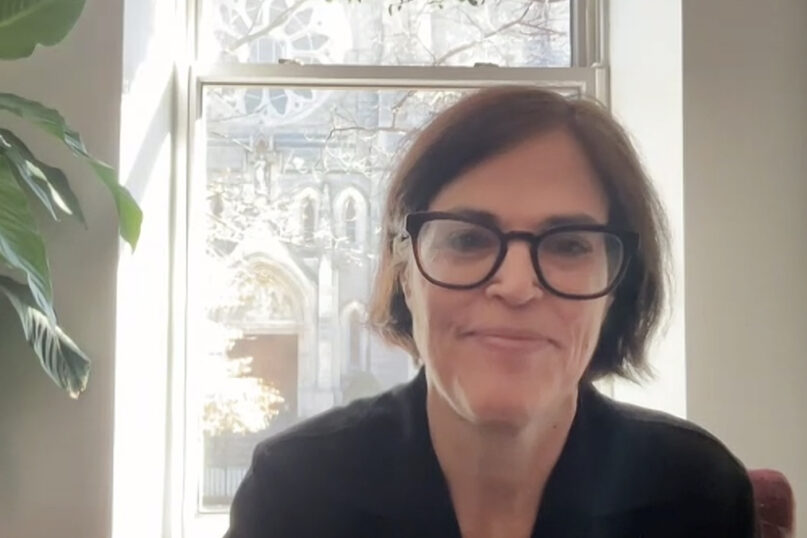
Laura Porter participates in the virtual event announcing the U.S. Campaign to End the Death Penalty, Wednesday, Dec. 3, 2025. (Video screen grab)
Porter, who also is the executive director of the 8th Amendment Project, another organization that has worked to rescind the death penalty, and other speakers criticized the Trump administration and states — especially in the South, including Florida, which has had the most death penalty executions in 2025.
President Donald Trump signed an executive order on the day he began his second term that called capital punishment “an essential tool for deterring and punishing those who would commit the most heinous crimes and acts of lethal violence against American citizens,” and sought to enforce its use for certain crimes.
The coalition includes a combination of faith-based organizations, conservative groups, and civil rights organizations.
“By showcasing this partnership and collaboration publicly for the first time, we are able to build more trust and broaden our outreach to work directly with a range of faith communities that we weren’t able to reach before and connect them with campaigns in their state or local areas,” Porter told Religion News Service in a statement. “Each of our partners speak to different faith-based communities, including Evangelicals, Catholics, Black and Indigenous faith leaders, Spanish-speaking faith communities, youth ministries, and Protestant denominations allowing us to share information more widely than ever before.”
The faith-related groups involved include Prejean’s Ministry Against the Death Penalty; Catholic Mobilizing Network; Mission Talk, a Florida-based evangelical Latino group; Faith Leaders of Color Coalition, which includes Black and Indigenous opponents of capital punishment; and Live Free, a national group mobilizing faith leaders to help end mass incarceration.
The coalition pointed to declining American support for the death penalty. A Gallup poll published in October found 52% of Americans favor the death penalty for a person convicted of murder — the lowest level of support since 1972, although the change was not statistically significant over the past two years. Support for it was highest in 1994, when 80% of Americans were in favor of using it for someone convicted of murder.
In 2021, Pew Research Center found that 60% of Americans favor the death penalty for people convicted of murder. Looking at religious affiliation, it found opposition to the death penalty was highest among atheists (65%) and agnostics (57%), followed by Black Protestants (47%), white Catholics (43%), Hispanic Catholics (37%), white non-evangelical Protestants (27%), and white evangelical Protestants (23%).
Opinions on the death penalty also vary based on political affiliation. According to the 2021 Pew study, 77% of Republicans and Republican-leaning independents support the death penalty for convicted murderers compared to 46% of Democrats.
Demetrius Minor, executive director of Conservatives Concerned, a network opposing capital punishment, said he is working with “pro-life groups” and joining with other anti-death-penalty partners to raise their concerns about cases of prisoners scheduled for execution where issues like innocence, prosecutorial misconduct, severe mental illness, and intellectual disability are factors.
“More and more conservatives across the country are questioning the death penalty and advocating for change,” he said. “In the past two years, Republicans have introduced repeal or moratorium legislation in Indiana, Missouri, Ohio, Pennsylvania, Kentucky, and Oklahoma.”
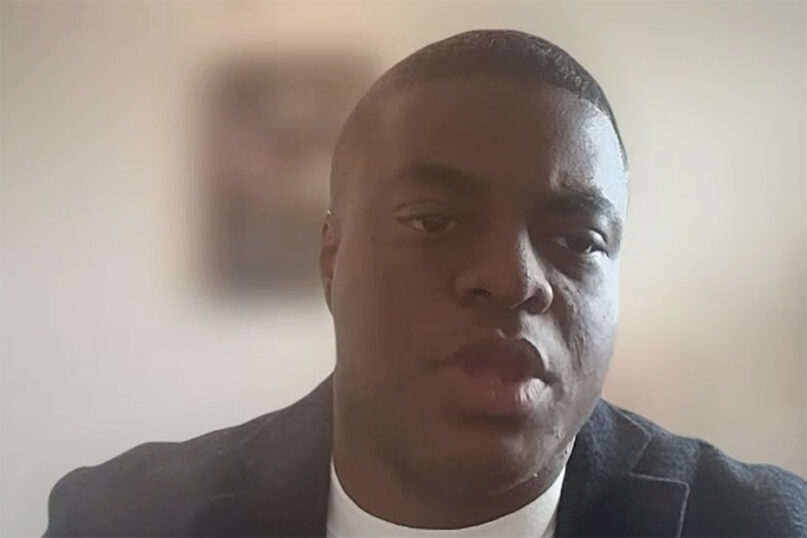
Demetrius Minor participates in a virtual event about the U.S. Campaign to End the Death Penalty, Wednesday, Dec. 3, 2025. (Video screen grab)
Barry Scheck, co-founder and special counsel of the Innocence Project, a nonprofit that works to exonerate wrongly convicted people, cited bipartisan and religious support for Robert Roberson, a Texas prisoner with autism convicted of murdering his 2-year-old daughter, whose scheduled October execution was stayed by an appeals court. He has maintained his innocence for more than 20 years on death row, and the Innocence Project has argued his case was “riddled with unscientific evidence, inaccurate and misleading medical testimony, and prejudicial treatment.” Scheck said the campaign to save him from death was “infused” with faith leaders.
“It was quite moving and extraordinary to see these Republican legislators go to prison and pray with Robert,” he said.
Prejean, a veteran of the movement, expressed her appreciation for other long-term death penalty opponents in the new coalition as they continue their work in a new partnership.
“I am full of hope on this issue, despite the harshness and terribleness of what’s going on,” she said. “When you build a fire, you need a fire in each log to build on the rest to keep the fire going.”