For more than a century, external powers have played an outsized role in shaping — and often sustaining — the Palestinian-Israeli conflict. From Britain’s 1917 Balfour Declaration, issued without the consent of Palestine’s indigenous population, to the United States’ steadfast political protection of Israel, foreign interference has repeatedly tilted the balance and complicated the path to a just peace.
Daoud Kuttab
Today, one of the most influential and consequential forms of interference comes from activist Christian Zionism. Rooted in distorted biblical interpretations, this movement offers a theological framework that blesses military policies, illegal settlement expansion, and the continued denial of Palestinian rights. Wrapped in religious language, the message has become a powerful political tool that is being used to justify actions in Gaza amounting to plausible genocide.
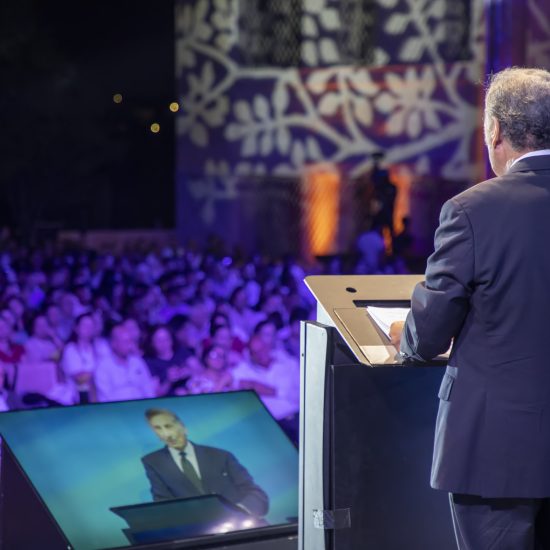
The latest illustration came with the visit of roughly 1,000 American pastors, led by Mike Evans, a prominent Christian Zionist activist who has made Jerusalem the center of his operations. Evans, founder of the “Friends of Zion” museum, claims that 100 million Americans support his theological vision — one that endorses a state ruling over millions of Palestinians without rights, while pursuing Jewish supremacy across the entire land between the Jordan River and the Mediterranean Sea.
The pastors’ trip was reportedly arranged in coordination with the White House’s faith office, headed by Paula White-Cain. Their expenses were covered by a special Israeli government initiative aimed at countering declining evangelical support for Israel. But the erosion of support is not due to poor public relations. It reflects deep discomfort with the way some Christian leaders deploy scripture to justify collective punishment, ongoing land seizures, and the deaths of thousands of civilians.
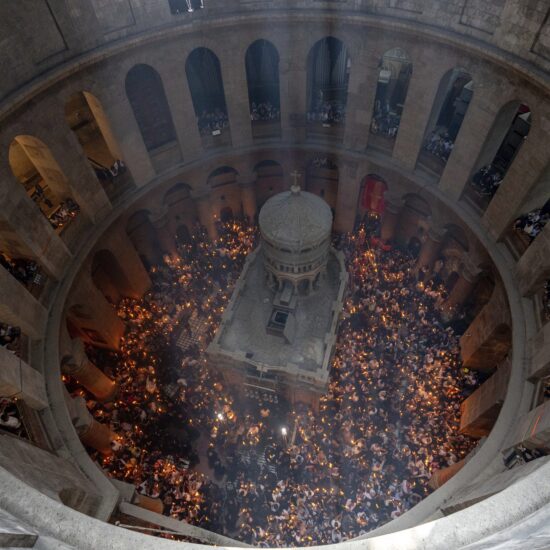
During their tour, the visiting pastors focused on Jewish holy sites and even visited settlements built on confiscated Palestinian land. Yet they did not make time to visit Bethlehem, Nazareth, or the Church of the Holy Sepulcher in Jerusalem — core locations of Christian history and pilgrimage. The omission was clearly intentional, underscoring that the trip’s purpose was political, not pastoral.
Their absence from Christian communities in the Holy Land sparked frustration among Palestinian Christian leaders of all traditions. Rev. Dr. Jack Sara, president of Bethlehem Bible College, shamed them using ten biblical contradictions among them: “You teach the Good Samaritan while passing by today’s wounded along the road?” A clear reference to the apathy towards “local believers whose communities have safeguarded Christianity’s sacred sites for two millennia.”
This reaction is part of a broader, growing pushback within global Christianity. The World Evangelical Alliance recently elected Palestinian Christian Botrus Mansour as its Secretary General — a significant milestone for representation. The European Baptist Federation (EBF) appointed Lebanese pastor Charles Costa as its President and named Jordan’s Baptist Convention leader, Rev. Nabeeh Abbasi, as its ambassador to the Middle East and North Africa. These developments signal increasing recognition of Middle Eastern Christian voices within global evangelical institutions.
Momentum is building in the United States as well. The 2025 “Church at the Crossroads” conference, held September 11-13 at Parkview Community Church in Glen Ellyn, Illinois, brought together believers seeking a more ethical and theologically grounded engagement with the Holy Land. Participants challenged Christian complicity in violence and called for solidarity with both Palestinians and Israelis striving for peace.
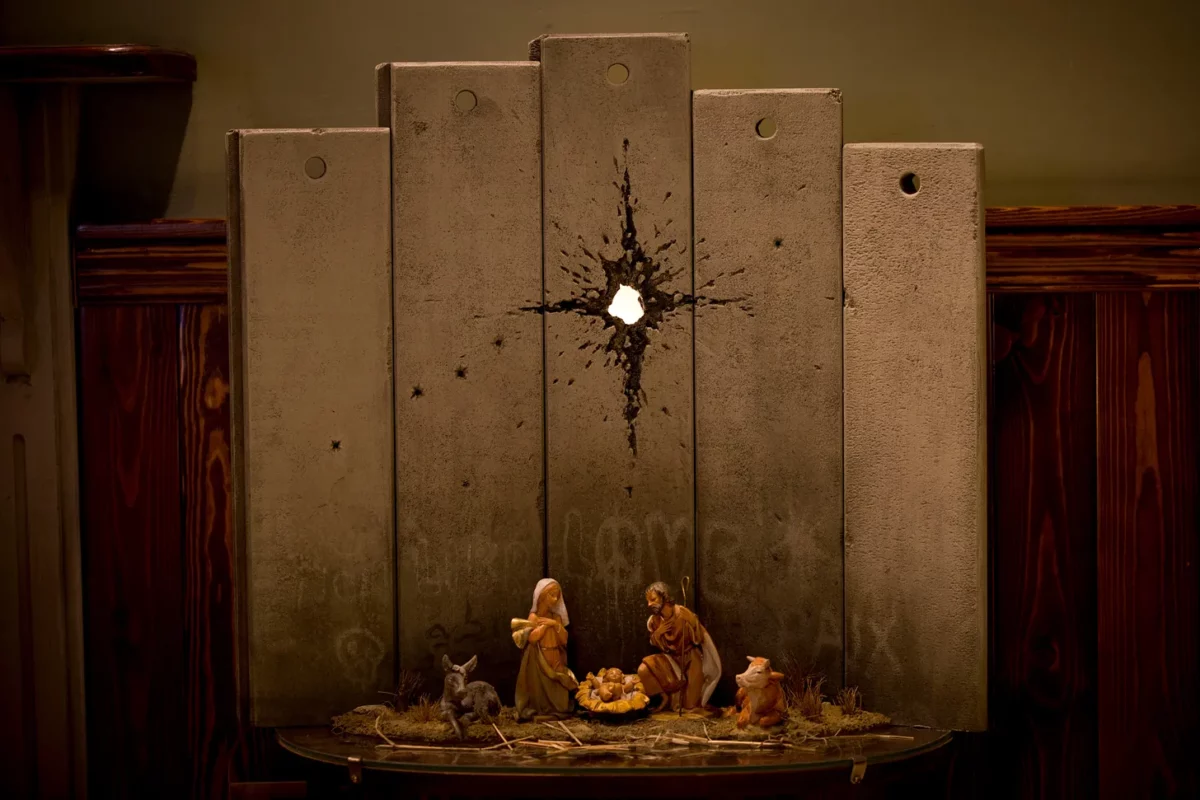
Artwork dubbed “Scar of Bethlehem” by the artist Banksy is displayed in The Walled Off Hotel in the West Bank city of Bethlehem on Dec. 22, 2019. (Majdi Mohammed/Associated Press)
Last summer, Middle Eastern evangelical leaders issued a landmark document titled “A Collective Call to the Global Church.” Backed by 32 biblical citations, the statement expressed deep concern over the silence — and at times, even support — offered by Western churches in the face of Gaza’s devastation. Signatories urged the global church to promote accountability, call for a ceasefire, demand the release of hostages, and support unrestricted humanitarian access.
Their message was clear: Christian Zionism has produced a widening theological and moral gap between Western congregations and local Christian communities who live with the real-world consequences of these interpretations.
Across the United States, activists and church groups are working to remind Americans that Bethlehem — the birthplace of Jesus — is not merely a symbol or a page in Scripture, but a living Palestinian city under occupation. In Philadelphia, a mobile billboard is circulating through Christmas markets and churches with a simple counter invitation: “Visit Bethlehem, Palestine — Where It All Began.”
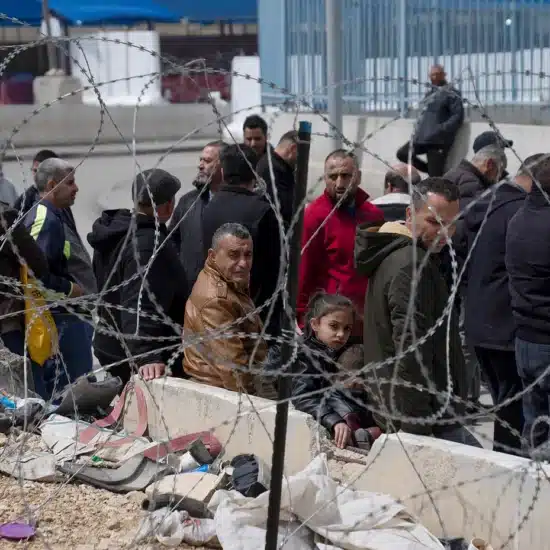
Organizers emphasize that Palestinian Christians are the “living stones” of the Holy Land, descendants of the earliest followers of Jesus who continue to preserve Christianity’s holiest traditions. Their daily lives, however, are marked by restrictions on movement, economic hardship, land confiscation, and a rate of emigration that threatens their continued presence.
The campaign underscores a message often overlooked in Western discourse: “Your presence is solidarity. Your tourism is survival. Your pilgrimage is an act of faith and justice.”
Christian Zionism does more than misread scripture — it reshapes it into a justification for policies that inflict deep human suffering. In doing so, it sidelines the voices of the very Christian communities who have lived, worshiped, and carried the message of Christ in the Holy Land for centuries.
As Christmas approaches and the world gazes once again toward Bethlehem, a fundamental choice emerges: Will Christians align themselves with interpretations that use scripture to justify oppression and exclusion? Or will they stand with the local Christian community that nurtures the faith in the very land where it was born?
The answer will shape not only the future of Middle Eastern Christianity but also the credibility of the global church’s commitment to justice, compassion, and truth.
Daoud Kuttab is an award-winning Palestinian journalist born in Bethlehem and a member of the Amman Baptist Church. He is the publisher of Milhilard.org, a news site focusing on the lives and challenges facing Christians in Jordan and Palestine.