OKLAHOMA CITY — An Oklahoma state board on Monday rejected a proposal to open a Jewish charter school, likely restarting a legal fight over public funding of religious education.
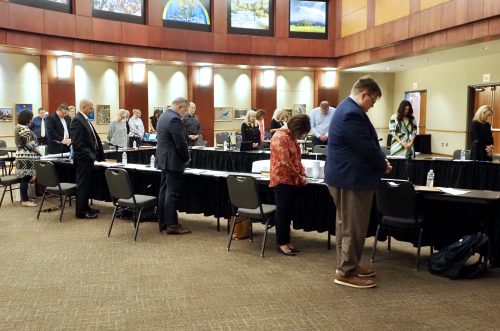
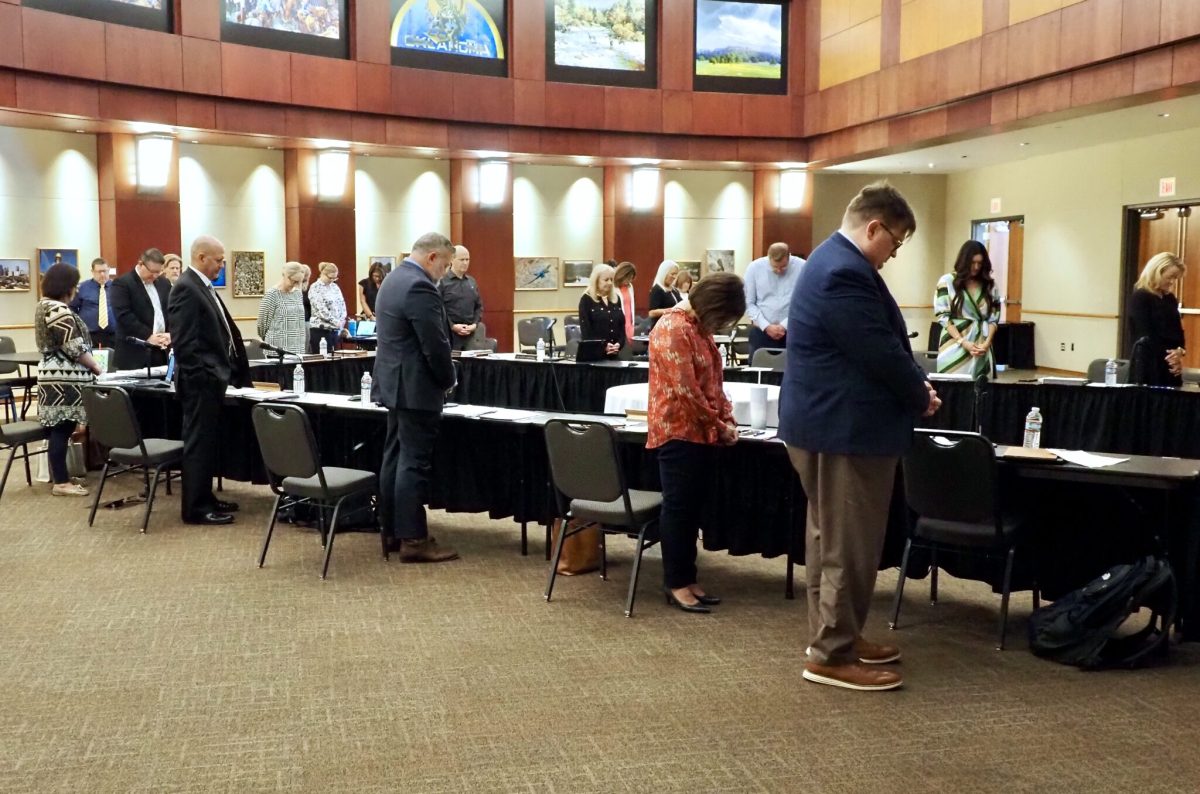
The Oklahoma Statewide Charter School Board members and staff pray at the beginning of a meeting Sept. 9, 2024, at the Oklahoma History Center in Oklahoma City. (Photo by Nuria Martinez-Keel/Oklahoma Voice)
Members of the Statewide Charter School Board, though complimentary of the school’s academic prowess, said they are obligated to obey an Oklahoma Supreme Court decision that rejected the concept of a state-funded religious school. The same board had supported opening a Catholic charter school in recent years, but a deadlocked U.S. Supreme Court allowed the state Court decision against it to stand.
The board and the Jewish charter school’s founders are now preparing for another protracted legal battle. After unanimously rejecting the school, the board voted to seek out private attorneys to handle expected litigation.
“I would be shocked if there’s not a lawsuit filed by Friday,” board Chairperson Brian Shellem said.
The anticipated case taps into church-state separation concerns that underscored the Catholic charter school dispute.
Ben Gamla Jewish Charter School would offer an online-based education that is “intellectually rigorous and deeply rooted in Jewish knowledge, values and lived tradition,” according to its application.
Local Jewish institutions have objected to the Ben Gamla effort. Five leaders of Oklahoma synagogues and Jewish service centers issued a joint statement contending the school’s founders failed to consult the local community before seeking state approval.
“We are deeply concerned that an external Jewish organization would pursue such an initiative in Oklahoma without first engaging in meaningful consultation with the established Oklahoma Jewish community,” the statement reads. “Had such consultation occurred, the applicant would have been made aware that Oklahoma is already home to many Jewish educational opportunities.”
The school’s leading founder, former U.S. Rep. Peter Deutsch, of Florida, said he visited Oklahoma a few years ago and believes the state presents the best opportunity to open a Jewish charter school. Deutsch established six secular Hebrew-English charter schools in Florida.
In a presentation to the statewide board last month, Deutsch said he spoke with about 10 Jewish parents in the state who were “looking for a sort of a faith-based, rigorous academic program, but there was nothing there.”
The school’s founding board also includes Brett Farley, a board member of the overturned Catholic charter school, and Ezra Husney, of New York. All members of an Oklahoma charter school board must reside in the state, said Thomas Schneider, the statewide board’s attorney.
Farley said the board’s decision Monday was no surprise.
“The law is what it is,” he told reporters after the vote. “We made our best application, and now we’re off to the courts.”
The school’s founders plan to file a legal challenge in federal court, according to a written statement Farley handed to news media. The prepared remarks reiterate arguments Catholic officials made before the state and U.S. supreme courts — that religious entities cannot be excluded from a neutral public benefit solely because of their faith-based character.
The Oklahoma Constitution mandates that public schools be “free from sectarian control.” The state Supreme Court reaffirmed the state’s long-held stance that charter schools are public schools and therefore are barred from adopting a religion.
“I just think regardless of the school’s reputation or whatever strengths that it has, the law’s the law, and right now the law says no,” statewide board member Kitty Campbell said.
Oklahoma’s top education official, State Superintendent Lindel Fields, cast one of the votes against opening the school. Fields, who typically appoints a proxy to attend the statewide board’s meetings, appeared personally on Monday.
He said the board’s decision simply aligned with Supreme Court precedent.
“I serve on 21 boards, so I attend as I can,” he said afterward. “Certainly today’s votes, the votes were meaningful, and I felt my presence here was important.”
Oklahoma Voice is part of States Newsroom, a nonprofit news network supported by grants and a coalition of donors as a 501c(3) public charity. Oklahoma Voice maintains editorial independence. Contact Editor Janelle Stecklein for questions: info@oklahomavoice.com.