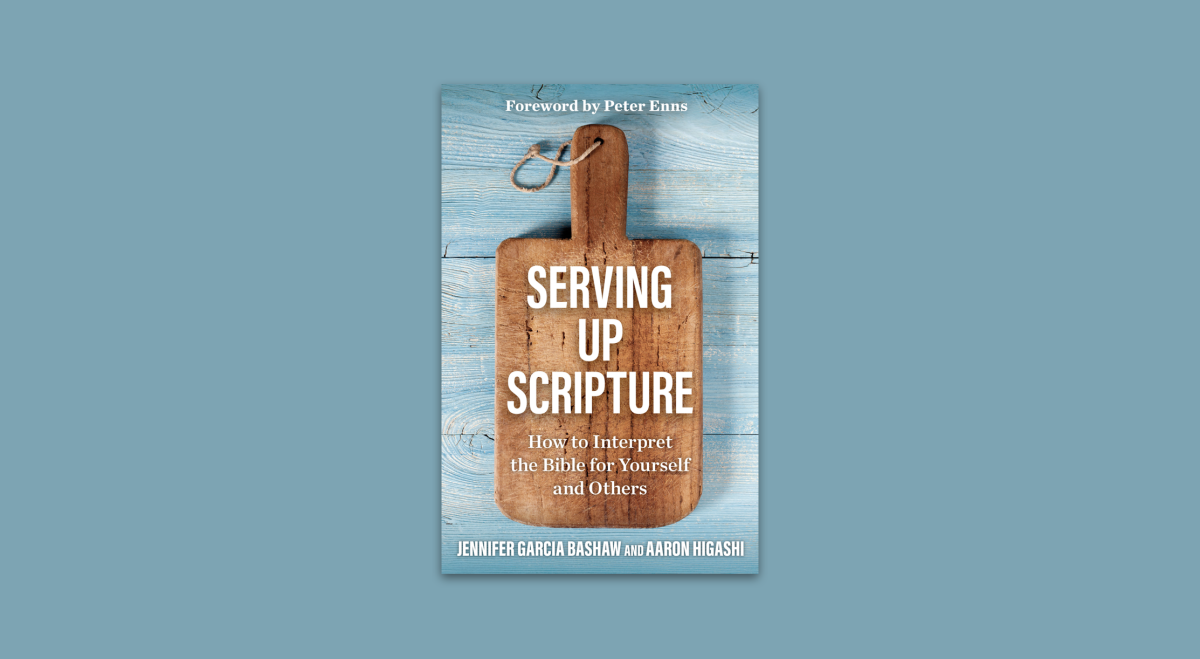
SERVING UP SCRIPTURE: How to Interpret the Bible for Yourself and Others. By Jennifer Garcia Bashaw and Aaron Higashi. Minneapolis, MN: Broadleaf Books, 2026. Viii + 254 pages.
Biblical illiteracy is a major issue in Mainline Protestantism and probably Roman Catholicism as well. It may also be true even in evangelical churches, despite affirmations of biblical inerrancy. While it is true that until maybe the seventeenth or eighteenth centuries, the likelihood was that few people had Bibles in their homes that they could read for themselves, today Bibles are easy to find, at least in places like the United States. In fact, there is a plethora of translations that fit just about every level of education and training. You can even read it from your phone through a Bible app. So, why is it that so many Christians don’t read the Bible? We indeed gather less for Sunday School and Bible studies, which may account for some of the drop off. But there is also this sense that the Bible is not only ancient but alien. It may be honored as a sacred text that every Christian home needs, but it is not meant to be read. Even when it is read, it can be misinterpreted and misapplied. As they say, you can prove just about anything with a verse from the Bible. So, what people need, it would seem, is some guidance about how to read and interpret this familiar but strange book.

Robert D. Cornwall
There are, in fact, a great multitude of resources that can help people encounter Scripture for themselves. Some are more helpful than others. With that in mind, a new offering has been made available that is geared to more progressive, perhaps post-evangelical Christians. That book is titled: Serving Up Scripture: How to Interpret the Bible for Yourself and Others. It is authored by Jennifer Garcia Bashaw, a professor at Campbell University, and a holder of a PhD in New Testament from Fuller Theological Seminary (my alma mater), along with Aaron Higashi, who is a public Bible scholar with a PhD in biblical interpretation from Chicago Theological Seminary.
Bashaw and Higashi use the imagery of cooking to draw us into reading and interpreting the Bible. That may be why Tripp Fuller describes the book in his endorsement as “the ultimate comfort food for anyone who’s ever been intimidated by Scripture study.” This is the aim of the authors, who hope that Serving Up Scripture can introduce people to forms of biblical interpretation that make the Bible more accessible and do so responsibly. I believe they do an excellent job of helping people do exactly that, especially people who have been hurt by the way the Bible has been used in their past. Their use of the metaphor of cooking is designed to take the edge off the conversation by helping people understand the role the interpreter and the ingredients play as they engage with Scripture.
The authors divide their book into four parts. The first section, Part I, is titled “Setting the Table.” It is here that Bashaw and Higashi discuss what it means to interpret the Bible (Chapter 1), the role that the interpreter (metaphorically the chef) plays in the process of interpretation (Chapter 2), and finally, how one engages in “Navigating Biases” (Chapter 3). That third chapter is very helpful because it is important that we not only should be aware of our biases but also name them. One of the challenges that people face as they come to Scripture is overcoming the myth of objectivity. That is, the idea that culture, social context, and belief systems do not color our reading of Scripture. My previous review was for a book focused on Indigenous American interpretation — Reading the Bible on Turtle Island. In fact, one might read the two in tandem.
Moving on to Part II, we find that Bashaw and Higashi discuss “The Main Ingredients.” In this section, the authors provide brief introductions to the Books of the Bible. They start with a chapter on “The Bible in General” (chapter 4). Here they remind us that the Bible is a “multivocal text” that “invites you to think alongside its many voices,” as such it allows us to experience the diversity of human life because it “is in fact born from that diversity.” So, “welcome to the kitchen” (p. 55). Having addressed the multivocal nature of the Bible which emerged over many centuries, they are ready to introduce us to the “The Pentateuch” (chapter 5); “The Prophets” (chapter 6); “The Writings” (Chapter 7); “The Gospel and Acts” (Chapter 8); “New Testament Letters and Revelation” (Chapter 9). After they briefly introduce us to the books that make up the Bible, they offer the reader “The History of Biblical Interpretation” (Chapter 10).
You will notice that they use the Jewish organization of the Hebrew Bible/Old Testament, with its three parts—Pentateuch, Prophets, and Writings. This is a different organizing principle than that found in most Bibles printed with Christians in mind. However, their decision to go this route is helpful because it reminds Christian readers that what is typically known as the Old Testament is, in fact, the Bible of our Jewish siblings. Although Bashaw and Higashi have geared their book to Progressive and Post-evangelical Christians, I found it interesting that, when it came to the Pastoral Epistles (1 and 2 Timothy, Titus), they attributed authorship to Paul. The general consensus among most Mainline scholars is that the Pastorals are post-Pauline. In any case, this is a helpful introduction to the books of the Bible and the history of their interpretation.
Now that we have identified the chef and the ingredients, it’s time for “Preparing the Ingredients” (Part III). Here, the authors focus on the key interpretive questions that readers bring to the text. These include “Historical Questions” (Chapter 11). The kinds of questions dealt with here include when and where a text was written, as well as when and where the story was set. These are two different sets of questions that require our attention if we wish to responsibly read Scripture. Then there is the question of why the books of the Bible were written and preserved. They write that “Historical Questions help us to overcome our own biases and refocus on the issues that would be near and dear to the hearts of the people who originally wrote and read the biblical texts” (p. 178).
The next chapter focuses on “Literary Questions” (Chapter 12), which involves determining genre and literary devices, as well as the way language is used. They speak of exploring both the big picture and then zooming in on specific elements. In this chapter, the goal is to remind us that the Bible is like other books that also require interpretation. The first two sets of questions are expected, but then we move to the third set, “Ideological Questions” (Chapter 13). Here, the focus is on social identity, both as it is presented in the text and as it defines the person doing the reading/interpreting. In this chapter, they speak of some of the various forms of social identity that people bring to the text. These include Feminist hermeneutics, Liberation Theology, Womanist Theology, Mujerista theology, and Asian Theology. Other forms could be added, but this gives us a sense of the possibilities.
Finally, there are the “Theological Questions” (Chapter 14). They suggest that the theological questions are the dessert. That is, these are the final questions that follow once the other questions are addressed. They note that these are important questions that have often been suppressed by practitioners of the historical-critical method. So, just because the theological questions are the dessert does not mean they are unimportant. They want to note that when it comes to historical-critical and theological questions, this is not a matter of an either/or scenario. Both are necessary if we are to truly appreciate the messages that emerge from the Bible.
Now that we have been introduced to the chef, the ingredients, and the process of preparing the meal, we come to Part IV, which is titled “Feeding People.” In the concluding chapters, the authors remind us that the purpose of cooking a meal is to eat the food that has been prepared. With this in mind, they offer questions that address the purpose of interpreting the Bible. The focus is on two audiences or categories of diners. First, there is the matter of “Interpreting for Yourself” (Chapter 15), followed by “Interpreting for Others” (Chapter 16). In asking these questions, the authors remind us that there is value in reading the text for ourselves. However, there is also value in reading and interpreting the text for others and with others. While the latter is something that preachers and teachers do, Bashaw and Higashi suggest that everyone who gathers with the text in hand can share their insights with each other. The point is making sure we do so responsibly.
In terms of intended audience, the authors have geared this book to a general or lay audience. With that in mind, they provide readers with a set of discussion questions that could be used in small groups. I would recommend that the book be utilized in that way. I have a feeling that it will invite many questions that can lead to a better experience with the Bible. The authors also provide readers with two appendices. The first offers a Social Location Inventory, which will help the reader locate themselves in relation to the text. Then Appendix 2 offers “Resources for Further Study.”
Because I believe that if Christians are to move into spiritual maturity, they need to have a strong biblical foundation, I believe that Bashaw and Higashi’s effort in Serving Up Scripture will prove very helpful in this effort. They offer an accessible text that attractively introduces the Bible, using metaphors that will appeal to many, if not most, readers (at least readers who enjoy eating a variety of foods). So, take and “eat” for dinner has been served.
This review originally appeared on BobCornwall.com.
Robert D. Cornwall is an ordained minister in the Christian Church (Disciples of Christ). Now retired from his ministry at Central Woodward Christian Church (Disciples of Christ) of Troy, Michigan, he serves as Minister-at-Large in Troy. He holds a Ph.D. in Historical Theology from Fuller Theological Seminary and is the author of numerous books, including “Eating With Jesus: Reflections on Divine Encounters at the Open Eucharistic Table” and “Second Thoughts About Hell: Understanding What We Believe” coauthored with Ronald J. Allen. His blog Ponderings on a Faith Journey can be found here.