(RNS) — As LGBTQ-affirming faith communities across the United States prepared to celebrate International Transgender Day of Visibility on Tuesday (March 31), their plans were interrupted by news the Supreme Court had ruled that morning against Colorado’s ban on conversion therapy.
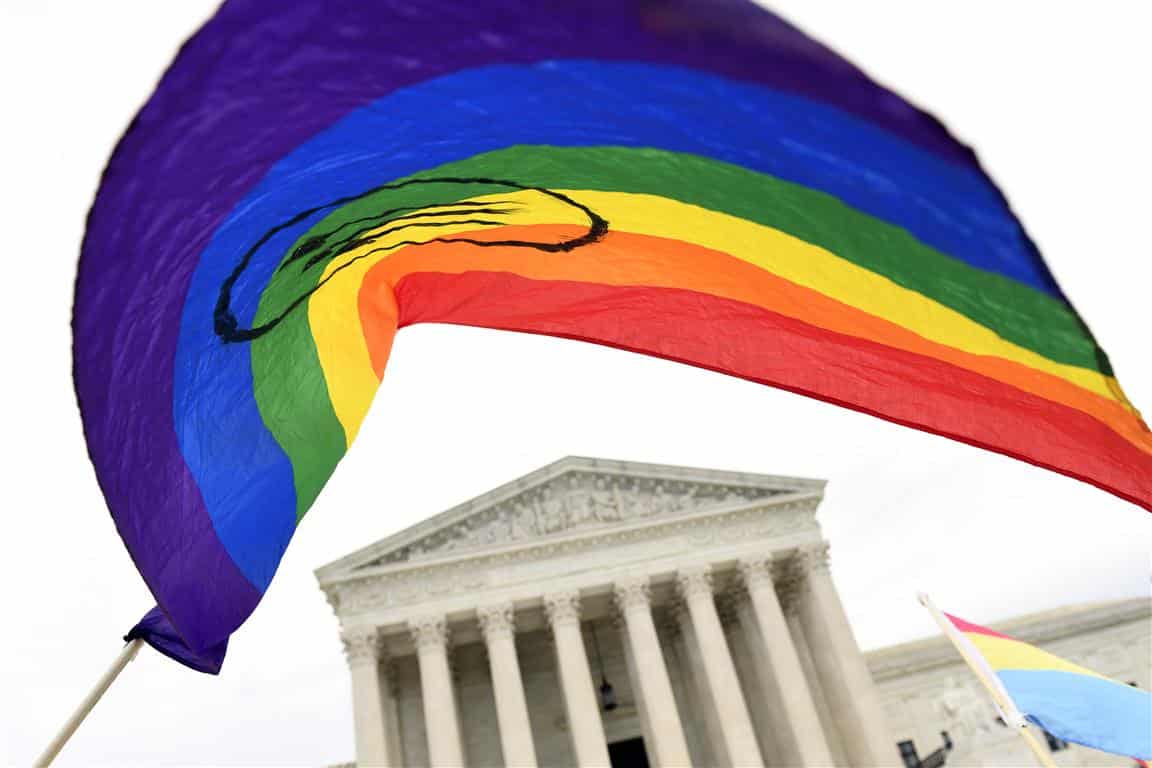
In this Oct. 8, 2019, file photo, people gather outside the Supreme Court in Washington. (AP Photo/Susan Walsh, File)
A form of talk therapy that attempts to change the gender identity or sexual orientation of LGBTQ people, conversion therapy has been widely discredited by major medical organizations due to evidence it is ineffective and can lead to suicide. In a striking 8-1 ruling, the court sided with evangelical Christian therapist Kaley Chiles, who argued Colorado’s law violated her right to free speech by preventing her from working with young people “who have same-sex attractions or gender identity confusion” and are seeking to “live a life consistent with their faith.”
As conservative groups celebrated the news as a win for free speech, LGBTQ and LGBTQ-affirming faith groups condemned the decision, saying it could threaten conversion-therapy bans in over 20 other states.
“‘Conversion therapy’ is not only medically spurious, its history is inseparable from a kind of religious malpractice that tells LGBTQI+ people that something about them is inherently depraved and in need of fixing,” the Rev. Sofía Betancourt, president of the Unitarian Universalist Association, told RNS.
In statements, Americans United for Separation of Church and State, Interfaith Alliance, and the National Council of Jewish Women shared similar sentiments.
“Our tradition teaches that every person is created b’tzelem Elohim — in the image of the Divine,” said Darcy Hirsh, vice president of government relations and advocacy at the NCJW. “That means every LGBTQ+ child is made exactly as they are supposed to be, and should be cherished for who they are.”

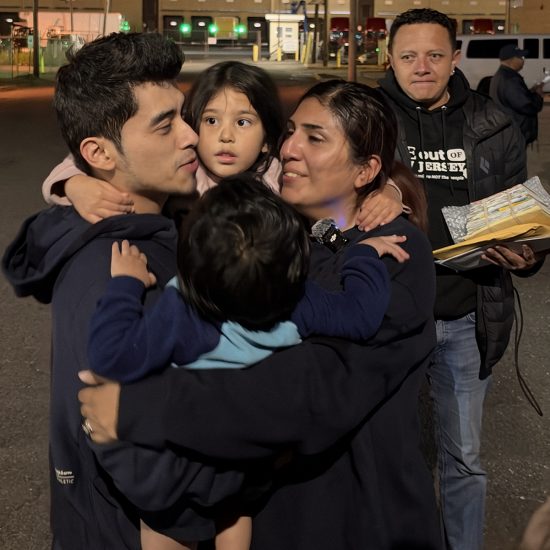
Mitch Leet, left, and his mother embrace during the Room for All National Conference in Holland, Michigan, in October 2025. (Photo courtesy of Mitch Leet)
These groups were among the more than 20 diverse religious organizations that joined an amicus brief arguing that the Colorado law doesn’t violate free speech. As it stands, the law prohibits the use of conversion therapy on minors but exempts religious ministries.
As a result of the Supreme Court’s decision, lower courts will now review the Colorado ban using the highest form of judicial scrutiny.
Conversion therapy survivor Timothy Schraeder Rodriguez told RNS that while people often speak about conversion therapy as a thing of the past — especially since the closing of the “ex-gay” organization Exodus International in 2013 — the practice has only been repackaged for a younger generation.
“A lot of people would assume it looks like military-style boot camps or electroshock therapy or things like that,” Schraeder Rodriguez said. “Most of the time, it’s happening in the church basement around the corner from your house.”

Timothy Schraeder Rodriguez. (Courtesy photo)
He added that while bans like Colorado’s aim to protect young people in therapeutic settings, religious exemptions allow ministries that employ conversion therapy tactics to go unchecked. He pointed to the Changed Movement, a nonprofit connected to Bethel Church, an evangelical megachurch in Redding, California, that aims to help people find “freedom and wholeness beyond LGBTQ identities,” per the group’s statement celebrating the Supreme Court ruling.
“It took me more than a decade after I left conversion therapy to finally start to really, truly untangle the harm that it caused in my life,” said Schraeder Rodriguez, who is the author of the forthcoming book “Conversion Therapy Dropout: A Queer Story of Faith & Belonging.” “When a faith tradition tells you that who you are is fundamentally broken, that God hates you because of you being the way that you are, that you have to change who you are to be accepted by whatever faith tradition you’re a part of, that just does something to someone’s spirit.”
Miryam Kabakov, founder and executive director of Eshel, an LGBTQ+ inclusive Orthodox Jewish organization, told RNS that part of the group’s work involves helping people avoid conversion therapy by connecting them with affirming mental health professionals, and working with hundreds of rabbis, schools, and guidance counselors to teach them that “being LGBTQ+ is an immutable part of who someone is.”
She said the court’s ruling was “deeply upsetting” to many in Eshel’s community, especially survivors of the practice. “This ruling is bringing up past trauma from these therapies,” she said.
Several LGBTQ faith leaders told RNS that their top concern is how the ruling will impact LGBTQ youth, who might not have agency over the providers entrusted with their care. Some pointed to educational resources or support groups. Q Christian Fellowship — an ecumenical, nonprofit group that advocates for LGBTQ Christians and allies — has teamed up with The Trevor Project to develop a Christian discussion guide on the harms of conversion therapy. DignityUSA, an organization advocating for LGBTQ Catholics, has its own anti-conversion therapy publication. And while the Trump administration terminated the suicide prevention hotline for LGBTQ youth last year, Mitch Leet, associate director for the Reformed Church in America’s LGBTQ-affirming group Room for All, noted that organizations such as Trans Lifeline and The Trevor Project have their own hotline services.
The Rev. Brian Henderson, executive director of the LGBTQ+ affirming Association of Welcoming & Affirming Baptists, noted that the Supreme Court’s ruling came not only on trans visibility day, but also during the week Christians observe Good Friday and Easter, which commemorate Jesus’ death and resurrection.
“Within the Christian tradition, Holy Week is a week that reminds us that ultimately, love prevails, death does not win,” he said. “There is hope for us as we continue to gather together, stand in solidarity with each other, and do together what none of us can do on our own.”
Marianne Duddy-Burke, executive director of DignityUSA, said Holy Week tells the story of “crucifying holiness and trying to stamp out movements for the liberation of people.”
“And,” she said, “we have to go through the Good Fridays to get to Easter.”