(RNS) — On Monday (April 6), NASA astronauts finally were about to commence Artemis II’s flyby of the moon, the first such close observance of Earth’s satellite in nearly 60 years. The four astronauts had spent days on the Orion spacecraft, hurtling toward the moon, and they were about to travel farther away from Earth than any human being in history.
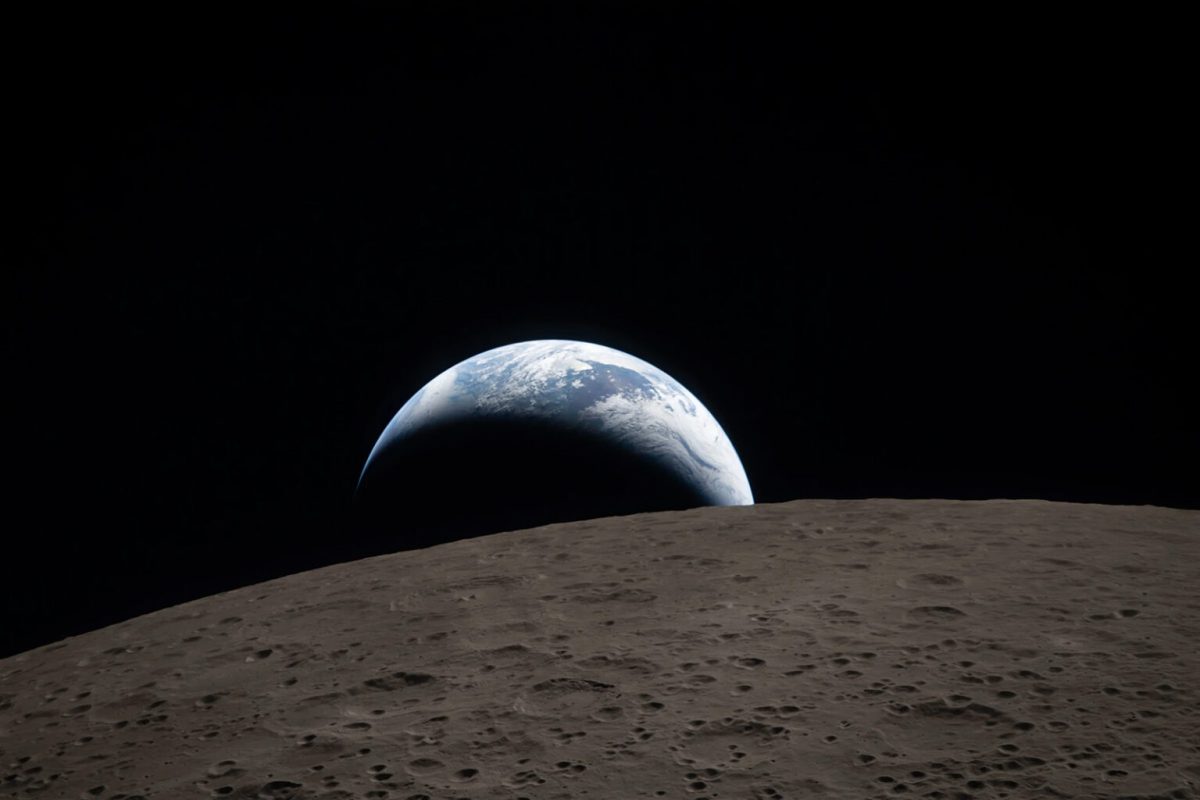
The Artemis II crew captured this view of an Earthset on April 6, 2026, as they flew around the Moon. (Photo courtesy of NASA)
But moments before the crew would enter into roughly 40 minutes of radio silence as they passed behind the moon, the voice of astronaut Victor Glover — who has been open about his Christian faith and worships at Churches of Christ congregations in Texas — crackled over the broadcast channel to offer a message of love.
“As we continue to unlock the mysteries of the cosmos, I would like to remind you of one of the most important mysteries there on Earth — and that’s love,” said Glover. “Christ said, in response to what was the greatest command, that it was to love God with all that you are. And he also, being a great teacher, said this: ‘I give you equal to it, and that is to love your neighbor as yourself.’”
Glover added: “And so, as we prepare to go out of radio communication, we’re still able to feel your love from Earth and to all of you down there on Earth, and around the Earth, we love you from the moon.”
The spiritual appeal recalled perhaps one of the most widely broadcast moments of religious expression: the 1968 Apollo 8 mission, when three astronauts read from Genesis on live television as they, too, orbited the moon. Both missions also happened to coincide with religious holidays: Apollo 8 circled the moon on Christmas Eve, and the 10-day Artemis II mission overlapped with the Christian celebration of Easter and the Jewish holiday of Passover.
But for all their similarities, the four astronauts participating in the Artemis II mission have collectively showcased a broader, more pluralistic approach to public religious expression than the three men who rode aboard Apollo 8. It’s a subtle change that showcases NASA’s evolving relationship to public displays of faith, a tonal shift that likely traces its origins to the legal challenges that followed the reading of Genesis aboard the lunar module back in 1968.
Much of the God-talk on the Artemis mission has centered on Glover, who is also the most publicly religious astronaut on the mission. He reportedly brought a Bible along with him for the 10-day journey in space, which is something he’s done before: He told The Christian Chronicle in 2020 that he had a Bible and Communion cups sent to the International Space Station in preparation for his arrival aboard a Space X capsule in November of that year. At the time, Glover suggested he planned to worship virtually with his church while in orbit, as he had been doing throughout the early stages of the COVID-19 pandemic.

Artemis II pilot Victor Glover, right, speaks about the role of Easter and the importance of unity across beliefs on Easter Sunday, April 5, 2026, from inside the Orion spacecraft. (Video screen grab)
NASA officials did not offer a direct response when asked by Religion News Service if Glover or other Artemis II astronauts have made special arrangements to worship while aboard the Orion capsule. But Glover did offer some public religious reflection while hurtling toward the moon over the weekend, when CBS reporter Mark Strassmann asked him to comment on the journey’s overlap with Easter.
“When I read the Bible and I look at all of the amazing things that were done for us who were created, it’s you have this amazing place, this spaceship. You guys are talking to us because we’re in a spaceship really far from Earth, but you’re on a spaceship called Earth that was created to give us a place to live in the universe and the cosmos,” Glover said.
He added that whether listeners “believe in God or not, this is an opportunity for us to remember where we are, who we are, and that … we got to get through this together.”
A similar sentiment was expressed a few days before the astronauts blasted off from Earth. A reporter in the press pool asked the astronauts about traveling to the moon during Easter. Reid Wiseman, Artemis II’s commander, and the two other astronauts — Christina Koch and Jeremy Hansen — all glanced over to Glover, who said something inaudible that sparked a chuckle among the group.
Wiseman then stepped forward and acknowledged the legacy of Apollo 8, gearing his answer to a multireligious audience.
“We have our own different opinions, our own individual opinions and our own individual beliefs,” he said, gesturing to his fellow astronauts. “I think that’s one of the best parts about this mission right now: As we have said from the beginning, we really are for all, by all, and we want to take the whole world along with us.”
Wiseman then referenced Ramadan — “we just came out of a very important Muslim holiday” — noting that it ended less than a month before Easter.
“I think that that’s great — that we celebrate all of this all the way around the world,” he said.
It’s a different tone than the one struck by astronauts aboard the Apollo 8 mission.

Apollo 8 astronaut Jim Lovell speaks during an event commemorating the 50th anniversary of his 1968 space mission at the Washington National Cathedral, Dec. 11, 2018. (RNS photo/Jack Jenkins)
Whereas Artemis II shot past the moon only once before heading back to Earth, the Apollo 8 mission entered into lunar orbit, circling Earth’s satellite multiple times over the course of 20 hours. As the astronauts rounded the planet for the ninth time, all three astronauts — William Anders (a Catholic at the time), Jim Lovell (Presbyterian), and Frank Borman (Episcopalian) — took turns reading from the Book of Genesis on a broadcast, reciting verses 1-10 from the King James translation of the Bible. The men read from the mission’s flight manual, where the Scripture passages had been printed after Christine Laitin suggested them to her husband, a government official assisting with the mission.
“From the crew of Apollo 8, we close with good night, good luck, a Merry Christmas, and God bless all of you — all of you on the good Earth,” Borman said.
Fifty years later, Lovell reflected on the moment while addressing a crowd at the Washington National Cathedral.
“I arrived on a planet with a proper mass to have the gravity to retain water and an atmosphere — the essentials for life. I arrived on a planet orbiting a star at just the right distance to absorb that star’s energy,” he said. “In my mind, the answer was clear: God gave mankind a stage on which to perform. How the play ends is up to us.”
That broadcast prompted a lawsuit from atheist activist Madalyn Murray O’Hair, who argued it violated the First Amendment’s establishment clause. Although the U.S. Supreme Court eventually threw out the case due to “want of jurisdiction” — presumably referring to space — historians have long argued the lawsuit had a lasting impact on NASA, as astronauts were effectively discouraged from openly engaging in worship or religious activity during a mission.
Many point to Buzz Aldrin, who celebrated Communion on the moon shortly before walking out onto the lunar surface, but waited more than a year before commenting on the moment publicly.
In the intervening years, it has become common for astronauts to speak publicly about religious practices that occurred during their missions, even as the space-farers and NASA have taken pains to avoid giving a specific faith tradition center stage as on Apollo 8. Bibles were brought to the moon and returned in the Apollo era, and Christians of several varieties brought crucifixes, icons, and other religious symbols with them aboard various rockets. Teams of Islamic scholars were convened to help guide Muslim astronauts who wanted to pray and maintain their religious observance while orbiting Earth on the International Space Station — including during Ramadan. Jewish astronauts have brought Torah scrolls aboard the space shuttles, with one reading from Genesis while in orbit.
Sometimes religious expression can be more subtle. Aboard the Artemis II, the personal mission patch worn by Canadian astronaut Hansen includes references to spirituality embraced by Indigenous communities he has spent time with. According to the Canadian government, his patch, which was designed by Anishinaabe artist Henry Guimond, includes a representation of the “Seven Sacred Laws, a traditional First Nations teaching shared with (Hansen) in preparation for his journey around Grandmother Moon.”
But while religious ritual in space is common, the profundity of a moon mission appears to have inspired Artemis astronauts to broaden their public religious appeals. It’s an approach that may be drawn from the wisdom of past astronauts: Wiseman’s desire to “take the whole world along with us” is reminiscent of Aldrin’s thoughts on his moon Communion. In his 2010 memoir, he explained he now envisions major space missions as something for all people — be they religious or otherwise.
“We had come to space in the name of all mankind — be they Christians, Jews, Muslims, animists, agnostics, or atheists,” Aldrin wrote. “But at the time I could think of no better way to acknowledge the Apollo 11 experience than by giving thanks to God.”