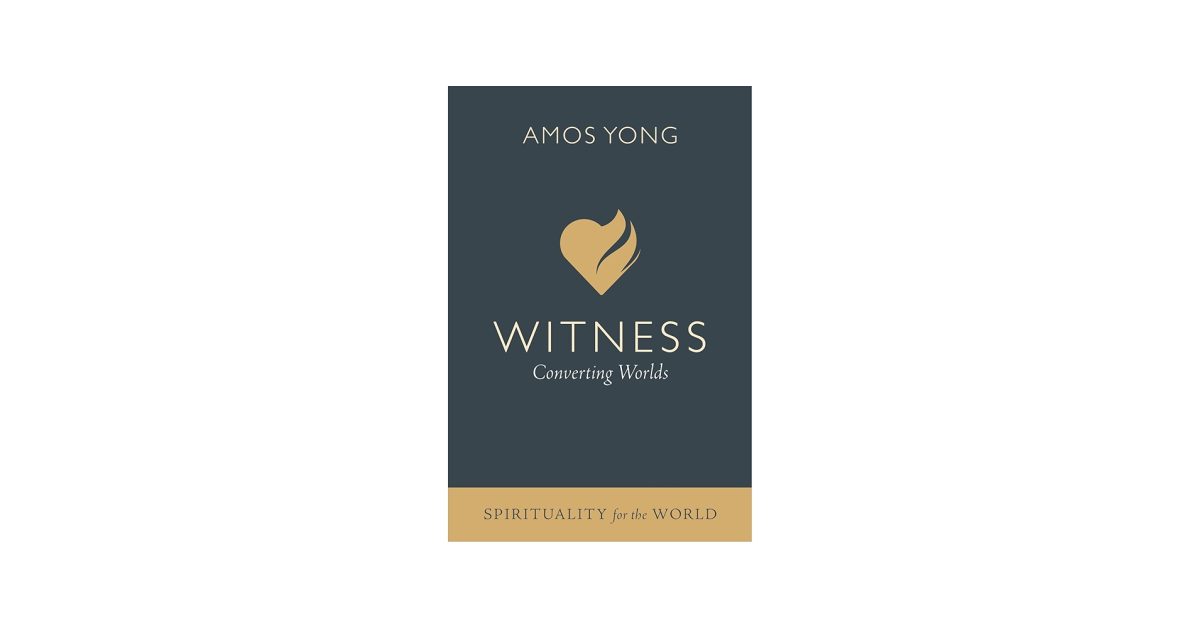
WITNESS: Converting Worlds (Spirituality for the World). By Amos Yong. Eugene, OR: Cascade Books, 2026. X + 174 pages.
What does it mean for someone to convert? Does it always involve leaving one religion for another? Could it be that we all experience differing kinds of conversions, such that even Christians can undergo a variety of conversion experiences? For example, during my earlier evangelical days, I assumed that conversion entailed saying yes to Jesus so that I and others could go to heaven when we die. After all, according to Jesus (in John’s Gospel), there is no other path to God other than through Jesus (John 14:6). I know that passage well, but could it be that this question of conversion is more complicated than that? I approach these questions as someone who is fully committed to following Jesus. At the same time, I have good friends who are Muslim, Jewish, and Hindu. Should I try to convert them to Christianity so that they might be saved and join me in heaven after we all die? In many ways, my friends better exemplify what I understand to be Christian values than many who profess faith in Christ. So, even though we do talk about Jesus, I will confess that I do not actively try to convert my friends, trusting their destiny into the hands of God. I say all of this as a preface to my review of Amos Yong’s book, Witness: Converting Worlds.

Robert D. Cornwall
Amos Yong is, first of all, a friend. In addition to being a prolific author, he serves as a professor of theology and mission at Fuller Theological Seminary (my alma mater). By tradition, he is a Pentecostal. Therefore, he is very interested in exploring the ways the Holy Spirit factors into theology, mission, and Christian life. This book, Witness: Converting Worlds, is, according to the author, the first in a series of shorter books, written for a wider audience, that he has titled Spirituality for the World: Explorations at the Edges of Late Modernity. He focuses this particular volume on “Christian faith-sharing in the 2020s.” Again, as would be appropriate for a Pentecostal theologian, in this book, which focuses on mission and witness, Yong draws on Luke’s two volumes, the Gospel as well as the Book of Acts. What is interesting about this book is that Yong begins not with the Gospel of Luke, as one might expect, but with the Book of Acts. He does this because he believes that the story we find in the Book of Acts makes the Gospel relevant to our Christian witness.
In Yong’s introduction to the book, he suggests that his purpose here is to shift our rhetoric and practice from mission to witness, and from evangelism to conversion. Writing as a missiologist, he suggests that the concept of mission carries significant baggage, with its “legacy of colonialism, racism, Eurocentrism, and, more recently, American imperialism.” (p. 1). That said, he also believes that the church is called to bear witness to the gospel. To do this, he suggests we must break free of the old paradigm by moving from mission to witness. As for evangelism, it too has become encumbered by baggage. Even with growing commitment to social responsibility, these efforts have been seen by the targets of this outreach as attempts to buy conversions.
My Hindu friend often speaks about “rice Christians” in India, such that food is offered in exchange for conversion. Although there are these important concerns, Yong still believes that Christians have good news to share with the world. If this is true, then we have to ask how this good news gets shared with the world. Here is where Yong brings Luke’s two volumes into the conversation. In his view, they provide important guidance when it comes to sharing the good news. With this in mind, Yong divides his book into two parts, with Part One focused on “Christian Witness to/with Others in the 2020s,” while Part Two focuses on “Apostolic Evangelism and Conversion in the 2020s.”
Part One of Witness includes two chapters, the first focusing on “Acts and Christian Witness: Then and Now.” In this chapter, Yong demonstrates that beginning with the Book of Acts reveals that the apostolic witness described in Acts provides the backdrop for Luke’s decision to write his gospel. In Yong’s view, there would be no reason to write the gospel if there had not been an audience for it, and that audience lived in an imperial and pluralistic world. Thus, we see how the apostolic expansion of the church took place in the context of the Pax Romana and the cultural-religious pluralism of the Mediterranean world. With this social/cultural context revealed, we can ponder how the church expanded as it moved outward from Jerusalem. This movement outward follows the pattern we find espoused in Acts 1:8, where Jesus commissions a Spirit-empowered community to take the gospel from Jerusalem outward to Judea and Samaria and on to the ends of the earth. As we ponder this foundation, he asks us to consider what that means for the contemporary church.
Having established the importance of starting with the Book of Acts in Chapter 1, when we move into Chapter 2, titled “Luke and Christian Witness: Then and Now,” Yong picks up the message found in Luke’s Gospel. In this chapter, Yong offers a brief but helpful introduction to Luke’s gospel as a missional text. With that in mind, Yong walks us through the Gospel with a missional vision in mind. Central to this vision is the idea that the Christian mission is Spirit-led and empowered. He suggests that the vision of Christian witness laid out in the Gospel will prove challenging to first world inhabitants. He writes that “If we think we are going to bear effective witness to the ends of the earth, much less beyond the enclave where we are sequestered, we need to come back out into the streets, and be exposed to the many tongues the Spirit speaks through the many voices. And exposure to the many tongues invites attending to them, being instructed by them, experiencing transformation through their witness” (pp. 50-51). Yong notes that his engagement with Luke’s two volumes should not be viewed exegetically, but as works of theology and missiology.
Yong titles Part Two “Apostolic Evangelism and Conversion in the 2020s—Multi-Transformational Witness Then and Now.” In this section, Yong takes up four forms that he believes conversion takes. Again, he uses Acts and the Gospel of Luke as his primary scriptural interlocutor. The four forms of conversion include: “Intellectual Conversion: Apostolic Testimonies Then and Now” (Chapter 3); “Affective Conversion: Apostolic Passions Then and Now” (Chapter 4); “Moral Conversion: Apostolic Interactions Then and Now” (Chapter 5); and “Sociopolitical Conversion: Apostolic Engagements Then and Now” (Chapter 6). As you can see from the chapter titles, these four forms of conversion mark the complexity of conversion, both in the context of the early church and in the present age.
Conversion is more than simply convincing people to embrace Christianity intellectually. It involves the emotions/passions; it leads to moral transformation and to sociopolitical engagement. As he explores the four forms that conversion takes, we discover that conversion is more than a one-off experience. It is an ongoing reality, such that we are continually hearing the witness, responding, converting, and moving onward. Of the four chapters in this section, I thought the one focusing on sociopolitical conversion might prove to be the most important for this moment, though moral conversion is clearly linked to sociopolitical conversion. What is clear from this discussion is that conversion involves more than saying yes to Jesus so we can get to heaven. Conversion is transformative and ongoing.
If you have read earlier works by Amos Yong, you know that he consistently invites us to consider how our faith interacts with the world around us. Standing at the heart of many of these books is his belief that the Holy Spirit plays an important role in the way we live out our faith. That is understandable considering that he comes to the conversation from a Pentecostal foundation. That said, one need not be a Pentecostal to gain important insight from his work. That is true in this newest contribution. While some of Yong’s books are highly detailed scholarly books, he is also the author of very accessible and thought-provoking books. With his Witness: Converting Worlds, we have an accessible resource that is rooted in both his scholarship and in a Christian faith that is open to the Spirit. Since this is the first installment of his Spirituality for the World, a series that is rooted in scholarship and yet designed to speak to a broad audience, I look forward to what comes next.
This review originally appeared on BobCornwall.com.
Robert D. Cornwall is an ordained minister in the Christian Church (Disciples of Christ). Now retired from his ministry at Central Woodward Christian Church (Disciples of Christ) of Troy, Michigan, he serves as Minister-at-Large in Troy. He holds a Ph.D. in Historical Theology from Fuller Theological Seminary and is the author of numerous books, including “Eating With Jesus: Reflections on Divine Encounters at the Open Eucharistic Table” and “Second Thoughts About Hell: Understanding What We Believe” coauthored with Ronald J. Allen. His blog Ponderings on a Faith Journey can be found here.