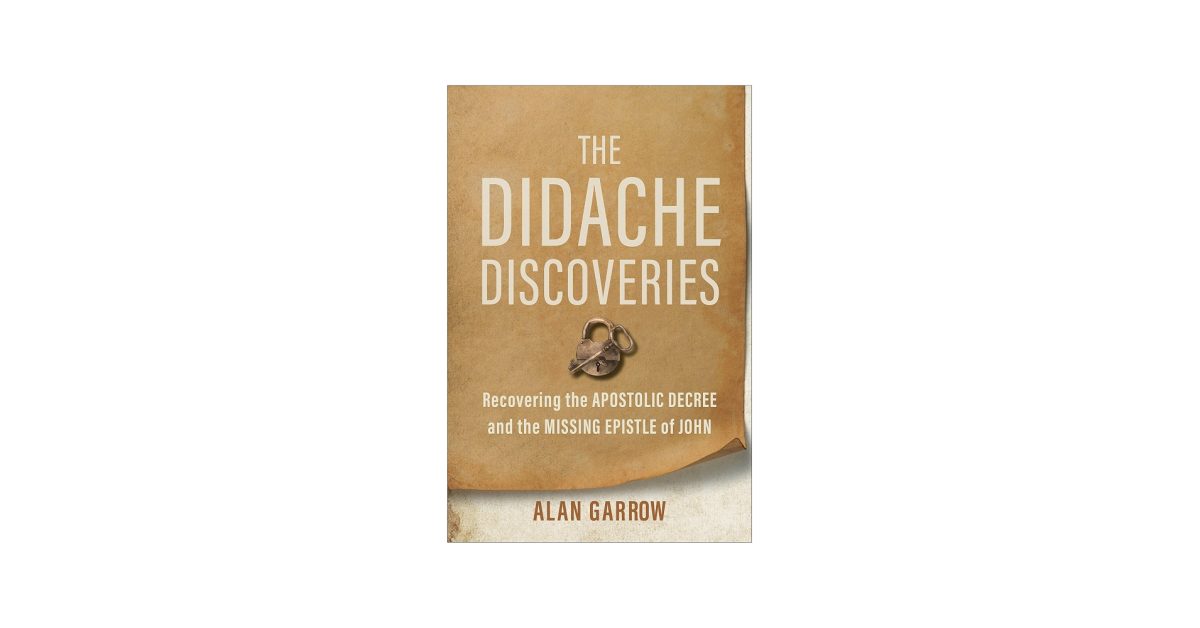
THE DIDACHE DISCOVERIES: Recovering the Apostolic Decree and the Missing Epistle of John. By Allan Garrow. Grand Rapids, MI: Baker Academic, 2026. Xii + 236 pages.
Christians, like followers of most religious traditions, are dependent on ancient texts that were deemed authoritative and worthy of passing on. Processes took place, among Christians, that over time produced a canonical set of texts known as the New Testament. Together with a set of texts commonly called the Old Testament, we have the Christian version of the Bible. Although the texts we call the New Testament have a certain authority no other texts have, there are other texts that have, at least in the past, served as authoritative texts. Among them is a brief text known as the Didache.

Robert D. Cornwall
This brief book fills in many gaps in our knowledge about how at least some early Christians organized themselves and understood their faith. The claim this text makes is that it is the teaching of the Twelve Apostles. While intriguing, the document presents numerous issues, since there is no consensus as to its date, origin, or its implications. Further complicating our sense of its value is the fact that although it was mentioned in early Christian and medieval texts, the document itself went missing until it was rediscovered in 1873 in a codex found in Constantinople in 1873. The person who discovered it was the Byzantine Archbishop Philotheos Bryennios. While the codex was discovered in 1873, it wasn’t until 1880 that Bryennios discovered the presence of a text known as “The Teaching of the Lord, by the Twelve Apostles, to the Gentiles.” That discovery produced great interest in a text that actually covers rather mundane matters. Even today, people find it intriguing and enlightening.
When it comes to the Didache, I have embraced the view that it dates to the Second Century. Thus, it would be a second- or more likely third-generation product. Nevertheless, the document makes intriguing points that help us better understand what was happening in the early years of the Christian movement. Nevertheless, we still do not know anything of its origins. What we don’t know is the origin story. Theories regarding its origins run from dates that would predate Paul’s letters to a much later time. The question is whether, even if the document as a whole dates to the Second Century, it might contain elements that date to the earliest days of the Christian community. Therefore, is it possible that something mentioned in Acts, such as the “Apostolic Decree” produced by the Jerusalem Council, be found there? What about the missing fourth letter of John? While I am not an expert in such matters, I am intrigued.
Stepping into the breach is Alan Garrow, whose recent book raises interesting possibilities. The book is titled The Didache Discovers: Recovering the Apostolic Decree and the Missing Epistle of John. Garrow holds a D.Phil. from Oxford University and serves as vicar of St. Peter’s Church, Harrogate, UK. He writes in his acknowledgements that the book has a lengthy history that includes his doctoral studies at the University of Oxford. The foundational point of Garrow’s book is that the “Apostolic Decree” spoken of by Luke in the Book of Acts is the “Original Didache.” If we embrace this theory, what we have in Acts is essentially a summary of a larger document produced by the Twelve, which Paul, James, and other NT authors utilized in their messages. This would make the “Original Didache” the foundation for the New Testament.
Then, if we add the missing fourth letter of John (the revised Didache), which is spoken of in 3 John 9 — “I have written something to the church, but Diotrephes, who likes to put himself first, does not welcome us” — to the “Apostolic Decree,” we have the foundation for the document we know as the Didache. Scholars, including Garrow, have concluded that the document Archbishop Bryennios discovered in the late 19th century is a composite work that reveals significant redaction, making it possible that it could date back to the early days of the church. What Garrow does here is explore the text of the Didache as we have it today, seeking to find the foundational layers of the document, which he believes lead us back to the “Apostolic Decree” and John’s missing letter.
Garrow’s divides The Didache Discoveries into five parts, with Part One titled “Two Rusty Keys.” The chapters in this section focus on removing what he calls rust that has accumulated on an ancient document. The two keys, which he seeks to restore, are the “Original Didache” and “The Revised Didache,” both of which he offers in an English translation (Chapter 3). In his view, as laid out in chapter 4, titled “Two Vacant Hooks: Two Found Keys,” the best explanation for the distinct elements of the Didache is the Apostolic Decree and John’s missing letter. This is because “the Original Didache bears resemblance to some aspects of the Apostolic Decree (and the Revised Didache resembles some aspects of the missing Epistle of John),” but he suggests that more work needs to be done to prove his point.
Part Two is titled “The Acts-Galatian Conundrum.” In two chapters, Garrow explores how Acts pictures the Apostolic Decree in contrast to the way Paul describes the decree in Galatians. The point of this discussion is that Luke and Paul seem to offer very different pictures of the Decree, at least that is the way it is commonly perceived. According to Garrow, Paul doesn’t mention the Decree at all in Galatians. Nevertheless, the Original Didache, when situated between the two, resolves the conundrum. Garrow suggests that if Paul carried the “Apostolic Decree” with him on the Second Missionary journey, we should see evidence of it in the Thessalonian letters.
This question leads us to Part Three, which is titled “The Thessalonians Test.” Here in three chapters, Garrow examines “The Ethical Tradition Behind 1 Thessalonians,” where he finds parallels to ethical materials in the Didache. Chapter 8 explores “The Eschatological Tradition Behind 1 Thessalonians,” again finding parallels to his “Original Didache.” Finally, in Chapter 9, he writes “‘Concerning Apostles and Prophets’ and 1 Thessalonians.” One of the issues that he seeks to address in Chapter 9 is what appears to be an apparent disjunction between the Didache‘s warning that true prophets and apostles would stay only two days, whereas Paul was known to stay much longer with the churches he visited.
He concludes that when we examine 1 Thessalonians in light of the Original Didache, the Didache drives the entire conversation, including the Thessalonian concern about the fate of those who had died. This suggests that Paul was dealing with the aftereffects of his sharing the Apostolic Decree with the congregation at the beginning of his ministry there. Then in Chapter 10, he focuses on 2 Thessalonians, which appears to be a repeat of the concerns of 1 Thessalonians; again, he addresses issues emerging from the Apostolic Decree. Chapter 11 offers an interlude focusing on “The Missing Epistle of John,” which centers on elements in the Didache’s message concerning hospitality. Thus, in his view, the Revised Didache has a Johannine feel, suggesting its origins as the missing letter.
Because Garrow believes the Didache, when it emerged in its final form, contains two earlier documents, he is concerned to show how these documents impacted other New Testament documents. Thus, Part 4, titled “The Full Circle of Impact,” takes note of perceived influences of these documents on “The Creative Fountainhead that Gave Birth to Revelation” (Chapter 12), “Illuminating Q” (Chapter 13), “The Law Reflected in James” (Chapter 14), and “The Corinthians’ Scripture” (Chapter 15). In looking at the relationship of the Apostolic Decree and the Missing Epistle of John, the question is whether his proposal that these two documents are contained in the Didache meets the evidential expectations of influencing these texts. We know that the canonical form of the New Testament contains documents that have been heavily edited. This is especially true of the Gospels. The question is whether elements found in the Didache have influenced the canonical books of the New Testament.
Part 5 of The Didache Discoveries is titled “Restoring the Originals — Revisited.” It contains annotated Greek versions of The Apostolic Decree/Original Didache and the Missing Epistle of John/Revised Didache. While he has attempted to provide scholars with reconstructed texts, he acknowledges the challenges he faces in making his case. He writes:
The goal is elusive not only because there is almost no manuscript tradition to affirm, or deny, an attempted reconstruction of the originals, but also because the principal manuscript out of which my reconstruction has been carved was copied a thousand years after those texts were created. On what basis and with what confidence, therefore, is it possible to affirm the contents of the Original Didache and Revised Didache as I have excavated and reconstructed them? (p. 189).
Although he acknowledges the challenge posed to his project, he is convinced that he has achieved his goal.
I will confess that I still have questions about the date and origins of the Didache, but I do find Garrow’s proposal intriguing and worth exploring further. Most intriguing is the possibility that if he is correct as to the origin of the “Original Didache,” then the Didache provides the scripture behind the scripture as found in the New Testament. Having shown the parallels and possible influences of the two pieces of the Didache, he concludes that if correct, his reconstructed Apostolic Decree may serve as the scripture behind the scripture of the New Testament. That is, here is “The Teaching of the Apostles.” Whether Garrow is correct is not something I can judge. What I can say is that it is an intriguing idea that is worth exploring further, making Garrow’s The Didache Discoveries a fascinating read.
This review originally appeared on BobCornwall.com.
Robert D. Cornwall is an ordained minister in the Christian Church (Disciples of Christ). Now retired from his ministry at Central Woodward Christian Church (Disciples of Christ) of Troy, Michigan, he serves as Minister-at-Large in Troy. He holds a Ph.D. in Historical Theology from Fuller Theological Seminary and is the author of numerous books, including “Eating With Jesus: Reflections on Divine Encounters at the Open Eucharistic Table” and “Second Thoughts About Hell: Understanding What We Believe” coauthored with Ronald J. Allen. His blog Ponderings on a Faith Journey can be found here.