I have a very vivid memory, from when I was about four or five years old, of watching an episode of Little House on the Prairie that still haunts me to this day. Albert (a character made up for the show) smokes a pipe in the basement of the Harriet Oleson School for the Blind and it ends up burning the whole place down, killing two people, including a baby.

Juliet Vedral
And though it’s also been several decades since I read one of Laura Ingalls Wilder’s Little House books, the scene where Pa’s toenail is ripped off is still the first thing I think about when someone mentions these books.
Ingalls Wilder’s work is so iconic that in Lost, another now-iconic piece of pop culture, former con-man Sawyer references the show as “Little House,” much to Kate’s amusement: “You call it Little House?”
So like probably every other Millennial/Gen Xer reviewing Netflix’s reboot of Little House on the Prairie, I came into this with some preconceived notions. And I wasn’t the only one. Warren Christie, the actor who plays John Edwards, shared, “I have two older sisters, who … were fans, but have since found out were super fans. … They were very excited.”
This is not your mother’s “Little House.” The Netflix reboot is a lot grittier than the show, but captures the edginess of Ingalls Wilder’s books. After all, these are memoirs of survival in post- Civil War America. In the books–assigned reading way back in the “1900s” when I was a kid — characters go blind, nearly starve, and endure a horde of locusts. In the new reboot, we’re immediately immersed (pun intended) in a terrifying scene of the Ingalls family trying to ford a river (which we all know is the alternative to caulking the wagon or hiring a guide).
Writer Rebecca Sonnenshine has somehow managed to evoke sympathy for both the plight of the Osage in the face of Europeans taking their land and the hopes of settlers like the Ingalls. The reboot takes pains to make clear that the Ingalls and the other settlers of Independence are trespassing on the Osage’s property, that the prairie was not actually “free land.” At the same time, we see the beautiful life that the Ingalls create for themselves and it’s hard not to root for them, even when they are forced to leave.
Sonnenshine also places Little House on the Prairie in time. We are reminded in nearly every episode that the Civil War has just ended. Two characters, including Edwards, are plagued by PTSD from the war. Other characters look down on Charles Ingalls for not fighting in it. Where the first TV series presented a somewhat sanitized experience of the frontier, the reboot feels truer to the books. It asks viewers to reconsider Ingalls Wilder’s narrative in the face of the true history and facts.
Referring to the frontier, Christie pointed out that “you couldn’t make it on your own. So the idea of community and hope … the strength of the human spirit, these universal themes … ripple throughout [the show].”
Community — what it is and the need for it — is a central theme of the reboot, exploding the myth of the American pioneer. After that first scene of the Ingalls family attempting to cross the river, they are helped by Dr. George Tann, who chastises Charles for endangering his family on the prairie by traveling without a larger community.
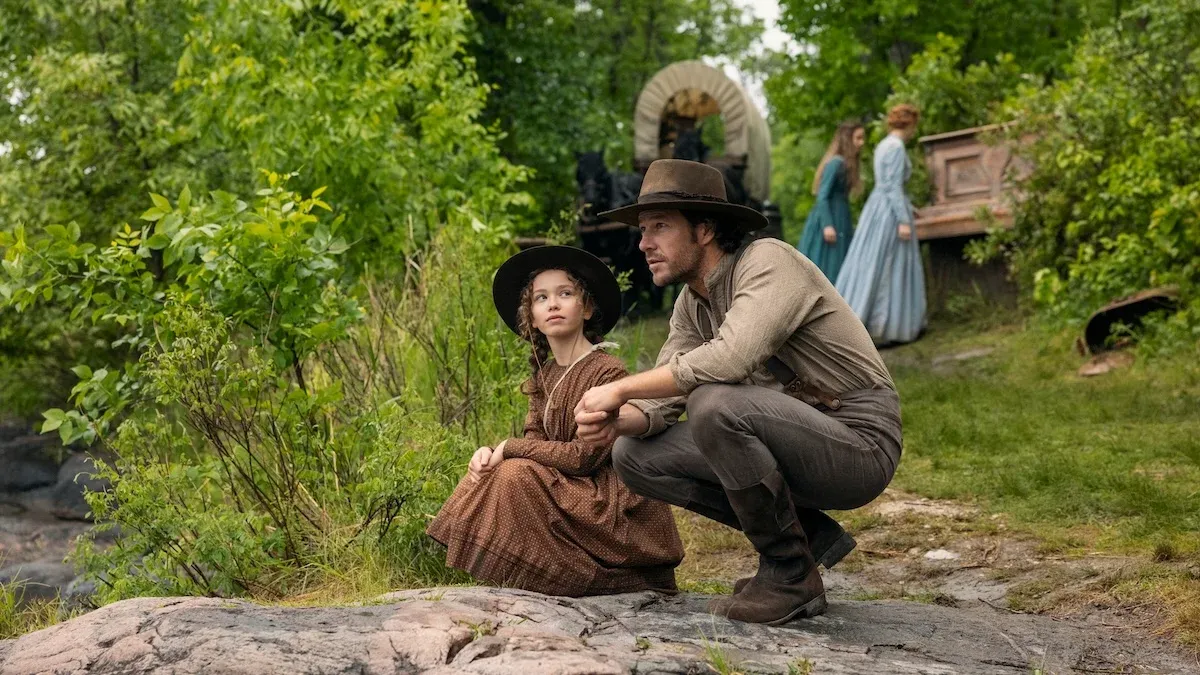
Alice Halsey and Luke Bracey in “Little House on the Prairie.” (Eric Zachanowich/Netflix)
In nearly every episode, we see the strength of the human spirit, as Christie put it, while also recognizing what gives the human spirit strength: grace. The Ingalls family arrives at Independence, Kansas, a speculative settlement, and finds that there is danger all around: wolves, other humans, and their own inadequacy in the face of an enormous wilderness. Despite Charles’ foolishness in trying to “settle” the land (more on that below) by himself, he is shown grace in the form of John Edwards and Mitchell, their Osage neighbor, who help him build his home and set up a life on the prairie. Mitchell’s family befriend the Ingalls, even though Laura and her family are stealing their land and resources.
Edwards, a Civil War veteran with PTSD, mourning the loss of his wife and children, also finds grace and redemption through the Ingalls family. According to Christie, “When we first meet Mr. Edwards, he’s obviously not in the greatest of places. He’s dealing with loss … he’s a drinker … I would go as far as to say you have a man very close to the end of his rope, and really struggling, and then … he meets his family. And suddenly there’s this sparkle, this glimmer of hope.”
By the end of the show, the nuclear Ingalls family is surrounded by the friends and neighbors they’ve met along the way. I was reminded of Romans 12:4-5, “For just as each of us has one body with many members, and these members do not all have the same function, so in Christ we, though many, form one body, and each member belongs to all the others.” While that scripture is specifically referring to the church, the reboot will surely provide preachers with an excellent sermon illustration.
Just as the show depicts the magic that can happen when people come together, Christie and his castmates are hopeful that the reboot itself will create community: “I have a hope that it’s going to bring people kind of around the TV together,” Christie said, “I hope that people are gonna have multi-generational viewings together, because it’s harder and harder to find shows like that.”
Though it’s definitely not your mother’s (or Sawyer’s) “Little House,” I think the show will achieve its goal.
Little House on the Prairie premieres on Netflix July 9.