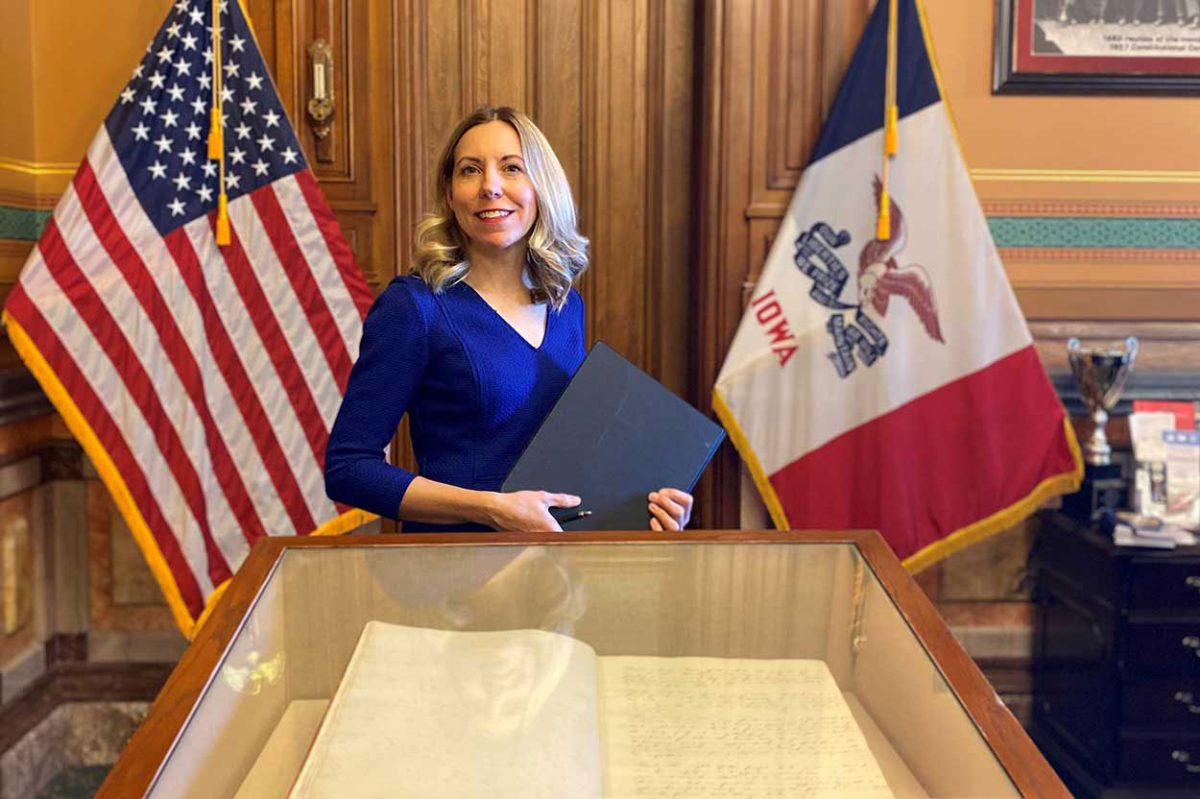
(RNS) — The Rev. Sarah Trone Garriott, a Lutheran minister and Democratic state senator in Iowa, has beaten Republican candidates in three state senate races going back to 2020. Next fall, she hopes to unseat GOP Congressman Zach Nunn in national midterm elections, too.
Sarah Trone Garriott. Photo courtesy Sarah for Iowa
Garriott said she is motivated by the needs she sees in her district, but also a desire to reclaim what it means to be a follower of Jesus in politics.
“Faith has something to say to politics. And what we are seeing labeled as the faith perspective is not faithful to me,” Garriott said. “It does not reflect the teachings in the Scriptures that I read. It does not reflect my values. This is a really important moment for people of faith to be engaged in the public realm.”
When she first ran for state office, Garriott was something of a rarity as a white clergy person seeking office as a Democrat. She will be more rare if she wins next November: Since the 1970s, only three white clergy have been elected as Democrats, two of them Catholic priests: The Revs. Robert Drinan, who represented Massachusetts from 1971-81, and Robert John Cornell (Wisconsin, 1975-79). Bob Edgar, a United Methodist minister, represented Pennsylvania from 1975 to 1987. Since then, all white ordained members of Congress have been Republicans.
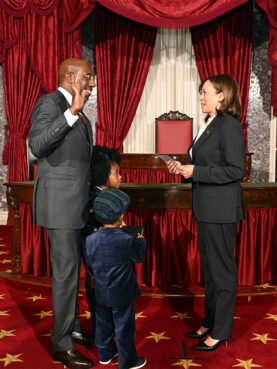
Vice President Kamala Harris, right, administers Senator Reverend Raphael Warnock’s oath of office on Jan. 3, 2023, in Washington. Photo courtesy of Warnock Senate office
Of the five ordained members of Congress now in office, two are Democrats, and both are Black: Georgia Senator Raphael Warnock, lead pastor of Ebenezer Baptist Church in Atlanta, where the Rev. Martin Luther King Jr. was pastor, and Emanuel Cleaver, a United Methodist minister, a congressman representing Missouri.
But this year at least six white clergy and one seminarian — some from evangelical Christian backgrounds and others from mainline Protestant denominations — have declared to run as Democrats in 2026. Another 20 ministers — many of whom are white Democrats — are seriously considering running for various state or local seats, said Doug Pagitt, executive director of Vote Common Good, a nonprofit that seeks to engage religious voters.
The jump reflects a sense of alarm among progressive pastors, who aim to counter President Trump’s agenda and the spread of Christian nationalism, Pagitt and several of the pastors said.
“The biggest threat to both faith and democracy is the rise of Christian nationalism,” said Justin Douglas, a minister running for a House seat in southern Pennsylvania, where he now serves as a county commissioner. “We’re seeing the ways Christian nationalism is corrupting the church and public life, and the way our faith is being misused in legislation. That’s something we feel an obligation to push back against — to not legislate our faith, and show a faith guided by love and justice.”
Robb Ryerse, who leads a progressive evangelical church in Arkansas, said he feels he has a moral obligation to run for office — and convince voters that being a Christian and a Democrat “isn’t an oxymoron.”
“I’m convinced that the most effective thing to stop Donald Trump’s agenda is to flip Congress. Congress has absolutely given up its role as a check and balance on the administration,” said Ryerse, who grew up fundamentalist Baptist and a Republican, and ran as a progressive GOP candidate in 2018.
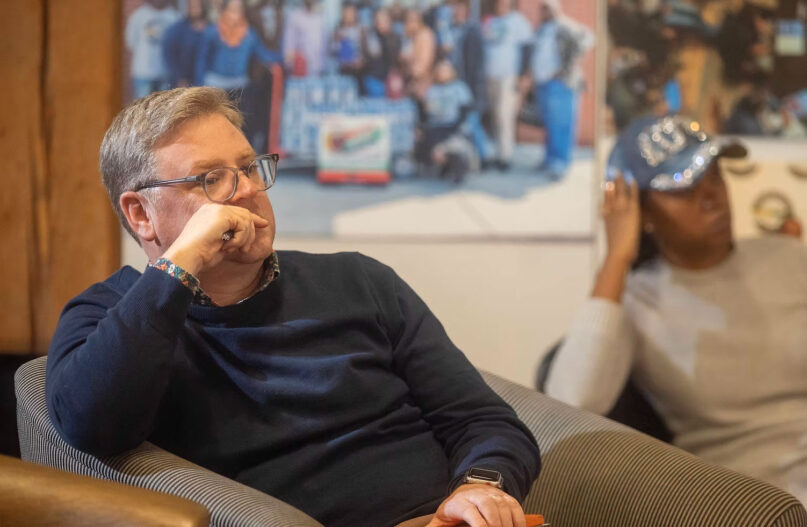
Robb Ryerse is running for office because of what he describes as a “moral obligation.” Photo courtesy Robb for Congress
“Pastors across the country have seen the rise of Christian nationalism on the religious right and have said, ‘Whoa, this is not OK.’ I understand what this is theologically, politically, and philosophically, and I’ve got to do everything I can to stop it,” he said.
Some in the Democratic Party, however, are often skeptical of candidates who are open about their faith. “The Democratic Party overall, as we’ve learned from experience, has not been overly welcoming and accommodating to religious candidates,” Pagitt said. Some candidates have told him they are reluctant to talk about their faith publicly because that’s not seen as a positive within the party. (The Democratic National Committee did not respond to requests for comment.)
Many Democrats’ suspicion of faith-based politics, Pagitt said, is due to concerns about the separation of church and state, or the belief among some that the party should exist for a “post-religious world.” There’s also concern about upsetting voters who have experienced religious trauma in their past.
Democratic voters have also been alienated from religion by evangelicals’ strong identification with the Republican Party, forged in a common opposition to abortion, as well as by their own disaffiliation with religious institutions — most prevalent among political liberals, according to Pew.
Equally damaging, said Pagitt, is Democrats’ condescension toward white evangelical voters. “One of them said, ‘If they’re so needy and dumb that they need us to explain why they should vote for Democrats, we don’t want them.’”
Douglas, the Pennsylvania candidate, says he understands that skepticism. “The loudest voices in politics have often misused faith for power.” He says he firmly believes in the separation of church and state and shares about his faith “only to give people context for who I am, and where my values come from. But I don’t expect anyone to share my beliefs, and I will never legislate my theology. My job is to serve everyone and invite everyone to the table.”
To skeptics, Douglas argues that his evangelical background — attending Liberty University, founded by Jerry Falwell, and in church ministry for 20 years — gives him a unique ability to push back against the dangers of Christian nationalism and “using religion as a political weapon.”
James Talarico, a part-time seminarian and Presbyterian running for U.S. Senate in Texas, is gaining attention for talking about his faith and using the Bible to call out Republicans for failing to care for the poor and immigrants and catering to corporate power. In one video blurb, he asks: “Instead of posting the Ten Commandments in every classroom, why don’t they post, ‘Money is the root of all evil’ in every boardroom? Why don’t they post ‘Turn the other cheek’ in the halls of the Pentagon?”
Matt Schultz, a Presbyterian Church USA pastor running for Alaska’s sole House seat, said he has experienced some “friendly” questions from Democratic officials, but no pushback. “There’s been a bit of skepticism, and I think that’s OK. We’ve seen not only in U.S. history but throughout world history that we need to be careful about mixing politics and religion.”
If they convince skeptical Democrats, this year’s crop of clergy have to overcome self-identified religious voters’ tendency to view Democrats as hostile toward religion. In 1976, nearly 60% of white evangelicals voted for Democrat Jimmy Carter, whom many thought of as one of their own. By 2016, only 16% voted for Hillary Clinton, about the same percentage who supported Kamala Harris in 2024.
Only 25% of religious voters view the Democratic Party as friendly toward Christians, while 70% considered the Republican Party as friendly, according to a May poll by Change Research of 1,761 voters who identified as Protestant, Catholic or other Christian. It also showed 61% believed that elected Democrats are more concerned with “woke” causes than solving real problems.
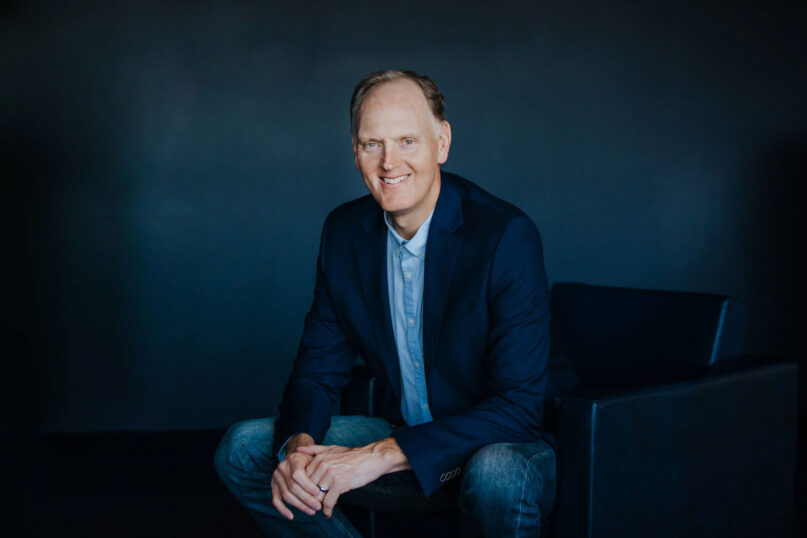
Doug Pagitt, executive director of Vote Common Good. Photo courtesy dougpagitt.com
Pagitt is hopeful, however, that this year’s batch of progressive religious candidates will change minds within the Democratic Party and among voters.
Schultz, a first-time candidate who says he’ll quit his job as pastor if he wins, has made affordability key to his campaign in Alaska, particularly healthcare costs, and vowed to use public policy as a strategic way to “show love” to as many people as possible. “So rather than provide one hungry family with a meal, we can make some policy changes to provide a thousand hungry people with a thousand meals.”
These issues are part of the effort to redefine what faithful politics means. Schultz said his identity as a Democrat is prompting some people to give him a second look — and prompt “an enormous sigh of relief” from believers who are repelled by Trump and MAGA. “They’re starting to see that faith can embrace people across the political spectrum and that’s OK. It’s giving people an opportunity to be more holistic in their political and religious points of view,” he said. “And that reaches across the aisle. Suddenly, we’re reaching out to Democrats and Republicans and independents.”
Ryerse, the Arkansas candidate, has even made traditional Republican faith language a feature of his campaign: “For a Future of Faith, Family & Freedom” says his website. “I don’t think Republicans ought to be able to own those things,” said the candidate, who has sought to reframe them in more progressive terms. “When I talk about faith, I’m not talking about religious faith; I’m talking about our belief in each other,” he says. “Our country is so divided now. We have this complete lack of trust between people. It seems like we’ve lost our ability to band together and do great things.”
By “family,” he said, there’s a need to protect families that “come in all sorts of different shapes and sizes. The so-called party of family values hasn’t valued families very well.” Defending freedom, he said, includes fighting off threats to women’s reproductive rights.
But Ryerse says he’s not “trying to take America back for a liberal Jesus. I’m not running for office because I want to have my progressive evangelical faith to be the law of the land,” he said, adding, “I see in Jesus an example of someone who cared for the marginalized, fed people and stood up to the rich and powerful, but the Bible is not the basis for law in America.”
Garriott, the Iowa state senator, stepped down as pastor of a Lutheran church in 2017 but still preaches frequently. “I’m kind of a free range pastor,” she jokes. She also works for a local interfaith food pantry network called the Des Moines Religious Council where she mingles with leaders and workers of many faiths.
She thinks the time has come to take her political career to the next level. “I need to run in ’26 because I have more to offer to this moment,” Garriott said she told her husband. Having won her senate seat in 2024 in a district that went heavily for Trump, she added, “I know how to win. I know what it takes to flip a seat. I’ve worked hard to build a grassroots network and support that I need to win those other races. I have all these resources that I can bring to this moment that I think are going to be really important to win.”
She’s optimistic about her fellow Democrats’ chances in the 2026 midterms, too. “I am very hopeful and I am seeing really good signs. I see people turning out of special elections. I see people volunteering. I see people running for office and stepping up. All these new folks who have never considered it before, they’re finding a way to get involved,” she said. “And that’s really encouraging because the greatest opponent we have is despair.”