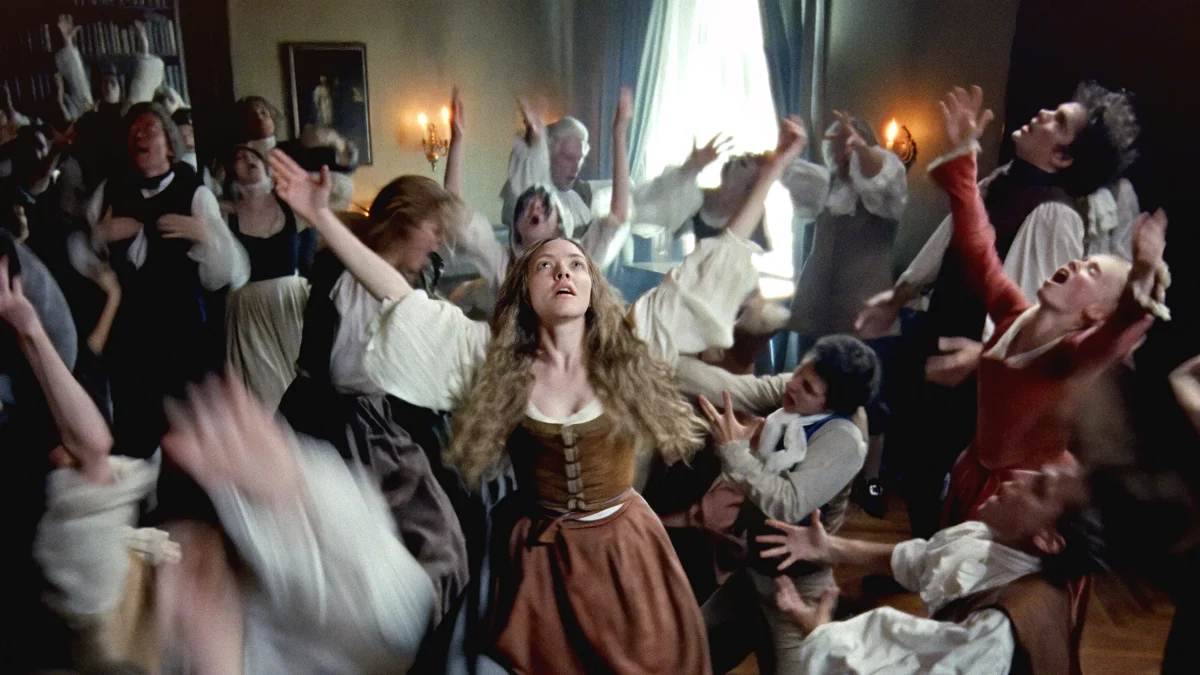
“The Testament of Ann Lee” is a bewitching new musical film that showcases the power of ecstatic prayer captured through jarring choreography. Amanda Seyfried — who previously starred in two of my all-time favorite religious films, “Les Misérables” and “First Reformed” — delivers one of the arresting performances of the year as the founder of the Shakers.

Guthrie Graves-Fitzsimmons
I’m not a film critic, but any casual moviegoer will recognize the technical achievement and spare intensity of the film directed by Mona Fastvold (she also co-wrote it with her partner Brady Corbet). What I can say with confidence is that the film is a powerful meditation on religious liberty — one with lessons for today.
The film begins with Lee’s life in Manchester, England, where she joins a religious group that would come to be known as the Shaking Quakers because of the grunts and cries of their rapturous worship. She faces persecution for her religious practices, leading her small band of followers to cross the Atlantic in 1774 in search of a place where they could worship freely.
The Shakers were one of many religious groups that sought religious freedom on our shores. They built communities that were radically countercultural: rejecting private property, practicing celibacy, and believing that God could be fully present in a woman’s body.
Yet the Shakers’ quest for religious liberty collides with the political demands of the emerging American state. As revolutionary fervor spread, Lee and her followers were pressured to take a loyalty oath to support the cause against England. She does not comply and will not bless the war. This is where “The Testament of Ann Lee” becomes more than a period drama. It becomes a mirror held up to the deepest contradictions in American religious freedom.
From the beginning, the United States has prided itself on being a haven for persecuted believers. But it has also, again and again, demanded that those believers demonstrate their loyalty in ways that blur the line between conscience and citizenship. The Shakers’ pacifism and neutrality placed them under suspicion, just as Quakers, Mennonites, and other dissenting communities would later find their commitments tested by wars and nationalist fervor.
Watching the film in the shadow of the approaching 250th anniversary of the Declaration of Independence, it is impossible not to feel the relevance of this history. Ann Lee’s refusal to endorse the Revolutionary War is not portrayed as cowardice. It is shown as fidelity to a theological vision that refuses to bend to the imperatives of state power. In an era when public religiosity is so often conflated with public patriotism, the film reminds us that the First Amendment was not designed to protect only those religious expressions that conveniently align with nationalist projects.
Amanda Seyfried, center, and ensemble in “The Testament of Ann Lee.” (Searchlight Pictures)
The Testament of Ann Lee does not offer easy answers for how faith and citizenship should be balanced. It does something more valuable. It reopens a conversation that is as old as the republic itself. Freedom of conscience in America cannot be about making religious leaders palatable to the state. It has to be about protecting the right of people to live out convictions that are strange, disruptive, and sometimes deeply uncomfortable to the surrounding culture.
The lessons in the film are directly applicable to today’s religious and political context. The Trump administration claims to cherish religious freedom while attacking any religious leaders who don’t bend the knee. And yet many religious communities are courageously standing up to the regime as an expression of their religious freedom.
As America prepares to celebrate 250 years, this film feels like a necessary interruption to the triumphal narrative. It invites us to remember that the promise of religious liberty was forged not only by revolutionaries with muskets, but also by mystics who refused to pick up arms. Ann Lee’s legacy is not merely that she founded a religious movement. It is that she embodied a form of freedom that refuses to be conscripted. In a time when faith is once again being asked to prove its patriotism, that is a testament worth hearing.
Guthrie Graves-Fitzsimmons is vice president of programs and strategy at Interfaith Alliance and the author of “Just Faith: Reclaiming Progressive Christianity.”