NOTE: This piece was originally published at our Substack newsletter A Public Witness.
“My relationship with the Lord is my foundation in all things. As a result, the values I hold according to biblical principles impact my decisions: we are called to love, but we’re also instructed to stand for truth. I’m hopeful my leadership reflects that.”
That’s what Kristi Noem told South Dakota Public Radio in 2018 as she ran for governor. She added in her interview that she was active in the Foursquare Family Worship Center in her hometown of Watertown, her grandparents helped start the church, and she and her husband “were children’s pastors there and we still teach kids church on Sunday mornings.”
The Foursquare Church is a Pentecostal denomination that grew out of the movement started in 1923 by controversial, media-savvy evangelist Aimee Semple McPherson. According to the U.S. Religion Census in 2020, the denomination today has more than 1,600 congregations with more than 360,000 members. Even if most people don’t know Noem’s decades-long membership, she’s perhaps the most high-profile member today.
It’s not clear if she’s been actually attending a congregation in the D.C. area since joining the Trump administration, but her South Dakota church’s Facebook page mentioned her husband as recently as July (and has frequently posted about her in the past). And Noem has long highlighted her connection to her local Foursquare congregation without suggesting she’s moved to a different church. She’s also been leading DHS to depict the militarized violence of ICE as godly.
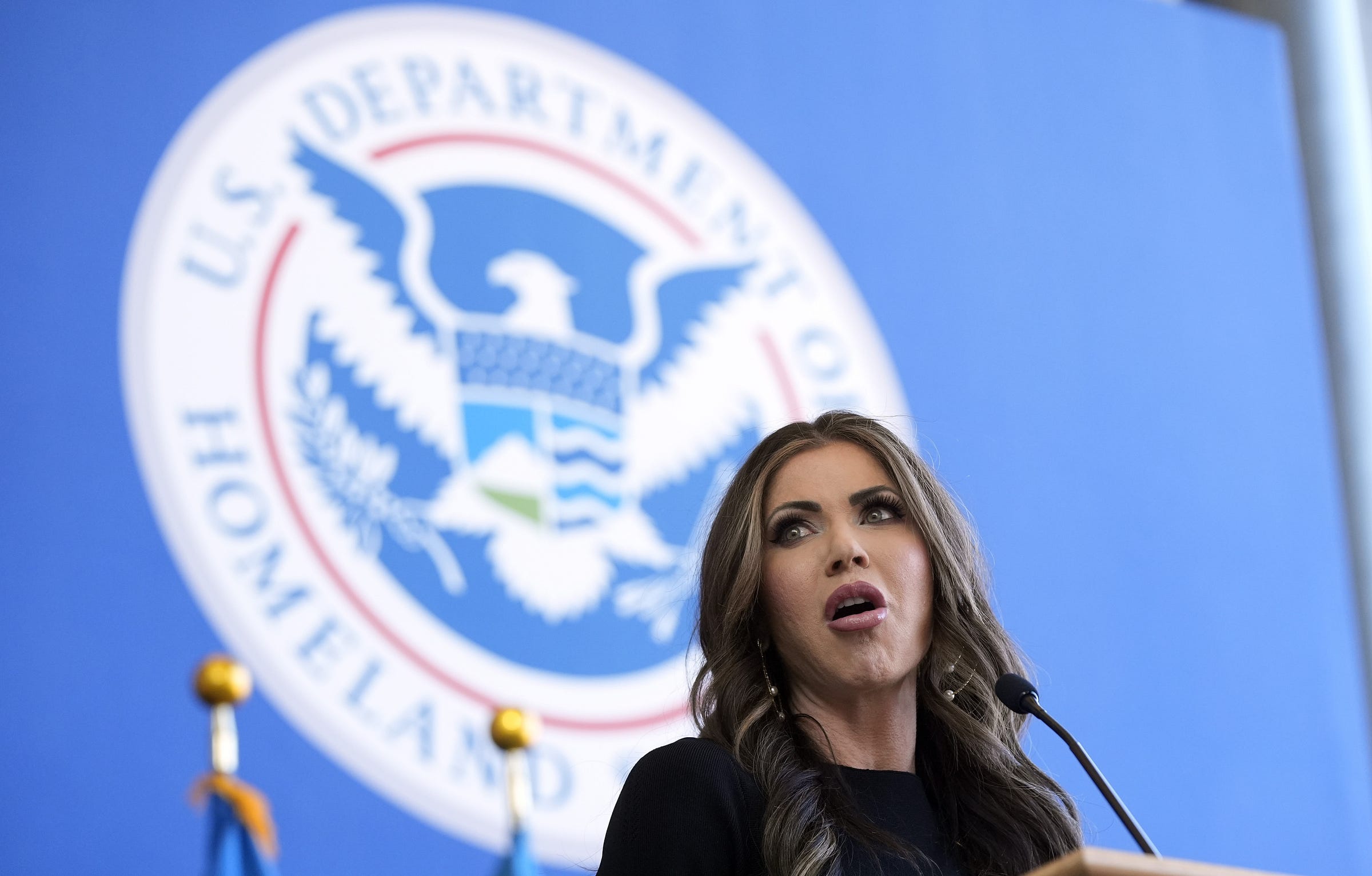
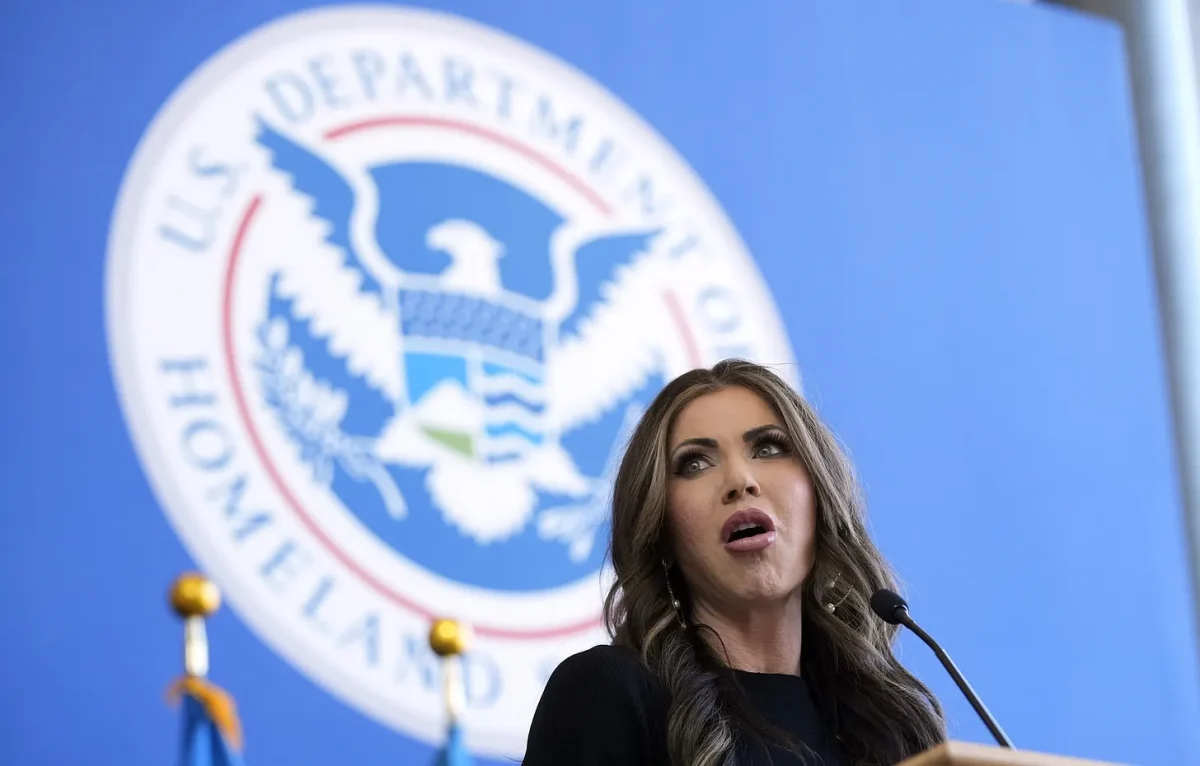
Homeland Security Secretary Kristi Noem speaks to employees at the Department of Homeland Security on Jan. 28, 2025, in Washington, D.C. (Manuel Balce Ceneta/Associated Press)
All of this raises some important questions. What do Foursquare Church leaders think of how the Department of Homeland Security, under Noem’s leadership, is terrorizing immigrants, children, and others in cities across the country? What do Foursquare Church leaders think of federal agents, under Noem’s chain of command, executing Renee Good and Alex Pretti in the streets of Minneapolis? What do Foursquare Church leaders think of Noem’s lies about Good, Pretti, and how the two were killed?
The short answer is we don’t know. Unlike many other denominations, the Foursquare Church hasn’t issued a statement in response to the federal violence in Minneapolis or the immigration actions across the country in recent months. Neither denominational leaders nor pastors at Noem’s home church responded to my requests for comment.
Beyond the fact that the denomination is remaining silent about a significant moral issue — whether it was being overseen by one of its members or not — there could also be a more personal theological concern. Historically, leaders and pastors in the Foursquare Church have warned about the danger of members falling away from the faith. McPherson listed as one of her creedal statements that they believe “in the free moral will power of man, who can apostatize, backslide, and be lost.” Is there a concern among Foursquare Church leaders about Noem’s soul? In addition to leading ICE and lying about the executions of Good and Pretti, Noem’s also been accused of having an affair with controversial Trump political operative Corey Lewandowski (who is now working for Noem at DHS and often travels with her).
Despite the various scandals and growing criticism of Noem across the political spectrum (with even some Republicans now saying she should be removed from office), Foursquare leaders remain silent. But other denominations have in the past shown a willingness to speak out against the immoral policies of politicians who sit in their pews.
‘A Particular Duty’
As President George W. Bush marched the nation toward invading Iraq, he found support from some Christian denominations like the Southern Baptists. But many Catholic and mainline Protestant leaders spoke out against the war plans and the false claims peddled by the administration. Most significantly, leaders in Bush’s own United Methodist Church condemned the idea of a preemptive attack. But they did so in ways to balance the prophetic call against an immoral war (on which history has proven them to be correct) with a pastoral awareness for one of their own (and two if you count Dick Cheney). As Jim Winkler, then-general secretary of the UMC’s Board of Church and Society, admitted at the time, they were “keenly aware” that Bush and Cheney were part of the denomination and so he was “frequently encouraged by others to be very careful about how I say things.”
While Winkler and other UMC leaders were mindful of that relationship, they still made their opposition clear. Winkler blasted the war plans as being developed “with unprecedented disregard for democratic ideals and with an astonishing lack of evidence justifying such a pre-emptive attack,” adding that it could not be considered a “just war.” And while it would’ve been important for UMC leaders to speak out against the war plans regardless of the faith of the president, it was even more important for them to do so since Bush, as a member of their denomination, regularly invoked his faith (including to justify the war).
“United Methodists have a particular duty to speak out against an unprovoked attack,” Winkler said. “President Bush and Vice President Cheney are members of our denomination. Our silence now could be interpreted as tacit approval of war.”

A protester paints a peace dove on cloth in front of the U.S. airbase in Frankfurt, Germany, on March 15, 2003. (Frank May/Associated Press)
A few years before the UMC’s condemnation of the Iraq invasion, the Southern Baptist Convention also wrestled with a president who was a member of one of its churches.
Although the SBC leadership in the late 1990s was (like today) overwhelmingly Republican and highly connected to the Republican-backing Religious Right, there was an odd moment in the late 1990s when Southern Baptists ruled the United States because of politicians in both parties. Bill Clinton was president. Al Gore was vice president. Newt Gingrich (prior to his conversion to Catholicism) was speaker of the House. Dick Gephardt was the House minority leader. Trent Lott was the Senate majority leader. And Strom Thurmond was president pro tempore of the Senate. That means not only the president but the next three people in line to succeed him were all Southern Baptists, in addition to some other key leaders in Congress. And this list of six Southern Baptists in high offices included three Republicans and three Democrats.
It was the Democrats, particularly Clinton, who vexed the rightwing SBC leaders. After his affair with Monica Lewinsky, SBC leaders offered strong condemnations and called on him to resign. Messengers to the SBC annual meeting in 1998 passed a resolution “on moral character of public officials” to condemn the behavior by Clinton and any other public official who acts that way.
SBC messengers voted down, however, a resolution that would have urged Clinton’s local church in Arkansas to discipline him. A similar effort in the UMC a few years later also failed to gain support. A few UMC ministers called for Bush and Cheney to be disciplined and have their church membership revoked (although the public statement admitted no one could determine if Cheney actually attended or had membership somewhere).
While the SBC’s resolution on moral character matched long-espoused values of the body, it now appears more partisan given their embrace of another man who also hung out with Jeffrey Epstein. Their earlier anti-Clinton rhetoric was why Albert Mohler of Southern Baptist Theological Seminary insisted during the 2016 campaign that he was a “Never Trump” conservative, posting on social media: “Never. Ever. Period.” He even added, “If I were to support, much less endorse, Donald Trump for president, I would actually have to go back and apologize to former President Bill Clinton.” However, Mohler flip-flopped during the 2020 presidential campaign and endorsed Trump (and did so again in 2024) — but did not apologize to Clinton. (Presumably, when Mohler preaches on the eternal security of the believer, his conception of forever lasts much longer than his lived definition of “Never. Ever. Period.”) Despite the more recent hypocrisy, the SBC’s 1998 resolution actually makes some good points about why moral character is important — as Trump proves by failing the test.
More recently, Mohler has defended federal agents after the executions of Good and Pretti, and he’s defended a Southern Baptist pastor in St. Paul who is also an ICE leader. The church where the ICE pastor serves was recently targeted by a protest that disrupted Sunday worship. While a leading organizer — who was later arrested — identified herself as an ordained minister and offered some theological remarks, the protest was not an attempt by Southern Baptists to address one of their own.
During the civil rights movement, one strategy employed was “kneel-ins” as individuals sought to integrate worship services of segregated churches. These interracial groups were often blocked at the door and even arrested for allegedly disrupting worship (even though it was actually the White deacons preventing people from being able to worship). On numerous occasions, clergy or seminary students within the same tradition of a segregated church would help lead the effort. Several White Methodist ministers did this in Jackson, Mississippi, as they joined Black students in trying, usually unsuccessfully, to enter a segregated Methodist church for worship. And Amos Brown, a Black Baptist student, was the first Black person to successfully get into First Baptist Church in Atlanta, Georgia, and thus integrate the service. More recently, he’s been the pastor at Kamala Harris’s longtime congregation.
Help sustain the journalism ministry of Word&Way by subscribing to A Public Witness!
The Catholic Question
Like United Methodists and Southern Baptists, the Catholic Church has also wrestled with how to respond to politicians within its tradition. For anti-abortion Catholic bishops and priests, this has sometimes meant announcing they would deny communion to pro-choice elected officials.
This type of response particularly gained attention as John Kerry, a Catholic Democrat, sought the presidency in 2004. Although a couple of Catholic leaders said they would not give him communion, others refused to take that position — and Kerry didn’t attend a Mass where he was denied. Since then, other pro-choice politicians have also been banned from receiving the Eucharist in at least one diocese, including Democratic Sen. Dick Durbin of Illinois, Republican presidential hopeful (and future Four Seasons Total Landscaping speaker) Rudy Giuliani, Democratic Kansas Gov. Kathleen Sebelius, President Joe Biden, and Democratic Speaker of the House Nancy Pelosi. As Biden ran for president, he was denied communion by a priest in South Carolina, though other Catholic clergy — including D.C. Archbishop Wilton Gregory later gave him communion. A Democratic state senator in New Mexico was similarly denied communion in 2021 because of his pro-choice legislation.
While some U.S. bishops and priests have pushed this approach, popes have not. In fact, Kerry, Giuliani, and Pelosi all received the sacrament during papal Masses led by Pope Benedict XVI. I’m not a Catholic, so I’ll let them decide if the best response is to deny communion or just speak out on moral issues. But the fact that these denials have occurred over one issue and not others makes it seem like a political weaponization of communion. As Pelosi said after her hometown archbishop barred her, “I wonder about the death penalty, which I am opposed to. So is the Church. But they take no action against people who may not share their view.”
This is a relevant question now because some of the most prominent administration officials joining Noem in leading the anti-immigrant actions and in lying about the executions of Good and Pretti are Catholic. Vice President J.D. Vance, who converted to Catholicism in 2019, has not only defended federal agents in Minneapolis but also has a history of lying about immigrants.
Gregory Bovino grew up Catholic in North Carolina. He has been serving as “commander at large” for the Border Patrol, a role he’s used to personally show up to push DHS actions in Chicago, Minneapolis, and elsewhere in recent months. After his shameful lies about Pretti’s murder, Bovino has reportedly been ousted from his “at large” role and is expected to retire soon after this demotion. Bovino previously admitted in court that he lied about an earlier incident of force in Chicago. Yet, last month, Bovino released a video promoting himself and his militarized boarder patrol agents with someone reading Isaiah 6:8 when the prophet Isaiah responded to the call of God by saying, “Here am I, send me.” That video followed a pattern of DHS co-opting Bible verses.
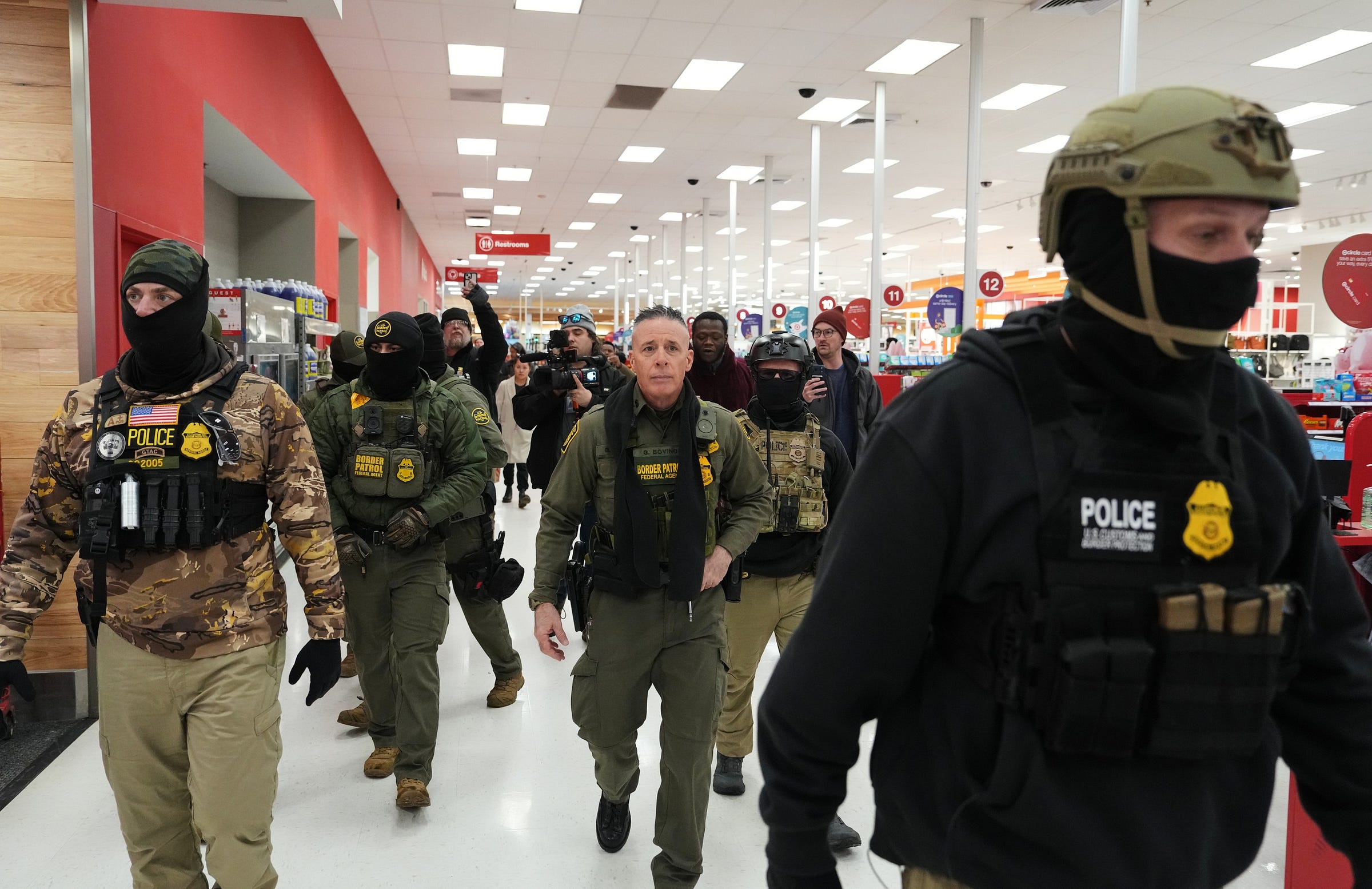
Gregory Bovino (center) walks with a group of armed border patrol agents in a St. Paul, Minnesota, Target store on Jan. 11, 2026. (Adam Gray/Associated Press)
While Bovino has been sidelined, Trump sent his so-called “border czar” to Minneapolis to be the new face of the DHS efforts. Tom Homan, who allegedly accepted a paper bag with $50,000 in cash as a bribe in 2024, is also a Catholic. In November, he invoked his faith to criticize U.S. Catholic bishops after they opposed the administration’s immigration policies: “Catholic Church is wrong. I’m sorry. I’m a lifelong Catholic. I’m saying it as not only a border czar. I’ll say it as a Catholic. I think they need to spend time fixing the Catholic Church in my opinion.”
Given the positions and rhetoric of Vance, Bovino, and Homan and their public claims of faith, challenging them directly is important for Catholic Church leaders. Historian Anthea Butler, who is Catholic, even suggested a more direct response as Homan headed to Minneapolis: “No priest should offer Homan communion. He’s Catholic. If you want to fight with me on this fine but I said what I said.” Whether that approach is taken or not, Catholic leaders cannot remain silent as Homan attempts to frame the Catholic public witness as pro-ICE. And we are seeing those statements — though not ones specifically criticizing Homan for invoking the Church to back his policies. Not only have the pope and Catholic bishops voiced support for immigrants, but a top Vatican official said the Minneapolis shootings by U.S. agents were “unacceptable.” Additionally, Cardinal Joseph Tobin called ICE “lawless” and urged Catholics to say “no” to such authoritarianism.
“One way that we say ‘no’ is that we mourn, we do not celebrate death, and, what is probably worse, we do not pretend it doesn’t happen. We say names. We pray for the dead,” Tobin added. “We mourn for a world, a country that allows 5-year-olds to be legally kidnapped and protesters to be slaughtered.”
Such statements not only condemn the Catholic and other administration officials leading the militarized force that’s terrorizing our neighbors, but they also show the moral failure of the Foursquare Church. Sometimes silence is golden. But in a moment like this, silence is self-condemning.
As a public witness,
Brian Kaylor
A Public Witness is a reader-supported publication of Word&Way. To receive new posts and support our journalism ministry, subscribe today.