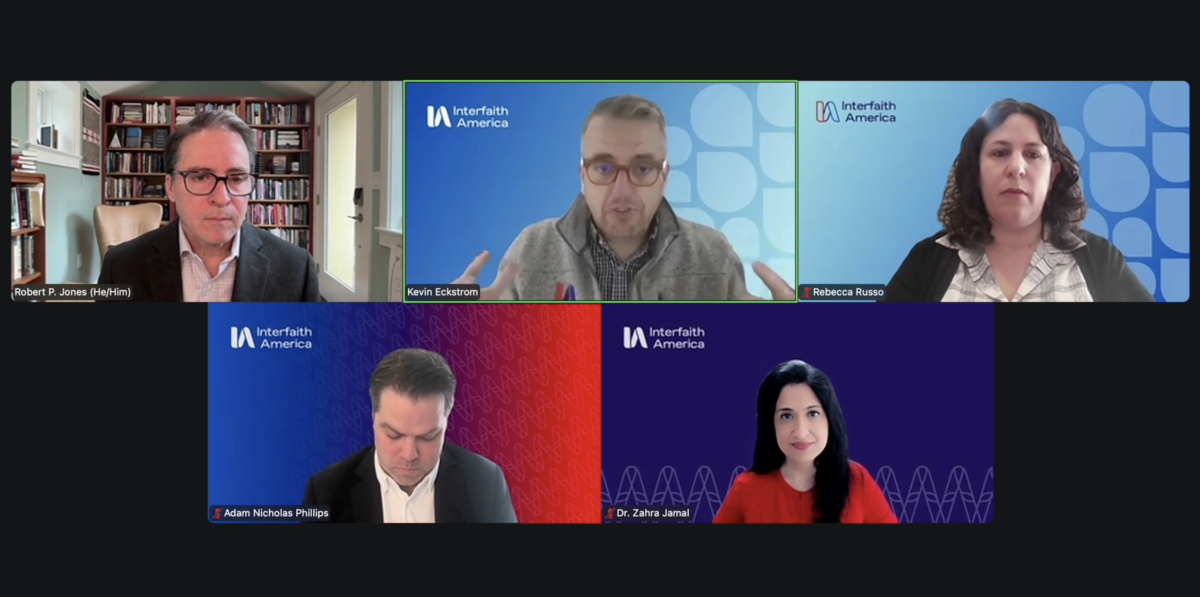
On Wednesday (Feb. 18), the nonprofit Interfaith America hosted a virtual media briefing, America at 250: Religion, Democracy, and the Promise of Pluralism, centered on solutions to the pressing issues of social isolation, political polarization, and bridging divides in the workplace and on college campuses. This served as an opportunity for leading experts to examine competing narratives about what it means to embody America’s founding principles in preparation for President Donald Trump’s State of the Union address next week, as well as the semiquincentennial celebrations and high-stakes elections later this year.
“Pluralism was actually baked into this country from the very beginning, and that diversity and the ability to bridge differences are really what make our democracy stronger and more resilient,” said host Kevin Eckstrom, chief strategic communications officer for Interfaith America.
“Pluralism, as we define it, is how we live, how we work, how we study, alongside other Americans and other folks from other places, and those folks might think or pray or worship or vote differently from us,” Eckstrom added. But this does not mean we have to set aside our closely held beliefs or ignore our very real differences in order to successfully live alongside our neighbors because “pluralism isn’t about ignoring the diversity; pluralism is about actively engaging that diversity.”
Screengrab of Interfaith America’s “America at 250: Religion, Democracy, and the Promise of Pluralism.”
In order to provide important context for this discussion, the founder and president of the Public Religion Research Institute, Robert P. Jones, introduced some of the key findings from their most recent Census of American Religion and a report from earlier this week mapping views of Christian Nationalism.
“Take this idea that the country is a White Christian country, which we hear kind of assertions of that — that is not demographically true,” said Jones. “Only 40% of the country, in fact, is White and Christian. That’s when we take all Christians together … and that is down from a majority at the turn of the 21st Century.”
Then, there is the question of who Americans say they want to be. On this, Jones noted that two-thirds of the country rejects the notion that the U.S. is intended to be a “promised land” for Christians of European heritage. 70% of the country says that they would prefer to live in a country made up of people from all over the world, while 80% say they prefer the U.S. to be a nation made up of people belonging to a wide variety of religions.
So, why doesn’t it feel this way? Jones attributed this to the way our political parties have sorted themselves. The Republican Party today has evolved to be nearly seven in 10 White and Christian, with a majority classified as either Christian Nationalism adherents or sympathizers.
“We’re not evenly divided, right? We … don’t live in a 50/50, country. We live in something more like a 2/3, 1/3 country, with one 1/3 of the country trying to reassert a kind of White Christian view of the country. But two-thirds or more really are embracing this view of a pluralistic democracy,” Jones concluded.
Adam Nicholas Phillips, CEO of Interfaith America, then took the time to situate our current moment historically. He noted that the important work of the day around a hundred years ago was the intentional effort to brand the U.S. as a “Judeo-Christian” nation in order to combat antisemitism, both at home and abroad. And now, the vital work for us in the 2020s is to recognize and celebrate the beautiful fact that we are truly an interfaith nation.
“Pluralism, this kind of ivory tower ideal, if you will, doesn’t always have to look like big events or plan initiatives,” Phillips said. “It’s that very awkward but real just interaction at the bus stop, or perhaps that’s your Thanksgiving or Easter meal coming up where we’re encouraging folks to not diminish the difference, but to lean in with a perspective of kindness, of welcome and curiosity, not contempt.”
The final two speakers from Interfaith America discussed a number of practical tools and resources that the organization offers people who are looking to cooperate across differences at places of work and learning.
“When companies treat pluralism like any enterprise system, meaning leadership development plus institutional change, then dignity isn’t left to individual goodwill,” noted Zahra Jamal, director of workplace strategy. “Pluralism instead becomes a leadership obligation and an institutional responsibility embedded in how we lead, what we normalize, and the culture that we sustain.”
Rebecca Russo, vice president of higher education strategy, also offered that “by fostering interfaith conversations on campus and encouraging universities to prioritize dialog and cooperation — not just as nice to have, but as defining elements of their campus culture and what it means to be educated from that institution — we are helping to train the next generation of leaders who will be better equipped to embrace pluralism and to bring our country into the next 250 years.”
Jeremy Fuzy is the digital editor at Word&Way. You can find him on Bluesky here.