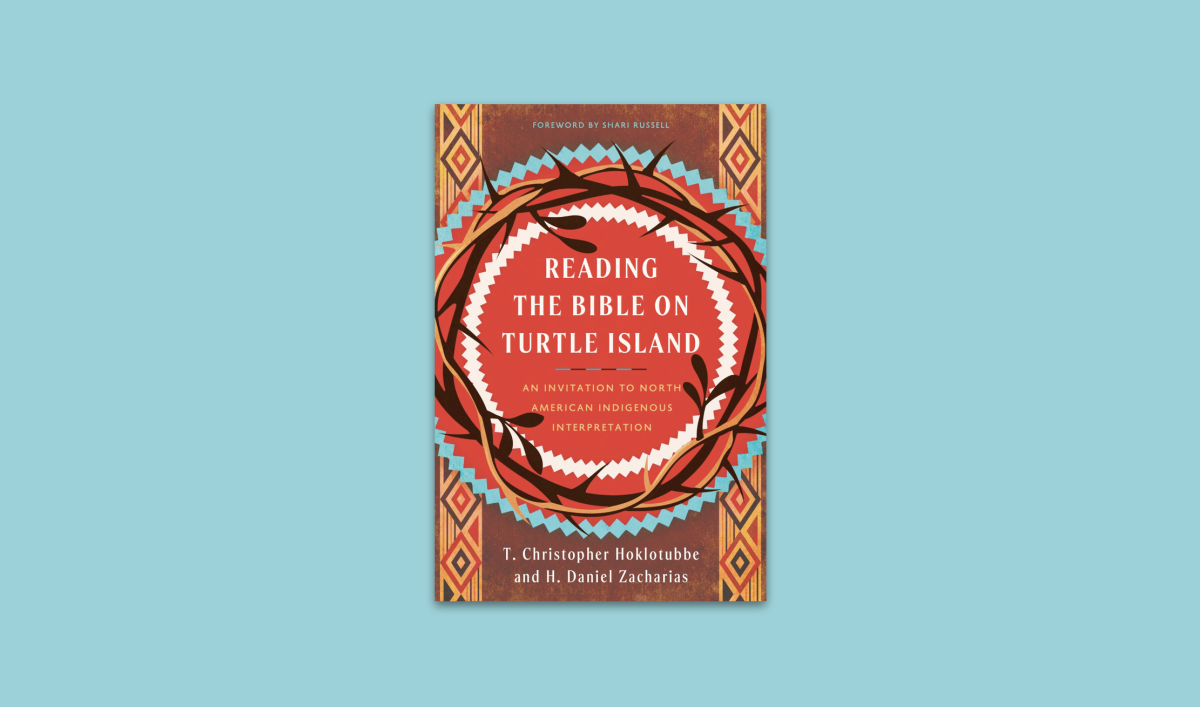
READING THE BIBLE ON TURTLE ISLAND: An Invitation to North American Indigenous Interpretation. By T. Christopher Hoklotubbe and H. Daniel Zacharias. Downers Grove, IL: IVP Academic, 2025. Xviii + 222 pages.
The Bible is sacred to many. It is also an ancient book that emerged in a very different culture and context from our own. Therefore, it requires interpretation. At the same time, interpreters bring their own context to their reading of Scripture. Since most scholarly biblical interpreters have emerged from European and Euro-American contexts, these are the lenses most often used to read Scripture. In recent years, biblical scholars have begun to recognize this truth, including the way colonialism has influenced how Scripture is read, interpreted, and applied. Post-colonial interpreters have begun to address how colonialism influences not only the way people read Scripture but also how they understand their faith.

Robert D. Cornwall
Indigenous peoples around the world have wrestled with what has often been an imported religion and its relationship to their own cultural contexts, including their own spiritual resources. This is true for North American Indigenous peoples, who not only lost their land after European colonization, but their cultures were suppressed and even destroyed in the name of civilization. In the name of assimilation, indigenous children were sent to boarding schools, to “kill the Indian to save the man.” That is, indigenous people were forced to give up their languages, cultural practices, and their religions. They were then forced to take on Euro-American cultural elements or perhaps face extermination in what has been termed cultural genocide.
While the effects of these efforts that took place over several centuries are being addressed, there is much more to do. Fortunately, growing numbers of Native American/First Nations religious scholars have engaged in important work in theology and biblical studies. One expression of the latter was the development of the First Nations Version: An Indigenous Bible Translation of the New Testament. That translation, making use of traditional indigenous nomenclature for God, for Christ, for the Holy Spirit, the church, and salvation, has proven to be immensely valuable. Now comes the important and revealing book Reading the Bible on Turtle Island: An Invitation to North American Indigenous Interpretation.
Reading the Bible on Turtle Island: An Invitation to North American Indigenous Interpretation was written by two Native American biblical scholars, T. Christopher HokloTubbe (Choctaw) and H. Daniel Zacharias (Anishinaabe/Metis). Both authors have doctorates in biblical studies. One is from the United States and the other from Canada, where they teach at colleges or seminaries. They bring their cultural context into conversation with the Bible, revealing how different hermeneutics reveal different elements of the biblical story.
The first thing that needs to be said involves the title: What is Turtle Island? The two authors answer that question by letting the reader know that the concept of “Turtle Island” reflects an indigenous understanding of the North American continent. With that as a starting place, they point out that while God made a covenant with Israel, God did not ignore the “Indigenous peoples of North America until the European colonizers arrived. Rather, Creator has always been present on Turtle Island and made a mark on the stories, ceremonies, lands, worldviews, and lifeways of its Indigenous peoples” (p. 3). Therefore, North American indigenous peoples have a context for receiving and interpreting the gospel. Unfortunately, this truth has not always been received, but these two Indigenous Christian scholars wish to change the conversation by introducing readers to forms of North American Indigenous interpretation.
Reading this book will challenge perspectives held by many people who may not recognize the tragedy inflicted on native peoples after the arrival of European colonists and settlers who were guided by the “Doctrine of Discovery.” This doctrine permitted Europeans to steal the lands belonging to Indigenous peoples. In this book, these two scholars reveal this tragedy and challenge the viewpoints held by many Western biblical scholars who assume that there is a universal frame of reference for interpreting the Bible, a frame of reference that is Eurocentric. As such, these scholars seek to bring into their conversation with the Bible the assets of their own indigenous cultures.
I will note here that Reading the Bible onTurtle Island has been published by an evangelical publisher. The starting point for the scholarly engagement with Scripture is a recognition of one’s relationship with Jesus. When it comes to the person of Jesus, Hoklotubbe and Zacharias recognize him to have been a brown-skinned Indigenous man living in a colonized land. While embracing Scripture as sacred to their own faith, they also note that “the desire for the Scriptures to dominate as the sole authority, denigrating and replacing Indigenous cultural traditions, is a colonizing form of Christianity that Indigenous people the world over have encountered” (p. 9). They challenge that understanding of Scripture.
Hoklotubbe and Zacharias begin their study of Indigenous hermeneutics in a chapter titled “Entering the Circle Dance” (Ch. 1). In speaking of the “circle dance,” they connect the importance of this particular form of dance to Indigenous peoples. Their understanding of Turtle Island hermeneutics is rooted in the indigenous belief in the goodness of their own culture and the assets present in that culture. In Chapter 2, titled “It’s All Relative: The Scriptures, Creational Kinship, and ‘All Our Relations,'” they begin to bring the various assets of indigenous cultures into the conversation, such as their creation stories. In doing so, they emphasize the indigenous belief that the Creator can be encountered through Creation.
Then in Chapter 3, titled “Reading Along the Bright Path,” they focus on Jesus’ jubilee teachings, which lead back to harmony with all relations, including non-human kin, or better, “more-than-human” kin. In this, we see a very different understanding of the relationship of humanity to nature than has been present in many Eurocentric interpretations. They write that “Creator’s dream of shalom is more expansive than we can begin to conceptualize; it is a work to restore all things. Indigenous voices and teaching are gifts and can contribute to the life of God’s people as we work together to walk the Bright Path of the Jesus Way” (p. 81).
I think many Westerners find it difficult to see the presence of our ancestors in our faith stories, but that is not true for many Indigenous peoples. Thus, in Chapter 4, which is titled “Crying for a Vision of Who We Are,” they address the question of ancestors. This includes the cultural practices of their ancestors, often involving ceremonies and lifeways that White Christians said were idolatrous. They seek to challenge that kind of thinking and bring the two into conversation. This includes embracing the dreams and visions found in Scripture, along with those present in their own contexts. So, in embracing Scripture, they also seek to bring together their Christian heritage and that of their ancestors. They add that “our Indigenous insistence to honor our ancestors and to respect their dreams and visions as well as our own has something to contribute to our broader understanding of the stories and figures detailed in Scripture” (p. 102).
As they begin to lean into biblical stories, we begin to see parallels between Indigenous realities and the biblical stories. Thus, when an Indigenous person reads the story of Naboth, whose land was stolen by Ahab and Jezebel, they see in the biblical story the stories of the broken treaties that led to the stealing of the lands of the Native peoples (Chapter 5, “Naboth’s Descendants). Hoklotubbe and Zacharias point out that “approximately 368 treaties were signed between US authorities and Indigenous leaders between 1777 and 1868,” most of which were broken. Something similar happened in Canada. So, even as the exiles in Babylon sang about their situation, so the Indigenous peoples sang their own songs of lament as they traversed the Trail of Tears.
While the story of Naboth is one such story, they also bring up Joshua and the conquest of Canaan, which was used as a paradigm for European colonization. Therefore, for Indigenous peoples, Joshua is not a hero. Chapter 6 is titled “From Babylon to Boarding Schools.” Here again, we encounter a reality faced by Indigenous peoples, the forced removal of children to boarding schools where they could be “civilized.” In the case of North American Indigenous peoples, these schools led to the deaths of thousands; as such, these stories serve as a lens through which to read a biblical story. This time, the key biblical stories involve Daniel and his friends Shadrach, Meshach, and Abednego, who were taken from their families and trained up so they could serve the Babylonian rulers. Again, we encounter the tragedy of policies by US and Canadian authorities that provide a very different lens to read biblical stories.
Chapter 7 is titled “Reading While Red(Bone).” The chapter title refers to a rock band from the 1970s and 1980s, Redbone, which was the first Indigenous music group to have a top-five hit. They use a song from the group as an entry point into a discussion of Indigenous ceremonies. The song they speak of is “Come and Get Your Love,” which will be familiar to anyone who watched the Marvel movie Guardians of the Galaxy. In making use of the song and the group that produced it, the authors seek to take note of Indigenous assets available to them for interpreting Scripture. In this case, the focus is on ceremonies, including dance, which they lift up as resources for reading the Bible and living the Christian faith. Once again, they wish to argue that what has often been deemed idolatrous can provide a foundation for Christian theology and practice.
Hoklotubbe and Zacharias conclude their invitation to North American Indigenous interpretation with “The Call of the Drum: An invitation to the Circle of Turtle Island Hermeneutics.” This concluding chapter invites us to gather around the “big drum,” which traditionally calls people together for ceremonies and gatherings, so that we might engage Scripture anew, by making use of Indigenous assets, which are deemed good. They state clearly that their primary audience is other Indigenous peoples, inviting them to read Scripture with a perspective informed by their own cultural resources. Although European-American folks like me are not the first audience, the authors invite us to gather around the big drum as well, so we can better appreciate the stories of people who have been marginalized, even as they have been “evangelized.”
Reading the Bible on Turtle Island is a very powerful book that will open eyes to realities that many, especially in this moment, wish to ignore. Even as we see people push back on what they consider to be “woke,” voices that have been marginalized will not be silenced. That is a good thing. We are fortunate that Christopher Hoklotubbe and Daniel Zacharias have provided us with this important offering. It is a good thing that the book has been published by an evangelically aligned publisher.
This review originally appeared on BobCornwall.com.
Robert D. Cornwall is an ordained minister in the Christian Church (Disciples of Christ). Now retired from his ministry at Central Woodward Christian Church (Disciples of Christ) of Troy, Michigan, he serves as Minister-at-Large in Troy. He holds a Ph.D. in Historical Theology from Fuller Theological Seminary and is the author of numerous books, including “Eating With Jesus: Reflections on Divine Encounters at the Open Eucharistic Table” and “Second Thoughts About Hell: Understanding What We Believe” coauthored with Ronald J. Allen. His blog Ponderings on a Faith Journey can be found here.