“We could basically say, ‘In the state of Texas, we get to define what a religion is, and Islam is not a religion protected under the First Amendment of the U.S. Constitution.’”
That’s an argument made recently by Texas Republican state Rep. Andy Hopper during a forum about the “threat of Islam” at a politically active charismatic church in Fort Worth. Speaking during Ramadan, he dismissed Islam as a “political ideology masking as a religion.” He said that in an attempt to redefine Islam so he can claim to be for religious liberty while also trying to ban the second-largest religion in the world.
Hopper is not alone in trying such definitional gymnastics. For instance, during a recent public debate as city council members in Broken Arrow, Oklahoma, denied a rezoning request for a proposed mosque, an opponent of the mosque used that line: “Islam is not a religion.”
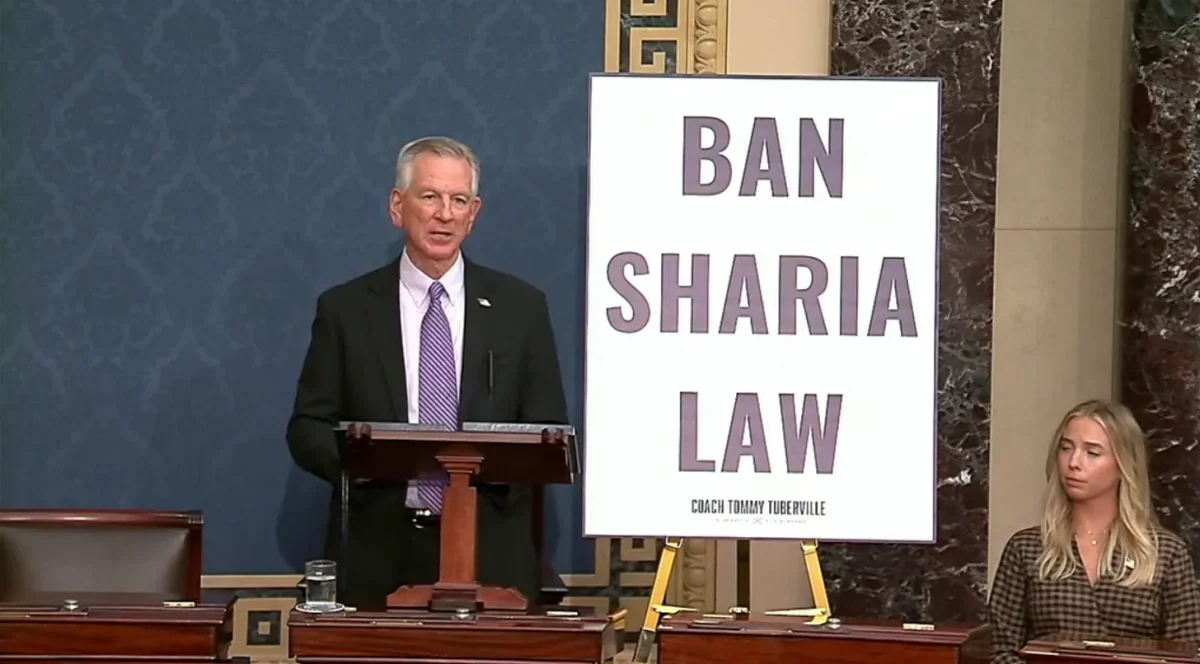
U.S. Sen. Tommy Tuberville of Alabama, who seems to be vying for the title of most Islamophobic member of the Senate, has also said it. He claimed in December, “Islam is not a religion.” He added that we must “send them home now,” which seemed to be both a call to deport Muslims and also odd given that millions of Muslims are American citizens who were born here. Tuberville, who is running for governor and promising to ban “Sharia law” in public schools (which will take about as long to remove as the unicorns in PE classes), last week attacked American Muslims as “the enemy.”
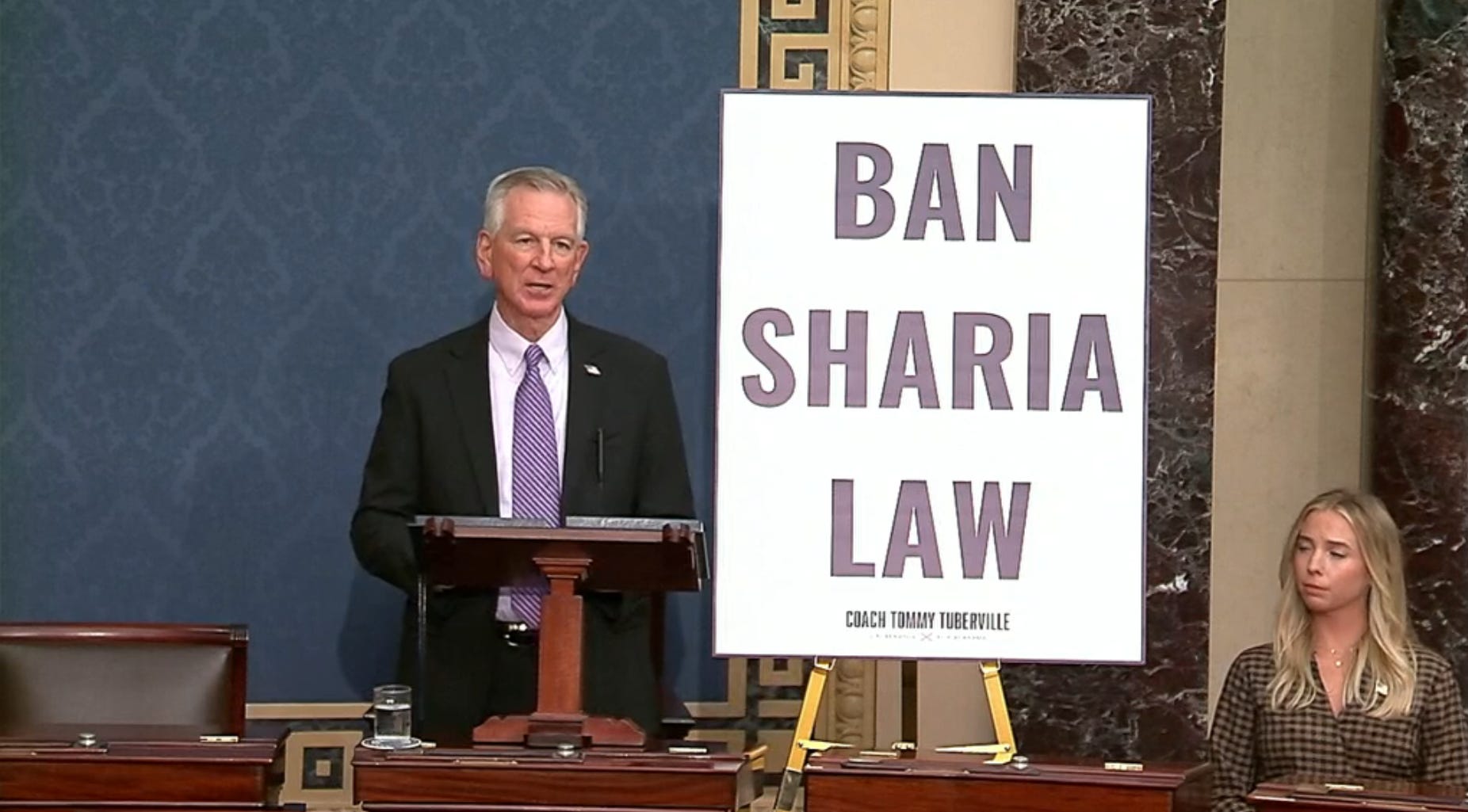
Screengrab as Sen. Tommy Tuberville speaks against Sharia law on the floor of the U.S. Senate on Oct. 8, 2025.
This rhetoric isn’t new, but we’re hearing it more now amid a resurgence of Islamophobia. More than 50 GOP members of the U.S. House have joined the new “Sharia Free America Caucus” to push legislation to supposedly stop Islamic law. State lawmakers across the country are also proposing similar bills that would “ban” Sharia law by requiring judges and courts to follow the state and U.S. Constitutions — something already required, which is why they’re called a “constitution.” I’ve testified against four such bills in Missouri this year and the hearings have included a lot of Islamophobic attacks made by sponsors and supporters.
“This is not a solution in search of a problem; this legislation is bigotry in search of a problem,” I argued last week during a hearing in the House Special Committee on Intergovernmental Affairs. “The targeting of one religious tradition is highly problematic and we should say ‘no’ to that. Because once we start threatening the religious liberty rights of one group by targeting like this, we put everyone’s religious liberty rights at risk.”
I added in my testimony that I’m more concerned about the threat of Christian Nationalism in government and public policy than Sharia law. Of course, Christian Nationalism is helping fuel the Islamophobia in our politics today. And in that should come a warning to us all. If we let the government decide what is a religion or not, then we put all of us at risk of that government in the future turning against our faith. This isn’t hypothetical. We can see this danger in practice in American history and right now in Russia. So this issue of A Public Witness considers the danger of letting government outlaw a religion and the warnings about who could be next on the target list after Muslims.
The ‘Wrong’ Church
Most of the early American colonies were what we could call Christian Nationalist states. Massachusetts Bay Colony banished religious dissenters like Puritan minister John Wheelwright, Anne Hutchinson, and Roger Williams. Colony leaders even executed Mary Dyer, William Robinson, and Marmaduke Stephenson for being Quakers. (If you can’t get along with the Quakers, that really says more about you than them.)
Or consider the treatment of Obadiah Holmes, who came to the new land from England in 1638 and became a glassmaker. A few years later while living in Plymouth Colony, he and a few others separated from their church and were baptized. He became the pastor of this group, but the colony’s court ordered them to stop worshiping because they weren’t recognized as a “real” church. Holmes and the group ultimately left to resettle in Rhode Island, which Williams had founded as a place with religious liberty for all people after he was banished from Massachusetts. Holmes would pastor in Rhode Island for three decades, but he got in trouble one day when he went to Massachusetts Bay Colony to minister.

The rest of this piece is only available to paid subscribers of the Word&Way newsletter A Public Witness. Subscribe today to read this essay and all previous issues and receive future ones in your inbox.