NOTE: This piece was originally published at our newsletter A Public Witness.
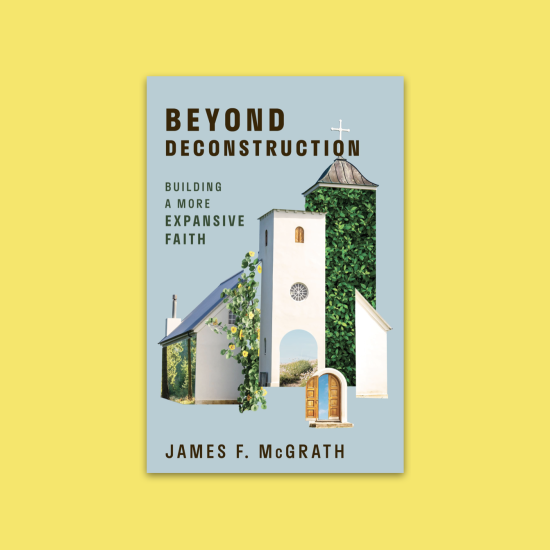
If HGTV decided to cast a show about fixing up your old religion, few could compete with James McGrath to be the star who transforms outdated edifices into contemporary spiritual structures. His new book Beyond Deconstruction: Building a More Expansive Faith is an expert’s guide to rehabbing religion in life-giving ways.
Recognizing that we live in a time where taking apart your belief system is a rite of passage, McGrath encourages his readers not to be satisfied just by what can be torn down. Deconstruction leaves you with a pile of rubble. The real value is found in creating a worldview that orients your life in rich and meaningful ways.
As he explains via a housing analogy, “if you were sold a structure that turned out to be structurally unsound, with a sinking foundation and no hope for preservation or restoration, you have a right to feel cheated, jaded, and skeptical. That isn’t a reason to remain homeless if there are other options available. People live in homes and people inhabit worldviews. I want, in this book, to help you move beyond the hurt of your past experiences and into freedom and healing.”
His recommendations for doing that are both obvious and complicated. Rather than seeing faith as a static set of beliefs, he urges readers to embrace an always-developing faith that is constantly being revised based on new information. In doing so, he challenges the myth that a strong faith resists change. From the very beginning of the tradition — reflect for a minute on Paul’s mission to the Gentile and their subsequent impact on the early church — Christianity has sought to adapt its core convictions to an evolving context.

Another suggestion is to reprioritize experience over doctrine. Rather than define faith as thinking about things the right way, McGrath believes a richer path is found in opening ourselves up to encounters with God. This is not the result of devaluing intellectual pursuits or an attempt to wall off religious belief from scientific influences. On the contrary, McGrath is a university professor who embraces both the critical study of the Bible and the integration of faith and reason.
Instead, his warning is not to reduce religious belief to academic pursuits and doctrinal debates. A faith that structures and shapes our lives has to be one that appreciates the reality of what it means to be human.
“Losing the security of our tidy equations about God and the workings of the universe is an experience that leads us into wider theological postures. Our new ways of thinking still cannot hold or do justice to God, but at least they don’t reduce and misrepresent God quite so badly,” he writes. “I suspect that if you continue your pursuit of God and have a transformative religious experience, your unanswered questions will remain and yet will pale in significance in the light of that life-changing encounter.”
Finally, McGrath highlights the inherent desire for community and the power of religion to provide it, though he believes more creativity is needed to imagine how “church” happens. Working for social change, tending a community garden, or meeting to discuss theology at your favorite restaurant are all ways that faith might inspire groups to gather for learning, service, and action.

Overall, Beyond Deconstruction reads like a love letter for intelligent and passionate people not to give up on faith but to reimagine it for themselves. McGrath provides permission to set aside what isn’t working and refocus on the essentials of fostering a life that can flourish within a community of like-minded people. It sounds quite basic, but it’s become much harder in our secularizing age.
“Don’t give up,” he advocates at the end of the book. “Build a worldview, build habits, build friendships. Share your faith in its new form. Share your story. It is still every bit as worthy of being called your testimony as what you might have said in years or decades past. You are on a journey, and your story will be ongoing. The way you tell and share it may change more than once in the future. … Whatever local and online communities you join or create, we are part of a larger whole, a bigger and even more diverse movement.”
While reconstructing Christian faith in the modern world is a lifelong challenge, finding the best reporting and analysis of how religion, politics, and culture intersect in American society is easy. Paid subscribers to A Public Witness get more of our award-winning content. Upgrade your subscription today and you’ll have the chance to win a signed copy of Beyond Deconstruction, as James McGrath has agreed to autograph a book for one of our lucky readers.
As a public witness,
Beau Underwood
A Public Witness is a reader-supported publication of Word&Way. To receive new posts and support our journalism ministry, subscribe today.