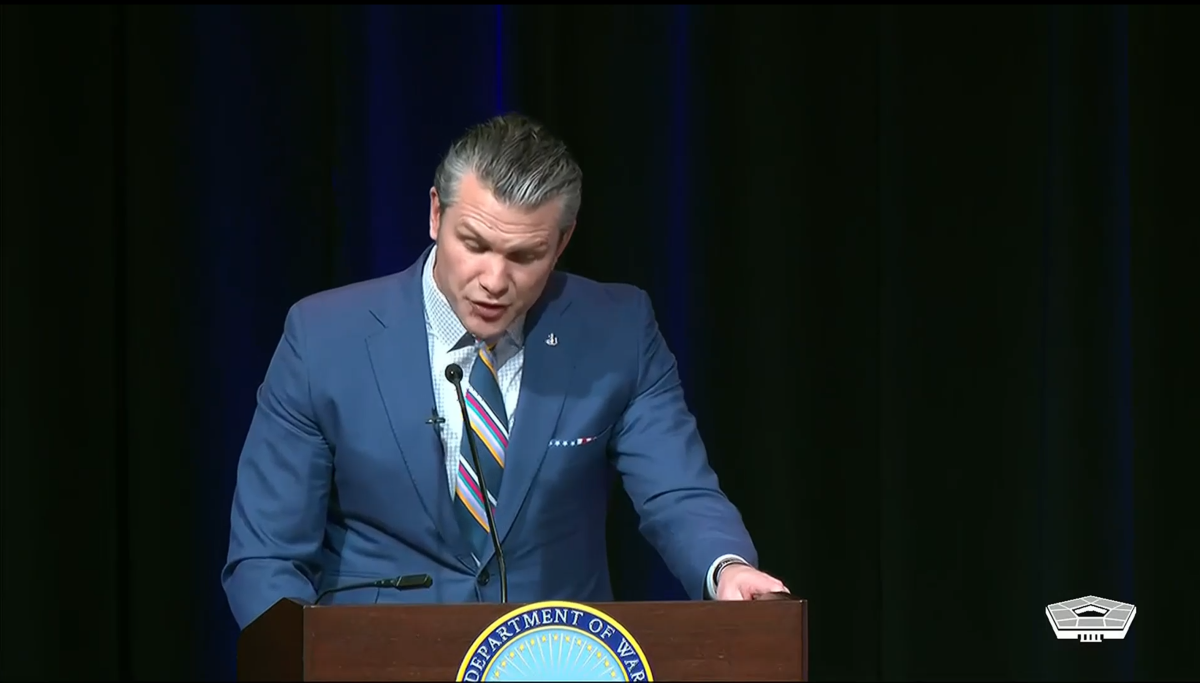
Standing in the Pentagon for a monthly worship service on March 25, the man who likes to call himself the “secretary of war” prayed for God to pour out righteous wrath in the Iran conflict by helping “break the teeth” and kill the “wicked” enemies “who deserve no mercy.” As I watched Pete Hegseth during the service, it quickly stood out as the second most violent prayer I’ve ever encountered, only after Mark Twain’s “The War Prayer.” But Twain was being satirical.
Brian Kaylor
Growing up just two hours away from Twain’s hometown of Hannibal, Missouri, I often went there as a child to visit grandparents, cousins, and other relatives. Most times, we would eat at a restaurant that sits just across a parking lot from the home where Samuel Clemens lived before becoming Twain and where Tom Sawyer tricked his friends into whitewashing the fence. While I enjoyed reading about the adventures of Sawyer and Huck Finn back then, only later did I discover and appreciate Twain’s brilliant satirical writings. And my favorite has long been “The War Prayer.”
A few years after the Spanish-American War, an imperial quest that Twain opposed, he penned a short story critiquing the religious zeal that supports such violence. However, due to concerns expressed by family members and friends, he refrained from publishing the piece during his life. As he reportedly remarked to his illustrator, “I have told the whole truth in that, and only dead men can tell the truth in this world. It can be published after I am dead.” Fortunately, the piece was eventually published more than a decade after his death. And it’s been dramatized a few times, including in a short Michael Goorjian film starring Jeremy Sisto.
The piece begins by describing the “holy fire of patriotism” swelling up to support “the war.” Pastors are preaching “devotion to flag and country.” In a nameless church, “a war chapter from the Old Testament was read” before prayers for God to bless the war effort and bring the nation victory. But then a character identified only as “the stranger” approaches the pulpit. Announcing he came “bearing a message from Almighty God,” he declares that he will now explain the full meaning of the prayer for victory by uttering the unspoken parts. And that’s when the violent prayer begins, serving as a critique of the milder-sounding prayers for war glory.
“O Lord our God, help us to tear their soldiers to bloody shreds with our shells; help us to cover their smiling fields with the pale forms of their patriot dead; help us to drown the thunder of the guns with the shrieks of their wounded, writhing in pain,” the stranger prays. “Help us to wring the hearts of their unoffending widows with unavailing grief; help us to turn them out roofless with little children to wander unfriended the wastes of their desolated land in rags and hunger and thirst, sports of the sun flames of summer and the icy winds of winter, broken in spirit, worn with travail, imploring Thee for the refuge of the grave and denied it.”
After the graphic prayer for help to “smite the foe,” the stranger closes the prayer by asking it all “in the spirit of love, of him who is the source of love, and who is the ever-faithful refuge and friend of all that are sore beset and seek his aid with humble and contrite hearts.” Rather than understand the message, the congregation simply dismisses him as “a lunatic.”
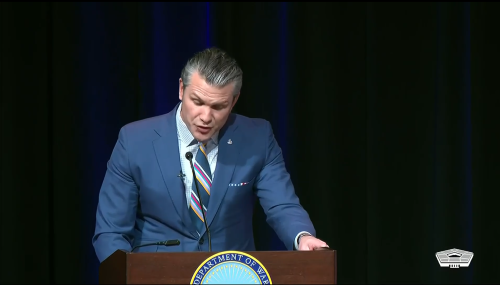
Screengrab as Pete Hegseth speaks during a worship service at the Pentagon on March 25, 2026.
Unlike those Twain critiqued for praying in generalities, Hegseth decided, like the stranger, to clearly articulate the violence requested from God. But Hegseth, unlike the stranger, said all of this in hopeful anticipation.
During the most recent monthly Christian worship service at the Pentagon, Hegseth read from a war chapter in the Book of Psalms before getting into the violent prayer. He said the prayer was previously delivered by a chaplain to bless the military operation in Venezuela in January, adding that he now wanted to pray it for the war in Iran.
“Break the teeth of the ungodly. By the blast of your anger, let the evil perish. Let their bulls go down to slaughter for their day has come, the time of their punishment. Pour out your wrath upon those who plot vain things and blow them away like chaff before the wind,” Hegseth prayed. “Give them wisdom in every decision, endurance for the trial ahead, unbreakable unity, and overwhelming violence of action against those who deserve no mercy. Preserve their lives, sharpen their resolve, and let justice be executed swiftly and without remorse that evil may be driven back and wicked souls delivered to the eternal damnation prepared for them.”
Hegseth offered this prayer while holding what looked like his Bible, which has a Jerusalem Cross and “Deus Vult” stamped on the cover, thus matching the tattoos on his body. With his Crusader Bible and violent prayer, he basically took Twain’s satirical work and offered it as a literal prayer. So while the stories about Tom Sawyer and Huck Finn might be better known, it’s Twain’s work like “The War Prayer” that reveals his much-needed prophetic voice. The only problem is I’m not sure Hegseth would understand the joke.
Brian Kaylor is president & editor-in-chief of Word&Way. You can follow him on Bluesky and YouTube. His latest book is The Bible According to Christian Nationalists: Exploiting Scripture for Political Power.