The last time I drove my mother to a methadone clinic, I believed I was witnessing an institution trying to save her. After she died from the consequences of addiction and alcoholism, I found myself asking a different question: How much of what failed her belonged to institutions and how much belonged to the people beside her, including me?

Michael Mellette
That question led me to Mena, Arkansas. Mena has a population of 5,607 as of a 2025 Census estimate. It is home to more than thirty churches alongside a documented methamphetamine and drug problem. Like many rural communities in the United States, it sits at the intersection of persistent poverty, substance use, and limited access to treatment infrastructure. Polk County, where Mena sits, has no inpatient drug rehabilitation facility.
Arkansas has long ranked among the highest states in the nation for methamphetamine use. Polk County is no exception. In 2023, a multi-agency operation involving the Polk County Sheriff’s Office and the 18th Judicial West Drug Task Force seized approximately $30,000 worth of fentanyl and other illicit street drugs in Polk County. The poverty rate in Mena is approximately 14%.
Across rural America, the same pattern repeats: high church density, persistent poverty, addiction crises, and the absence of systems capable of addressing problems at scale. The names of the towns change. The structure does not. What Mena makes visible, other places keep partially obscured.
Within the last several years, two local ministries tried to address part of this gap directly. Born Again Recovery Ministry and Masterpiece Ministries of Arkansas applied for funding through a state opioid settlement grant — the Arkansas Opioid Recovery Partnership (ARORP) — money explicitly designated for communities experiencing addiction-related harm. The application process requires endorsement from both the county judge and the mayor of the county seat before a proposal can even be submitted to ARORP.
This is where the structural and the personal stop being separate arguments. A single-signature bottleneck is a design choice, not a force of nature. Someone decided that one office should hold this much leverage over whether a county gets addiction treatment or doesn’t. But a design only functions as an excuse if the people inside it let it. A process can be badly built and still move, if the individuals occupying it choose to treat the gap as theirs to close rather than someone else’s to explain.
Whether the mayor’s office failed to sign because no one asked, or asked and was ignored, or asked and was declined, the outcome is the same: a chokepoint became a dead end because a person at that chokepoint did not make it their problem. The structure created the opportunity for the failure. An individual made it real. One ministry dissolved, and the crisis did not.
Masterpiece Ministries of Arkansas tells a different story. From the outset, its goal was to establish a women’s recovery home in Montgomery County, the next county over from Polk. It never applied for ARORP funding in Polk County at all. But Masterpiece’s ties to Mena are close enough that the distinction is easy to miss: many of the women who have come through the program are from Polk County, and the two counties share a judicial circuit.
In March 2025, Circuit Judge Andy Riner of the 18th Judicial Circuit — who has worked the Polk County legal system since 2005 — wrote to ARORP’s director in support of Masterpiece’s Montgomery County proposal. He noted that the primary way people struggling with addiction in his jurisdiction receive treatment is through arrest and the criminal justice system, and that a faith-based facility would provide an outlet for voluntary treatment. State Representative John Maddox of District 86 wrote in support three days earlier, saying the project would let people “reclaim their lives and become valuable members of society.” Both letters were signed, dated, and addressed to ARORP’s director on official letterhead.
Although Masterpiece Ministries submitted for the ARORP grant, it was ultimately declined because the ministry had only been operating for about a year, but was encouraged to apply again in the future. Masterpiece Ministries built their women’s recovery home in Montgomery County, as intended from the start. The mayor of Mount Ida signed off. The facility exists, and it serves women from Polk County even though it sits one county over. In Polk County, no comparable facility exists.
I emailed many churches in Mena. I explained I was writing about rural Christianity and social outcomes. I asked whether the presence of so many congregations had produced measurable changes in addiction, poverty, or community health. I asked what it meant to have a century of Christian presence in a town that has never been without it.
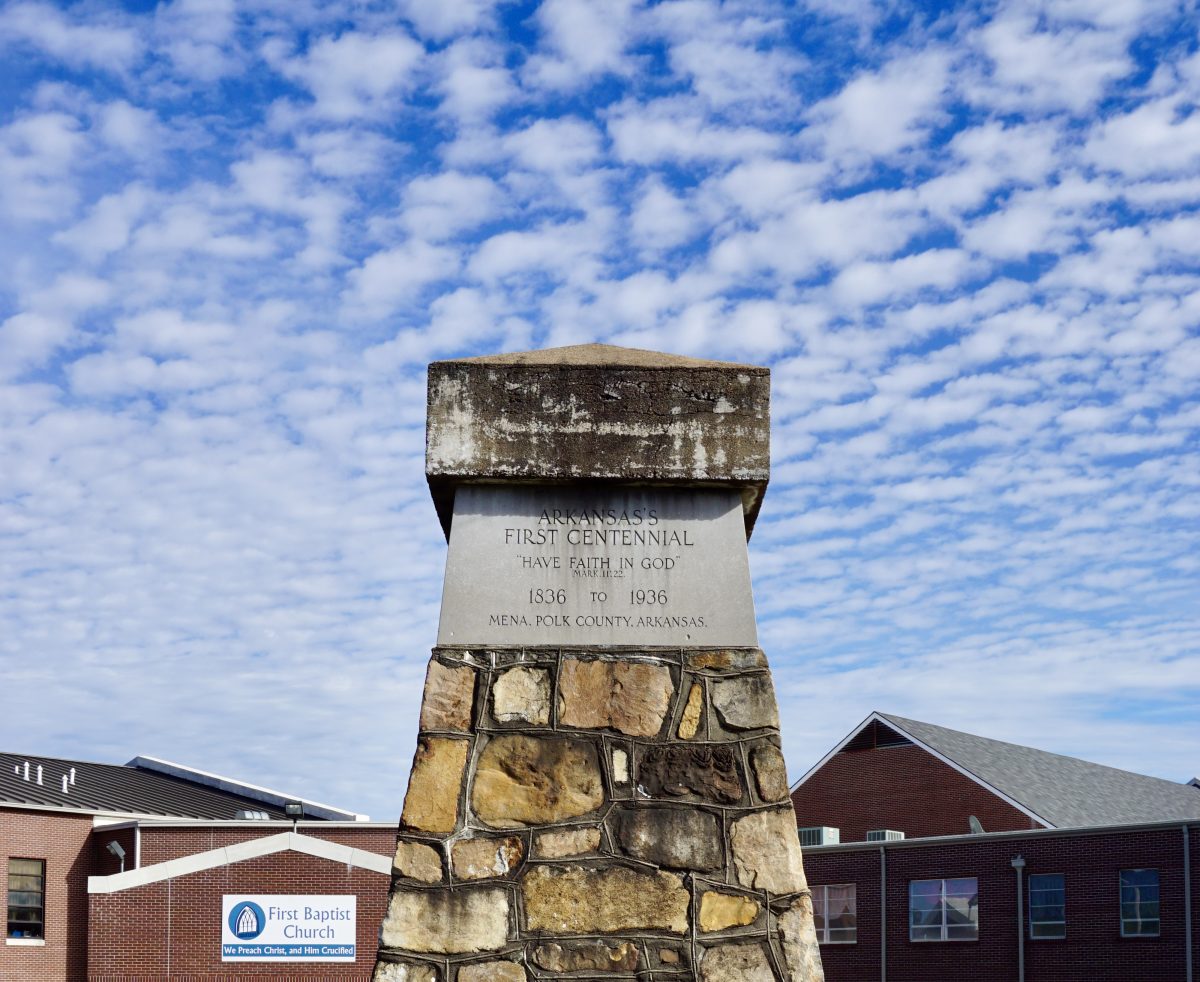
Michael Barera, CC BY-SA 4.0, (cropped) via Wikimedia Commons
One person responded quickly and with candor, and it changed the trajectory of this article. Not a pastor, deacon, or denominational leader but a church secretary. She has served across multiple congregations and nonprofits, and runs background checks on every volunteer who works with children. She attends drug court graduations when she can, because she says she needs to see that change is real. She replied within days, in an email of more than 2,000 words.
She did not offer a defense so much as a candid account. She wrote that American churches often invest more energy abroad than in their own communities. She acknowledged that not all of Mena’s churches are spiritually or practically healthy, and that some have caused real harm to vulnerable people.
The church secretary described what faithful presence looks like in a town like Mena: visiting the sick, opening homes after tornadoes and house fires, collecting funds after medical crises, supporting students in alternative learning programs, running background checks because safeguarding is nonnegotiable, and attending court graduations because someone needs to witness recovery when it happens. None of this appears in statistics. All of it absorbs real social burden.
She described a community in which human need consistently exceeds the capacity of any single institution. Food insecurity, housing instability, utility crises, and addiction fall disproportionately onto churches and small nonprofits because public systems are distant, limited, or under-resourced. A recovery home more than ninety minutes away functions as the nearest alternative to incarceration for some people because nothing closer exists.
Communities are often carrying compounded need with institutions too small and too fragmented to meet it. The church often steps in where the state has stepped back. Where the church falls short, the gap does not close. It simply goes unnamed.
She did not argue that the church had succeeded. She said plainly that it has often fallen short. Though churches are stepping in to help when they can, she observed, it seems the city is getting in the way of the churches stepping up. Then she went back to work.
I reached out to many pastors and received little response. This is not unusual. Pastors are busy, and silence does not necessarily indicate refusal. But the contrast remains between institutional representatives and a staff member whose role is largely administrative, and which of them treated a stranger’s questions about the church’s social role as something worth answering carefully.
I also contacted Mayor Seth Smith of Mena by email, asking why the city had not provided sign-off on Masterpiece Ministries’ ARORP proposal, which carried backing from a sitting circuit judge and a state representative. Mayor Smith responded that, to the best of his knowledge, the City of Mena did not receive the proposal and that he was not asked to review or provide sign-off on it. He said the city remains willing to consider future proposals “presented through the appropriate channels.” He asked that if documentation existed showing city sign-off was requested, he would appreciate the opportunity to review it.
Someone close to Born Again’s effort, who asked not to be named, told me the mayor was presented with the proposal. That account comes from inside the ministry, which means it carries some firsthand knowledge of how the application moved. But it also comes from a party with an obvious interest in locating the failure outside the ministry rather than within it.
I could not establish who was responsible for the gap between Born Again’s proposal and the mayor’s desk, or locate documentation showing it ever reached him. That failure of documentation is itself part of the story this piece is trying to tell. Masterpiece Ministries’ paper trail, by contrast, is intact: the letters from Judge Riner and Representative Maddox exist, signed, dated, and addressed to ARORP’s director, backing a Montgomery County proposal that never needed Mena’s mayor at all.
Whether Born Again’s proposal was ever presented to Mayor Smith — and by whom, and when — remains an open question. What is not in question is the outcome: Polk County still has no inpatient recovery facility of its own. Masterpiece’s home in Montgomery County, the nearest alternative, exists because its process reached a signature.
This pattern is not unique to Mena. Many communities often struggle to translate widespread recognition of a problem into coordinated institutional action. The result is that suffering persists not because no one sees it, but because seeing it and organizing an effective response are different things. Yet, the secretary remains, still running background checks, still attending graduations, still writing long emails to strangers when she believes the question deserves an answer.
I was not the secretary when I should have been. Within the foundational institution of family, I cracked under the pressure from my mom’s addiction and my inability to understand it. This is not to say I abandoned her — I simply became numb. Numbness evolved to uncaring. Hatred would have been better than my apathy. I failed my mother in more ways than any government or religious institution ever could. The gap was widened instead of filled. It took years for me to understand that I was the one who was ignorant. She did not fail me; I failed her. That is my cross to bear. Not with pride or shame, but as a scar that refuses to ever heal properly.
A century of Christian presence in Mena has not eliminated the problems it repeatedly names. Addiction and poverty remain persistent features of the town’s social landscape. That persistence does not negate local church work, much of which is real and often unseen. But it does complicate any assumption that institutional presence alone maps neatly onto social repair.
Jesus said a tree is known by its fruit. In Mena and in many towns like it, the fruit is uneven — visible in acts of care that rarely travel beyond local memory, and absent in systems capable of addressing scale. The institution, as institutions often do, has proven better at continuity than coordination, better at persistence than synthesis.
But the story is not exhausted by institutional performance. It also includes a woman without a major title or platform, who answered when the institution did not. Who has chosen, without announcement, to remain in the gap between what is needed and what is provided.
Why do individual Christians often appear more effective than the institutions built in Christianity’s name? The question is not whether she replaces the institution. She does not. The question is what it would mean for individuals and institutions to resemble her more than they currently do.
Michael Mellette is a philosopher and writer. Read more at michaelmellette.substack.com.