(RNS) — The Trump administration announced plans to provide close to $2 billion in funding to faith-based and community groups for health and humanitarian assistance in more than a dozen countries, drawing praise from groups receiving funding and criticism from others for its emphasis on funding Christian organizations.
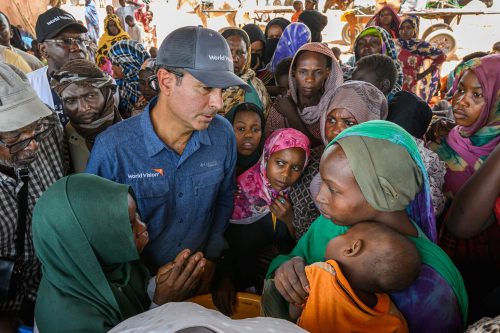
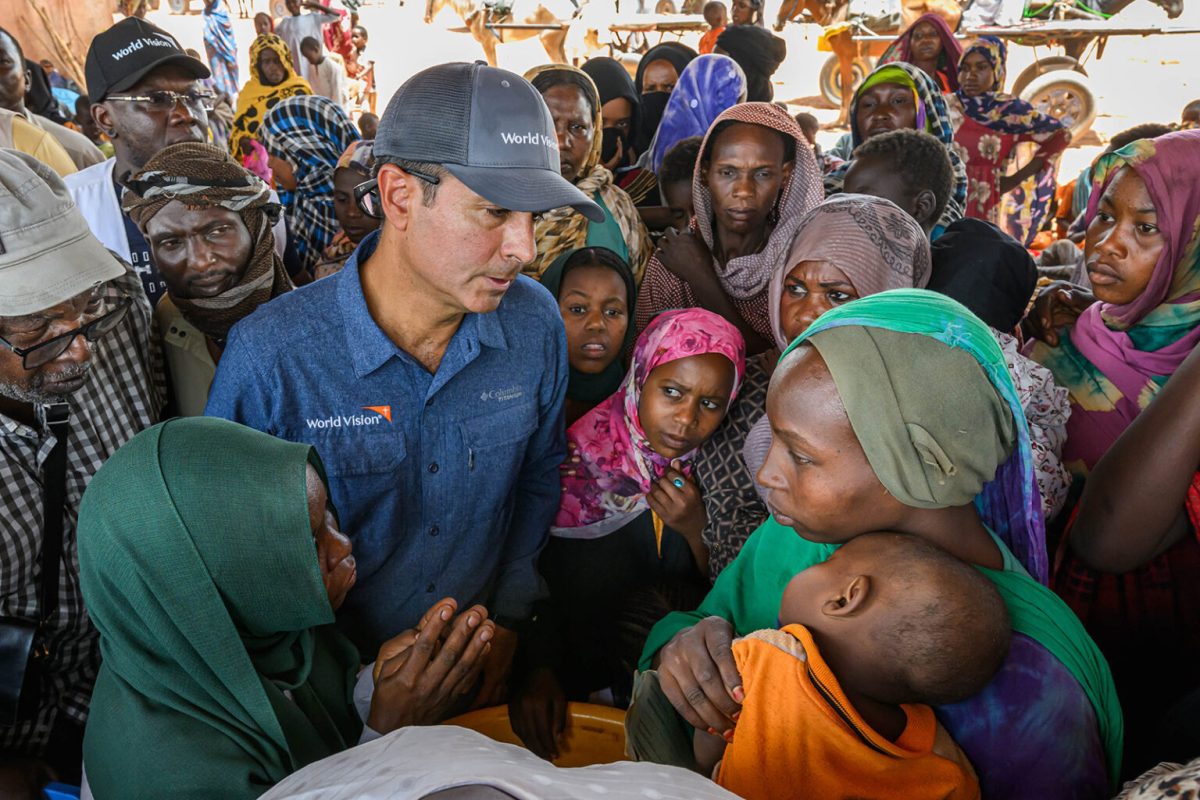
World Vision US President and CEO Edgar Sandoval Sr., center left, visits with Sudanese refugees who had just crossed into Chad from Darfur, at Adre’, Chad, in May 2024. (Photo © World Vision/Jon Warren)
The assistance, which comes after the administration’s massive cuts to global support once offered by the U.S. Agency for International Development, is part of commitments detailed in the America First Global Health Strategy released by the State Department last September. It focuses on prioritizing American interests while promoting assistance in saving lives, according to the administration, which announced the funding on Thursday (Aug. 6).
The largest portion of the funding — $1.4 billion — is expected to support some 2,500 faith-based hospitals and clinics and train and pay tens of thousands of community health workers to provide healthcare services.
World Vision, an international evangelical humanitarian organization, and a consortium of local faith-based groups are to receive an award for a Faith and Community Initiative to provide healthcare services totaling “up to $850 million over five years, subject to the availability of funds,” the State Department said.
In addition, $570 million is earmarked for community and faith-based hospitals and clinics via memorandums of understanding signed with country governments.
A chart in the 40-page strategy report cited the influence on and “faith reach” to Christians and Muslims by faith-based clinics and hospitals in 10 African nations. “For example, faith-based providers represent over 50% of the delivery capacity in Eswatini and Uganda and over 40% in many other countries,” the report stated.
But the funding for humanitarian assistance abroad does not appear to include any U.S. based non-Christian groups. The American Jewish World Service, the leading Jewish organization working to fight poverty and recover from disasters both natural and human-made, for example, was not a party to the consortium set up by the State Department.
“While AJWS is a proudly faith-based organization, we were not consulted and only learned of this funding when the State Department issued a press release,” said Tawanda Mutasah, AJWS’s president and CEO.
Mutasah also raised doubts that the funding could reach those with the most needs.
“Given the ideological screens the administration has created — including the expanded Global Gag rules — this money simply cannot reach the people in greatest need, including those who are invisible to conservative, faith-based providers,” he said in a statement. The Global Gag rules refers to a U.S. government policy that blocks federal funding to foreign organizations that provide abortion services, counseling, referrals, or advocacy for legal abortion.
Among the recipients, $538 million for humanitarian crisis assistance will go to Samaritan’s Purse, another evangelical aid organization, and a consortium co-led by World Vision and Compassion International in collaboration with Accord Network, all Christian groups.
Accord Network, which describes itself as a catalyst for relief and development work by “Christ-centered organizations,” had previously criticized the Trump administration when it announced its decision last year to cut the vast majority of USAID programs.
The National Association of Evangelicals, whose humanitarian arm, World Relief, lost contracts during the USAID cuts and is part of the new funding consortium, welcomed the State Department’s announcement.
“Faith-based hospitals, clinics, community health workers and humanitarian organizations combine trusted local relationships and compassionate service with the resources and diplomatic support that government can provide,” NAE President Walter Kim said in a statement.
The Freedom from Religion Foundation called the State Department’s plans “outrageous” and noted that its allocation “includes hundreds of millions of dollars for some of the world’s largest evangelical Christian ministries.”
“The administration is openly restructuring American foreign assistance around religion,” said FFRF co-President Annie Laurie Gaylor in a statement. “Humanitarian aid should be based on humanitarian need and the ability to provide effective, secular services, not on whether an organization puts ‘faith in action.’ Taxpayers should not be forced to bankroll an administration’s campaign to elevate and subsidize religion.”
The State Department also recently announced funding for secular groups providing international humanitarian aid. It also said it released $600 million of congressionally approved funds to Gavi, the Vaccine Alliance, to increase access to vaccines across the globe.
Heather Taylor, interim CEO and president of Bread for the World, a Christian anti-hunger advocacy group, said the faith-based consortiums receiving funding are led by groups with “decades of experience delivering care in the world’s hardest-to-reach places,” but more global assistance is necessary.
“Last year’s cuts to global health, nutrition, and food assistance programs have really been detrimental in the shared work on ending hunger,” Taylor said in a statement. “We will continue to help work with the Administration and Members of Congress so that additional resources/funding provide access to essential malnutrition treatment, maternal health services, and food aid — especially for communities that were profoundly impacted by cuts to USAID.”
World Vision’s statement said other groups involved in the Faith and Community Initiative are Catholic Relief Services, Adventist Relief and Development Agency International, HOPE Worldwide, International Care Ministries, and LifeNet International.
In a separate announcement in June, the State Department announced $250 million in humanitarian assistance funding for Catholic Relief Services.
Some of the faith-based relief groups named as grant recipients have received federal funding in the past.
In the fiscal year ending September 2025, World Vision reported receiving $511 million in government grants, according to the nonprofit’s annual Form 990, an IRS financial disclosure. The previous year, the nonprofit received $636 million in government grants.
World Vision CEO Edgar Sandoval told Christianity Today last year that World Vision lost about $170 million after the Trump administration made massive cuts to foreign aid.
According to its financial disclosure form for the fiscal year ending September 2025, Catholic Relief Services reported $550 million in government grants. The previous year, the group reported $761 million in grants.
ADRA International received $36 million in direct federal grants in the fiscal year ending in December 2025, according to its annual audit, and $69.9 million the previous year.
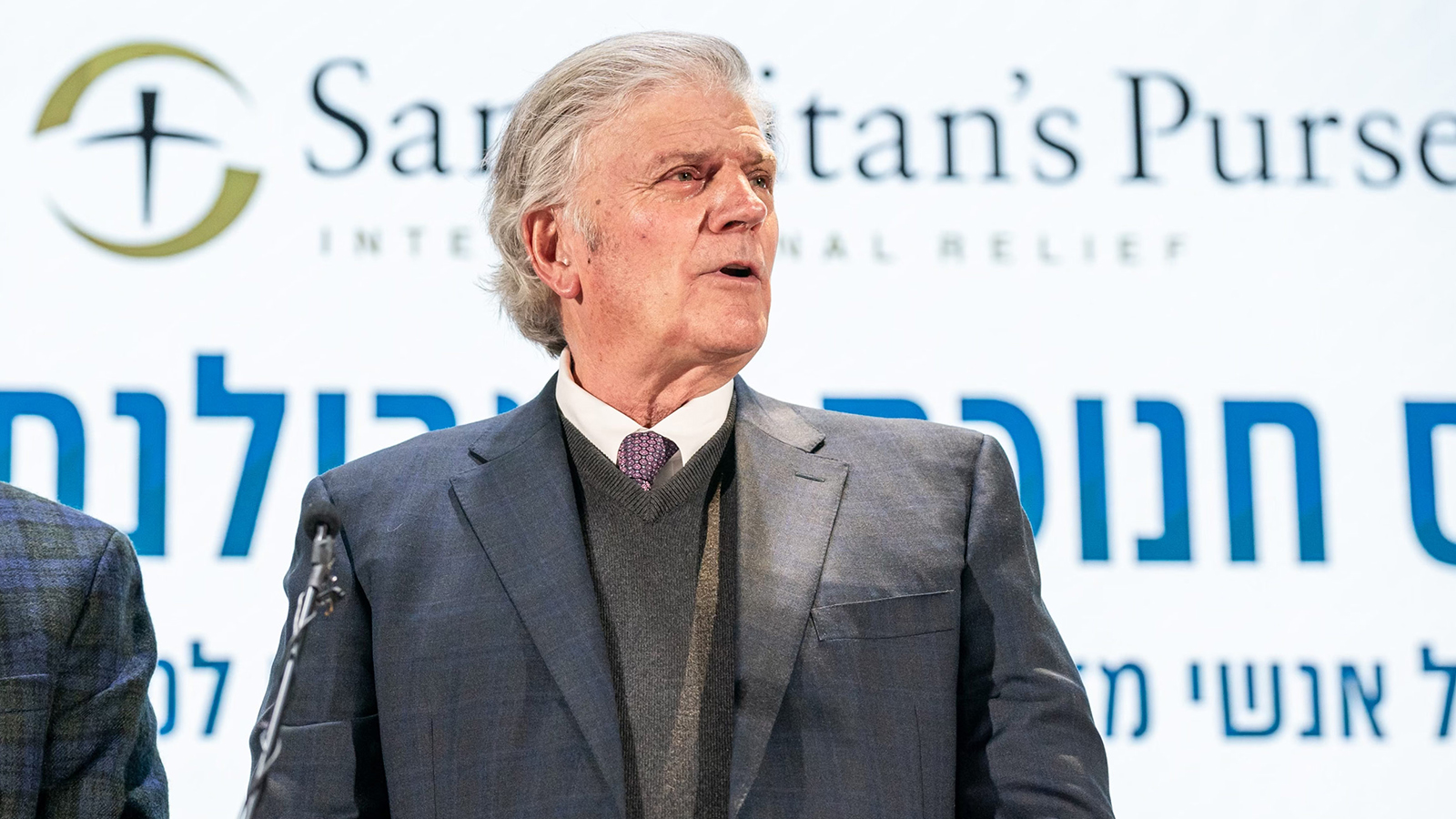
Franklin Graham speaks in Israel on Jan. 23, 2024. (Photo courtesy of Samaritan’s Purse)
Samaritan’s Purse had a long relationship with the now-shuttered USAID. But government assistance has always been a small portion of Samaritan’s Purse’s overall budget, said Franklin Graham, its president and CEO.
“Samaritan’s Purse is primarily supported by God’s people,” Graham said in a statement. “We have received government funding for specific projects under different administrations through the years, and it is always a very small percentage of our overall budget. We do not rely on the government for funding.”
Samaritan’s Purse does not make faith a condition of providing aid. It does, however, allow and even encourage its aid workers to talk about their faith.
“This grant and any funding we may receive from the U.S. Department of State will not change the way we operate, it will simply allow us to help more people in need around the world,” Graham said in his statement. “Whatever the crisis, we always respond in Jesus’ Name.”
The new funding will be used to respond to disasters around the world, such as the earthquakes that recently hit Colombia and Venezuela. Samaritan’s Purse recently set up emergency field hospitals in both Venezuela and the Democratic Republic of the Congo, where it is treating people who have contracted Ebola. Graham said an airlift of relief supplies will be sent to Colombia.
“We will also use this funding to provide additional help in countries where there is an ongoing need for life-saving relief, such as Sudan, where we have been working for more than 30 years,” Graham said.