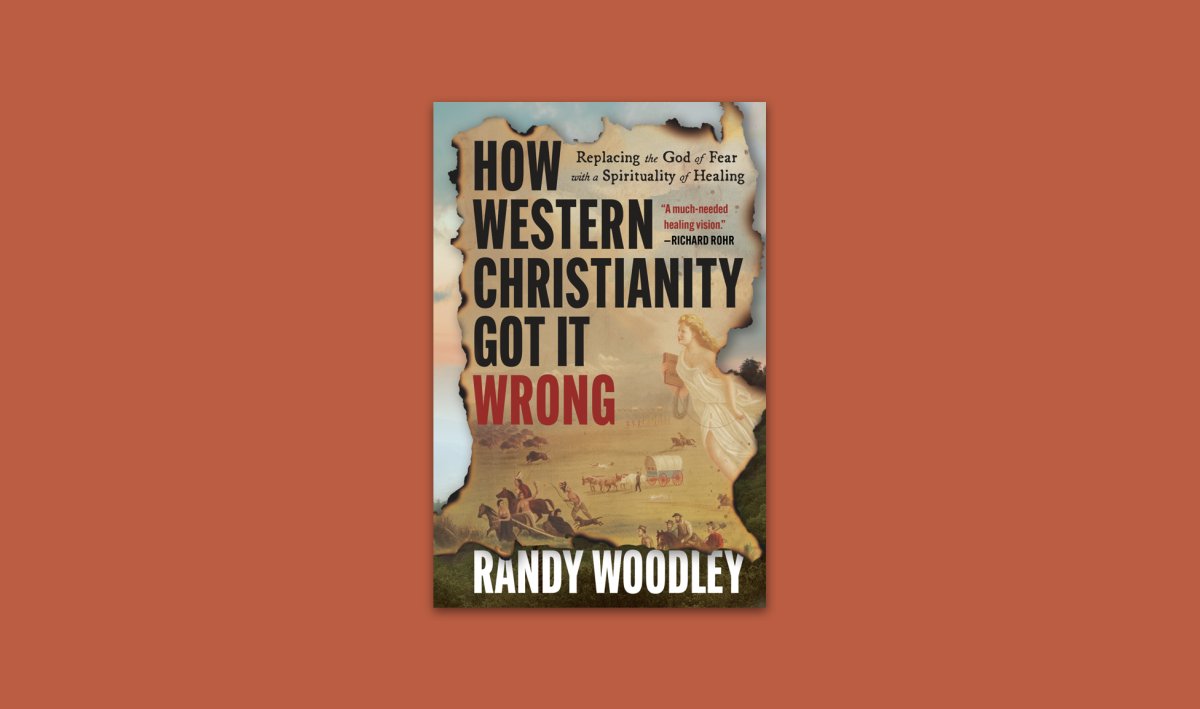
HOW WESTERN CHRISTIANITY GOT IT WRONG: Replacing the God of Fear with a Spirituality of Healing. By Randy Woodley. Minneapolis, MN: Broadleaf Books, 2026. Xiii + 262 pages.
The history of Christianity, like all history, is complicated. There is good, and there is bad. That’s why the idea of patriotic history is a recipe for bad history. The question is: Has Western Christianity gotten things wrong? Does the way Christianity has existed, at least since the late second century and most assuredly since the fourth century, go in the wrong direction? More specifically, has the way Western Christianity presented the nature of God to the world proven to be a mistake?

Robert D. Cornwall
From my perspective, we could easily say that the way Christianity, as it emerged in Europe, created a vision of God and the Christian movement has had destructive consequences at important points in history. Consider such things as the Doctrine of Discovery and Manifest Destiny, which gave colonial powers permission to conquer and subjugate the people they encountered in what, for Europeans, were newly discovered lands. This especially includes the indigenous people of the Americas, who saw their population and culture decimated due to encounters with Europeans. The question is how we deal with this history, both the good and the bad. The bad must be acknowledged along with the good.
Randy Woodley offers his take on these questions in his latest book titled How Western Christianity Got It Wrong: Replacing the God of Fear with a Spirituality of Healing. Woodley is a former professor at George Fox University in Oregon, who, with his wife Edith, is the co-sustainer of Eloheh Indigenous Center for Earth Justice as well as the Eloheh Farm and Seeds, which lie outside Portland, Oregon. Among his earlier books is Indigenous Theology and the Western Worldview (Acadia Studies in Bible and Theology): A Decolonized Approach to Christian Doctrine (Baker Academic, 2022), which lays out his approach to Christian theology as seen through an indigenous lens.
There is much I agreed with and liked about the book. Western Christianity has gotten a lot wrong. At the same time, there are places where I struggled with the way Woodley presented his message. As a historian of Christianity who is aware of the story’s complexity, I felt that his presentation of the development of Western Christianity lacked nuance at points. For example, while Augustine’s doctrine of original sin has been used in ways that I disagree with, we must place Augustine in his own context. The same is true of Pelagius, whose view of sin and salvation Woodley seems to prefer. While Pelagius did teach a view of Christianity that appears to be more freeing than Augustine’s, what we know of Pelagius’ theology and practice, which is very little, is that he seems to have been extremely ascetic.
So Augustine may have been more realistic about our ability to live the Christian life, while also offering a more gracious response to our failures. I will confess that while I’m not Augustinian, I often feel as if Augustine is misunderstood and possibly misrepresented by many progressives. I will also add that there is a strong restorationist element in this presentation, and having a restorationist background in both Pentecostalism and the Stone Campbell Movement, I understand the pitfalls that go with trying to jump back to the origins of the movement without recognizing how much we are influenced by what has transpired since the beginning. That said, we do need to attend to the way in which distortions emerged that have led to a view of God that demands fear. Thus, a spirituality of healing is something we need.
When it comes to speaking of the failure of adherents of Western Christianity to fully reflect the ways of Jesus, Randy Woodley writes from a particular frame of reference. That frame of reference is deeply grounded in Native American spirituality. While he embraces the message of Jesus, he, like many contemporary Christians, believes the way of Jesus has gotten corrupted by an imperial form of Christianity that he traces in some ways back to Augustine (thus the restorationist element). Interestingly, he seems to give a pass to Eastern Orthodoxy, which has the same roots as Western Christianity.
Whether it was the Cappadocians or Augustine, both were influenced by forms of Platonism. Why? Because it was the philosophical system available to the Christian world at the time it spread East and West. Should we continue to use that system today? Perhaps not, but let us not think replacing Plato with another philosophical tradition, such as Process philosophy, gets us back to the first-century Jesus. Thus, as I read How Western Christianity Got It Wrong, it seemed that while Woodley rooted his critique in an indigenous American context, there is that strong restorationist component as well.
I open this review with a rather critical foundation in part because I do think Woodley is on to something important, which is that Christians have corrupted the message of Jesus at significant points, such that Jesus’ message of love has been replaced by a Nietzschean message of power and domination. Does that mean we must throw out much of our inherited theology and practice? I’m not ready to go that far, but it would help greatly if we had an infusion of healing grace.
Perhaps Woodley’s indigenous inheritance can help us find the balance between orthodoxy and orthopraxis. Due in part to my reading of Liberation Theology, I recognize that doctrine, no matter how orthodox it is, if our practice doesn’t reflect the message of Jesus, which is at its heart one of love and inclusion, then as Paul reminds us, it is nothing more than a clanging cymbal.
Woodley begins by describing his path to truth in Chapter 1, after which he discusses “How Platonic Dualism Ruined Everything” (Chapter 2). While Platonic dualism may have unfortunate consequences, we are products of that heritage, even if we must modify it. Conversations with an indigenous worldview may help with this. But I felt the contrast between the two might be overly stark. In Chapter 3, Woodley asks “How People Stopped Seeing the Bible as Stories.” Here again, he contrasts an indigenous worldview with a Western one.
It is true that at some point theologians began trying to systematize the Bible in such a way that the story element got left behind, but the Bible is complex. The Gospels are written in story form, but not everything in the Bible is story. Remember that Paul wrote letters and Leviticus is primarily a book of legal precepts. That said, returning to telling stories from Scripture can prove beneficial in helping people embrace a view of God that is loving rather than fear-inducing.
He continues with a chapter entitled “How the Church was Overtaken by Doctrine” (Chapter 4). I find this an interesting charge in that doctrine is simply Christian teaching. Some forms are narrower than others, but all religions have belief systems. Christianity is no different. The issue, as one who is part of a noncreedal tradition, is how restrictive we are in our embrace of those teachings. The following chapter, “How the West Won a Monopoly on Sin and Salvation” (Chapter 5), is followed by “How Hell Was Born” (Chapter 6). That chapter is followed by “How Atonement Theories Fall Short” (Chapter 7). I take these three together because they are related.
There is great debate on how Christians should understand sin, salvation, divine judgment, the possibility of the existence of Hell, and whether anyone will inhabit it (see my co-authored book Second Thoughts about Hell for more on that question), along with debates about the role the cross plays in the process of salvation (atonement theories). The issues raised here are important because they stand at the center of the historic definitions of the Christian faith tradition as this tradition has come to be understood in the two millennia since the founding. Woodley’s emphasis on the idea of healing, which is a possible definition of the Greek word for salvation, is worth pondering.
Chapter 8, “How Destiny Theologies Deceive Us,” focuses on the questions that drive manifest destiny. This is a question that does need to be engaged with, especially in the Eurocentric foundations of American Christianity that failed/fails to listen to indigenous voices. The chapter also deals with matters of eschatology and whether God knows the future. Here he reflects the views of open and relational theology, especially the work of Thomas Jay Oord. This chapter in some ways goes back to the beginning in its engagement with Jesus, again through an indigenous lens. The chapter is titled “How to Unearth Jesus’ Message” (Chapter 9). Here again he focuses on the importance of story versus doctrine, though even here there is doctrine, just held lightly.
Chapter 10 is titled “How All Creation Gets Restored.” Here he speaks to the sacredness of creation and the importance of partnering with creation, a perspective that again is rooted in his attempts to envision the way of Jesus in indigenous dimensions. The core message of Woodley’s book is that Western Christianity has taken a wrong turn, largely because of its embrace of Platonic dualism. Despite this wrong turn, the way of Jesus offers the world a spirituality of healing.
In Chapter 11, he offers his vision of “How We Recover from Western Christianity.” Central to this recovery is the importance of community that reflects what he calls the “Great Mystery.” This is not just any community, but one rooted in one’s relationship to God, the Great Mystery. With that in mind, he offers ten pathways to collective healing — I will leave the discovery of the ten pathways to the reader. Woodley concludes with a chapter he calls “How We Find Courage for the Days Ahead” (Chapter 12). The answer lies in Jesus, whom Woodley calls his Eagle.
I am not sure that Western Christianity is mortally wounded, but what has existed has been undergoing deconstruction. Voices like Randy Woodley’s, as expressed in How Western Christianity Got It Wrong, have opened up the conversation, offering alternative perspectives that, at the very least, can broaden our understanding of what it means to be a follower of Jesus. Books that embrace deconstruction can try to simplify what is rather complex, but again, there are times when we must cut through the Gordian knot that is Christian history because I would much rather embrace a spirituality of healing than one focused on a God of Fear. Woodley offers a helpful process by which we can do this by bringing into the conversation indigenous voices that have too often been pushed to the margins.
This review originally appeared on BobCornwall.com.
Robert D. Cornwall is an ordained minister in the Christian Church (Disciples of Christ). Now retired from his ministry at Central Woodward Christian Church (Disciples of Christ) of Troy, Michigan, he serves as Minister-at-Large in Troy. He holds a Ph.D. in Historical Theology from Fuller Theological Seminary and is the author of numerous books, including “Eating With Jesus: Reflections on Divine Encounters at the Open Eucharistic Table” and “Second Thoughts About Hell: Understanding What We Believe” coauthored with Ronald J. Allen. His blog Ponderings on a Faith Journey can be found here.