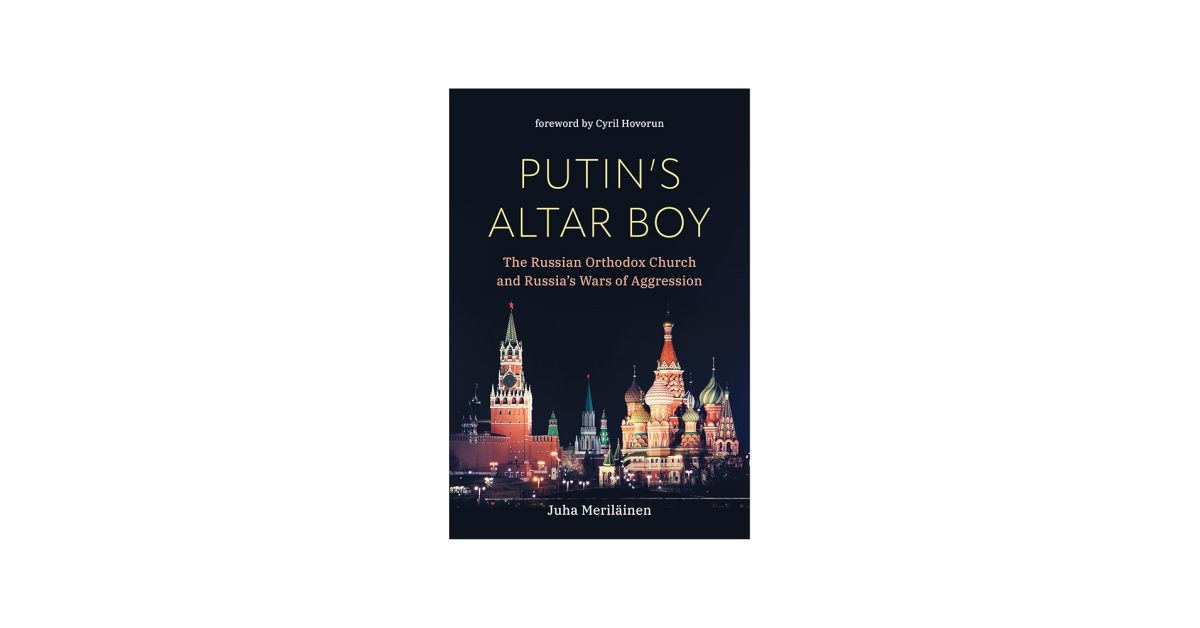
PUTIN’S ALTAR BOY: The Russian Orthodox Church and Russia’s Wars of Aggression. By Juha Meriläinen. Foreword by Cyril Hovorun. Minneapolis, MN: Fortress Press, 2026. xv + 324 pages.
It’s been more than four years since the Russian military invaded Ukraine. What looked in the beginning like a quick victory by the Russians over an overmatched Ukrainian army has proven to be a stalemate. Despite Russia’s military’s inability to defeat the Ukrainians, Vladimir Putin seems to be in no mood to change course. Most North Americans and Europeans have supported Ukraine from the beginning, in part out of fear of what Putin might do next if he succeeded in Ukraine (interestingly, the current American administration seems to give at the very least tacit support to Putin’s claims).
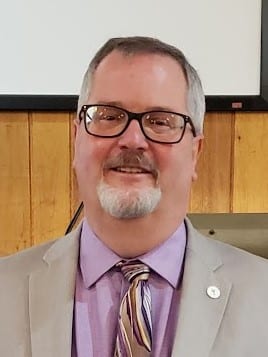
Robert D. Cornwall
It’s in this context that I come to review Juha Meriläinen’s Putin’s Altar Boy. While I have the current aggression in mind, I also grew up during the Cold War, a time when the Soviet Union was the primary enemy of the United States. The current Russian state is the core remnant of the Soviet state, with Vladimir Putin seemingly desiring to reclaim the components that made up the Soviet empire. He seems to have the support of the Russian Orthodox Church in this effort.
Now, the Soviet Union was, by its own definition, atheistic. Nevertheless, although suppressed by the government, the Russian Orthodox Church found ways to survive. Then, in 1991, when the Soviet Union collapsed, a new day came for the Russian Orthodox Church as it was freed from the shackles of the Soviet system. While the first decade of freedom was rather chaotic, the country stabilized once Vladimir Putin came to power. As for the church, it found a partner in Putin that supported its claim to being the religious and cultural foundation of Russia.
Then came the aforementioned Russian invasion of Ukraine in 2022, which followed the invasion of Crimea in 2014, which at the time was part of Ukraine. In the intervening years, leading up to the current conflict, Russian-backed rebels have tried to reclaim the Donbas region from Ukraine. Mixed into this conversation is the nature of the relationship of the Russian Orthodox Church with Putin’s government, especially in light of its wars of aggression toward its neighbors. That question turns on the nature of the role played by the Russian Orthodox patriarch, Kirill, in this relationship. As we ponder that question, we must ask whether Kirill is “Putin’s Altar Boy,” as some have suggested.
The question as to the nature of the relationship of the Russian Orthodox Church and the Russian state is taken up by Juha Meriläinen, a Finnish Lutheran Minister, advisor to the Archbishop of the Evangelical Lutheran Church of Finland, and associate professor of church history at the University of Helsinki, in Putin’s Altar Boy: The Russian Orthodox Church and Russia’s Wars of Aggression. In this book, Meriläinen explores the relationship Putin’s relationship with the Russian Orthodox Church, not as an expert on the Russian Orthodox Church, but as one with an excellent understanding of religious nationalism, as well as the situation in Russia.
He begins the book with a Preface subtitled “The Pope and the Patriarch,” which takes note of an encounter on Zoom in March of 2022 between Pope Francis and Patriarch Kirill, in which Francis confessed his lack of understanding of Kirill’s support of the invasion of Ukraine. In May of 2022, after that conversation, Francis told interviewers that “the Patriarch cannot become Putin’s Altar Boy.” In making that comment, Francis expressed his desire to persuade Kirill to remember that he is the leader of a church, not a member of the Russian state.
As I read Putin’s Altar Boy, a book that suggests that Kirill is indeed Putin’s altar boy or acolyte, I found the book fascinating and a bit scary. One can see in Meriläinen’s description of the partnership of Putin and Kirill elements that are present in the religious nationalism that has arisen in the United States, especially as religious leaders have sought to partner with Donald Trump in his move toward authoritarianism. Interestingly, one of the primary issues that Kirill and Putin have placed front and center is “traditional values,” with special emphasis on gender and sexuality. In other words, the central theme of their vision of traditional values is opposition to LGBTQ rights.
Meriläinen covers a great deal of ground in this book, as he explores the history of the Russian Orthodox Church, its relationships with the different governmental entities, and finally the relationship of Patriarch Kirill and the Russian Church with Vladimir Putin’s war effort. The thread that runs through the book focuses on the question of why the Russian Orthodox Church has become so closely linked with the Kremlin and Russian nationalism. What this thread does for us is help us better understand the Russian war with Ukraine, a nation that Kirill and the Russian church leaders believe is their point of origin as a Christian community.
In Chapters 1 and 2, Meriläinen looks back on the rather chaotic 1990s, beginning in Chapter 1, titled “Freedom and Power, with an exploration of the Russian Orthodox Church’s situation under Soviet domination to the church’s prosperity in the 1990s after the fall of the Soviet Union freed the church from state control. Then, in Chapter 2, titled “The Rise of the Russian Orthodox Church,” he focuses on how the Russian nation embraced Orthodoxy, while the church sought to reestablish a close relationship with the state. This includes reclaiming the idea of symphony between church and state that goes back to the Byzantine Empire, where church and state, at least from a church perspective, were equal partners.
Significant attention has been given recently to the rise of Christian Nationalism in the United States and elsewhere, and religious nationalism is a major issue in Russia as well. In Russia, religious nationalism involves the central role of Orthodoxy in the new Russian identity. Thus, Chapter 3 explores “The Many Faces of Religious Nationalism,” which includes a discussion of the emphasis in Russian Political Orthodoxy on traditional family values, including a strong anti-LGBTQ effort. It also involves the attempt by the Moscow Patriarchate to maintain its authority over the Orthodox Churches that exist within the former Soviet republics, including Ukraine. There are several contributors to this effort, including Russian Pan-Slavism and Eurasianism. What is interesting about the Eurasianist component is the recognition of Islam as a quasi-form of Orthodoxy. That is, there is recognition that within Russia there is a significant number of Muslims, necessitating a recognition of its importance to the state.
Having taken note of “The Many Faces of Religious Nationalism,” we come in Chapter 4 to “Putin’s Russia.” Here we learn about Putin’s rise to power in the aftermath of the chaos of the Yeltsin era, including his original openness to the West, along with his eventual conservative turn that has contributed to the current situation in Ukraine. Among the situations that emerged during the years of Putin’s reign are the wars in Chechnya, the cooling of the relationships with the West, especially with the beginning of the Iraq War, which Putin opposed, and concerns about NATO’s expansion. An additional component of this conservative turn involved the relationship that developed between Putin and Kirill, which involved questions about Russian identity and Putin’s look toward the Russian Orthodox Church to answer that question.
Chapter 4 then leads into Chapter 5, “The Church as the Protector of the Russian World. By Russian World, this involves more than the current Russian state, but the larger sense of a Russian World that includes former republics and those in the diaspora. Thus, in this chapter Meriläinen explores the sense of an Orthodox Civilization, as Kirill and others contemplated it. Kirill’s view of Orthodox civilization borrowed the idea posited by Arnold Toynbee and Samuel Huntington, among others, that humanity is divided among several great civilizations. For Kirill, Western and Eastern Civilizations are very different. In his view, the Russian world was central to Eastern Civilization.
In his mind, the closest civilizations to Eastern Christian Civilization are Islam, Judaism, and Buddhism. Therefore, we see in Kirill and Putin the development of a strong reaction to Western Euro-American civilization, which they believe is decadent and even Satanic. One of the expressions of the Russian Church’s anti-Western view involves their serving as anti-gender lobbyists. That is, Russian entities have provided important support for anti-gender and traditional values efforts throughout the West, including the United States. Think here of the embrace by the Religious Right and their allies in the Trump administration of illiberalism.
In Chapter 6, titled “The Problem of a Shared History,” the focus moves to the relationship of Russia, the Russian Orthodox Church, and Ukraine. In this chapter, the author discusses the Russian, and especially the Russian Orthodox, belief that Kievan Rus’ is not only the foundation of Russia, but after the conversion of Vladimir the Great, the Russian Church. Quite helpfully, Meriläinen discusses in some detail “mythical Kievan Rus’,” which serves as the foundation for contemporary Russian identity and therefore a basis for the war in Ukraine, since Kirill and Putin believe Ukraine is part of Russia and not a separate entity. There is much here that will be of interest to those trying to understand why this war has become so central to the identity of the Russian state and church.
Continuing with the question of Ukraine’s identity, Chapter 7 is titled “The Battle for the Soul of Ukraine.” When the Soviet Union collapsed, Ukraine became an independent nation. The question discussed here concerns the identity of Ukraine as a nation and a people, including its religious life. The author points out that eastern and western Ukraine are different from each other in many ways. This is true religiously, with churches in the eastern portion being more Orthodox and those in the west being Greek Catholic (Eastern Rite Catholics). Because of these differences, the Christian community in Ukraine has been fragmented.
Even the Orthodox Church in Ukraine has splintered, with some parts of the Orthodox Church understanding themselves to be part of the Moscow Patriarchate, while others have sought independence. Then there are the Eastern Rite Catholics who were connected to the Catholic Church. As Ukraine sought to form its own identity, it also has had to deal with the fact that it imports much of its gas and oil from Russia, a fact that the Russians have weaponized. Then there is the annexation of Crimea in 2014, which the Ukrainians and much of the world have not recognized. As some Ukrainian Orthodox sought independence from Russia, they turned to the Ecumenical Patriarchate for support. This has produced more conflict between Constantinople and Moscow, which continues to this day.
When we turn to Chapter 8, the focus is on “The War Against Sin and Western Values.” Here again, the Russian war against sin and Western values undergirds Putin’s war efforts in Ukraine and Russian engagement with the Global South, which is attracted to Russian military aid and its emphasis on traditional values. So, what we have here is Russian propaganda opposing “The Dominance of the Satanic West.” Thus, the war in Ukraine is painted as an attempt to protect the people from Satanic Western influence. The Patriarch has played a leading role in this war on sin. However, as this war on sin has been undertaken, Kirill began to lose Ukraine. While it is true that Kirill has essentially lost influence over the Ukrainian Orthodox, aggression has continued and, to some degree, has been abetted by Donald Trump. As the author points out, while the economic outlook for Russia looks bleak, Trump’s more conciliatory attitude toward Russia has allowed Putin more room to maneuver.
So, the question before us as we seek to understand the relationship of the Russian Church and the Russian state is whether Kirill is, in fact, “Putin’s Altar Boy.” Juha Meriläinen seeks to answer that question by providing the reader with an in-depth analysis of the Russian state and its relationship to the Russian church. As we read along, it does appear that Kirill is following Putin’s lead, which has proven dangerous for Ukraine’s survival as an independent nation.
As we ponder the current situation in Russia and the partnership of Putin and Kirill, we can see that the situation in Russia and its relationship to its neighbors is increasingly complicated. This relationship has had an important effect on the larger world, especially as Putin and Kirill see themselves as protectors of traditional values against the influence of a Satanic West. Juha Meriläinen’s Putin’s Altar Boy: The Russian Orthodox Church and Russia’s Wars of Aggression is a fascinating and at times frightening book that needs to be read if one is to understand the interconnections of religious nationalism and Russian identity, including Putin’s aggression toward Russia’s neighbors and beyond. While Ukraine factors prominently in this story, we should not forget that Russian entities are at work in the Global South as well as in the West, lobbying for traditional values and more.
This review originally appeared on BobCornwall.com.
Robert D. Cornwall is an ordained minister in the Christian Church (Disciples of Christ). Now retired from his ministry at Central Woodward Christian Church (Disciples of Christ) of Troy, Michigan, he serves as Minister-at-Large in Troy. He holds a Ph.D. in Historical Theology from Fuller Theological Seminary and is the author of numerous books, including “Eating With Jesus: Reflections on Divine Encounters at the Open Eucharistic Table” and “Second Thoughts About Hell: Understanding What We Believe” coauthored with Ronald J. Allen. His blog Ponderings on a Faith Journey can be found here.