NOTE: This piece was originally published at our newsletter A Public Witness.
Multiple federal courts continue to consider issues related to whether or not the U.S. Department of Homeland Security can engage in warrantless actions at houses of worship. While three churches in Minnesota want a judge to force DHS to hand over documents related to DHS’s spying at the churches, several Muslim groups filed a brief to support Christian denominations seeking a ruling for an injunction that prevents DHS from conducting warrantless immigration enforcement in or near affiliated churches.
At the heart of new filings in two different courts are examples of DHS spying in houses of worship. And both cases could ultimately impact how DHS engages at or near houses of worship in the future.
“People deserve to know the full extent of how and why the federal government spied on Minnesotans,” said Irina Vaynerman, CEO of Groundwork Legal (the law firm representing three churches in the Twin Cities that were surveilled by DHS). “Sending undercover agents into houses of worship and tracking community members engaged in lawful activities strikes at the very heart of our democracy and religious freedom. Americans do not want to live in a surveillance state, and the federal government cannot hide behind a veil of secrecy. We will continue to go to court to hold the government accountable and ensure the public gets the answers it is entitled to under the law.”
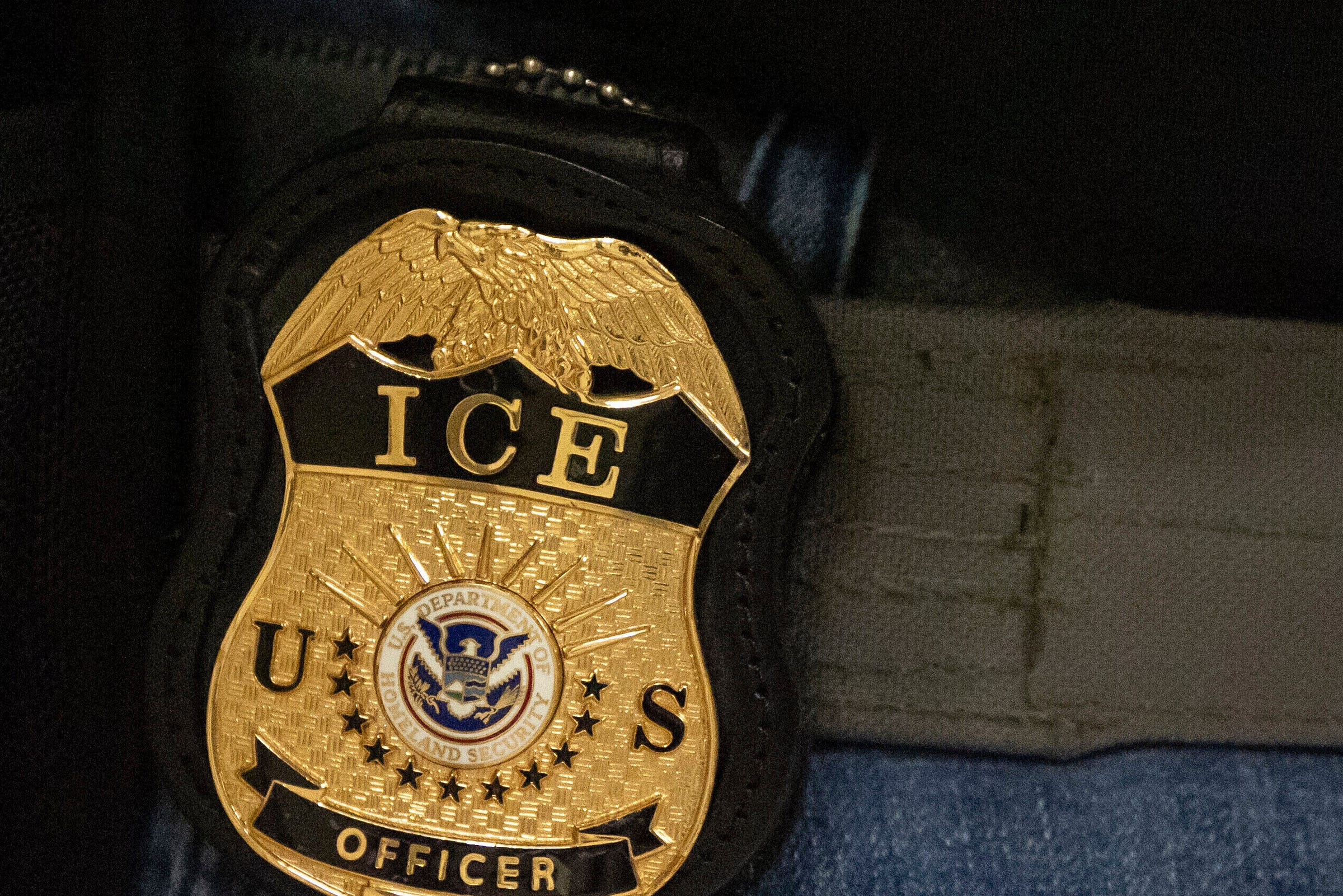
A federal agent wears an Immigration and Customs Enforcement badge in New York City on June 10, 2025. (Yuki Iwamura/Associated Press).
The recent court filings in multiple cases involving DHS’s actions at churches offer insights into the impact of the Trump administration’s actions on houses of worship and how churches and other faith groups are resisting in court, in the streets, and in their sanctuaries. So this issue of A Public Witness dives into recent court filings in a criminal case in Minnesota and an appeals court considering a civil case in Massachusetts.
Triplet Churches in the Twin Cities
The revelations about DHS spying on churches have been growing since they were first revealed in court documents in August. In the case of someone arrested in June for allegedly plotting to harm ICE agents, documents showed some of the measures DHS agents had taken to track those accused in the anti-ICE conspiracy and many other people not accused of any wrongdoing.
The first round of court documents detailed five times DHS agents entered a church building, with spying incidents at First Universalist Church in Minneapolis, Prince of Peace Lutheran Church in Roseville, St. John the Evangelist Episcopal Church in St. Paul, University Baptist Church in Minneapolis, and Zion Lutheran Church in Ann Arbor, Michigan. As first reported by A Public Witness, University Baptist Church was covered by a federal injunction that was supposed to prevent DHS warrantless actions there. News of the injunction led to the release of additional DHS records detailing three more times when DHS surveilled people entering and leaving the church.
Later releases of documents showed yet another incident of surveillance at St. John the Evangelist Episcopal Church as well as an instance of surveillance at Hennepin Avenue United Methodist Church in Minneapolis. (I spoke in October at Hennepin Avenue UMC about Christian Nationalism along with journalist and ELCA Lutheran minister Angela Denker.)
While DHS said in court that there were no more than four surveillance incidents at University Baptist Church, they have not said whether there were more actions at other churches. As a DHS official put it in a court statement, “I cannot confirm or deny that there are additional investigations at other locations on the protected locations list.” DHS later admitted it does not know how many churches it has spied on.
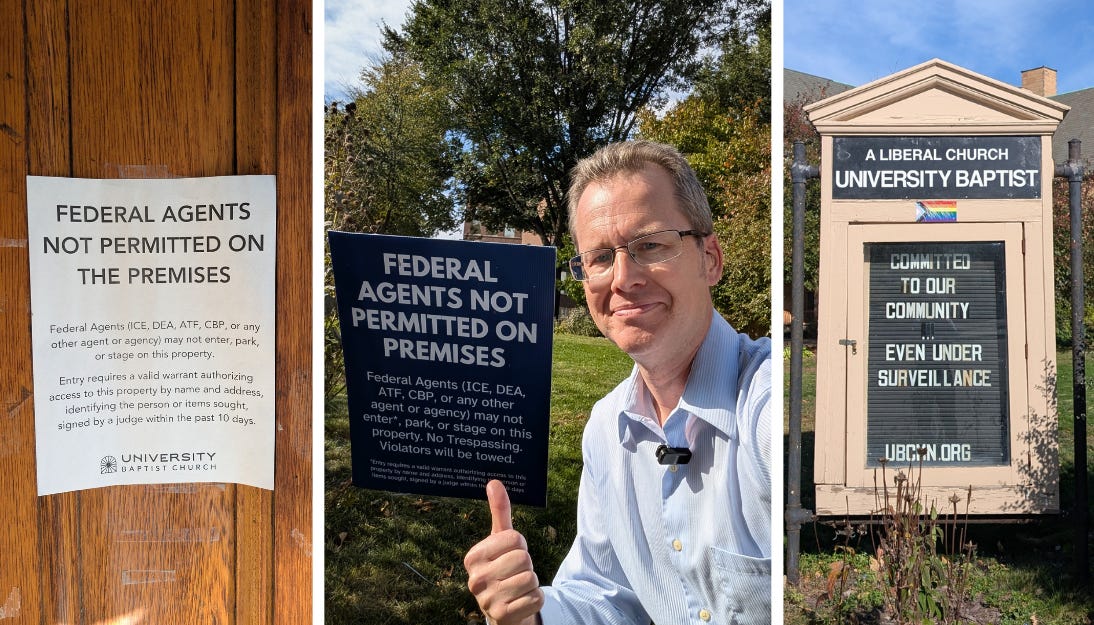
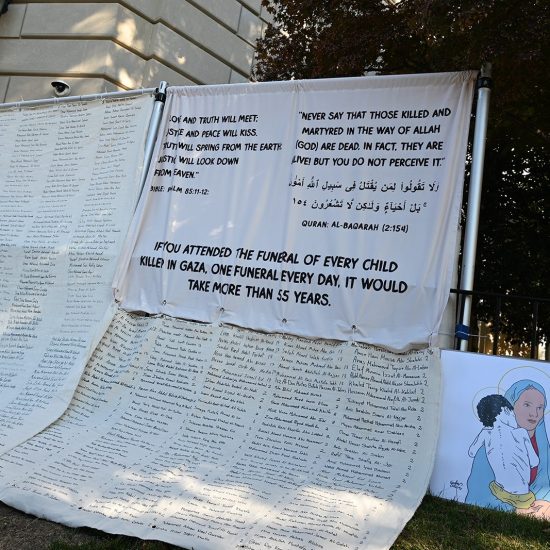
Some of the signs at University Baptist Church in Minneapolis, Minnesota. (Brian Kaylor/Word&Way)
University Baptist Church previously filed a document with the court to note the injunction covering it and to support discovery. Now, three more of the churches that appear in DHS surveillance records are requesting a federal judge to require DHS to turn over all records related to their congregations. As first reported by Minnesota Reformer, First Universalist Church, St. John the Evangelist Episcopal Church, and Hennepin Avenue United Methodist Church documented in a filing on Wednesday (Nov. 18) how they were “directly affected by the government surveillance” and urged “a complete account of the government’s surveillance.”
“The government monitored peaceful gatherings at amici churches, and the resulting revelations have impaired their ability to worship, assemble, welcome newcomers, and advocate for their neighbors,” the three churches explained. “The churches have incurred additional security costs, altered their operations, and seen members withdraw from in-person participation. They also reasonably fear that the disclosed reports reveal only a fraction of the surveillance.”
“The public must be able to evaluate whether the government used its prosecutorial power to target people and organizations for constitutionally protected expression. Discovery is an essential first step,” the churches added. “The surveillance of religious congregations and civic organizations is not an isolated phenomenon. Rather, it is part of a recurring history of government monitoring political and religious movements with which it disagrees. A complete record can expose the scope of that conduct, facilitate meaningful public scrutiny, and help prevent its recurrence.”
The filing also notes DHS records included “no unlawful conduct” at the three churches and that DHS was monitoring “protected First Amendment expression.” The churches also reported that some individuals have stopped attending services out of fear that the government is still surveilling the buildings. At Hennepin Avenue UMC, “One family canceled their child’s planned baptism and moved it to another church because relatives did not feel safe attending the church.” And all three churches have spent time and resources on increasing security.
Noting that the government has admitted to withholding some reports from the investigation, the churches insisted they are not confident that no other surveillance incidents occurred — especially since all three churches regularly opened their doors for events and services challenging ICE’s activity in the Twin Cities. The judge has yet to rule on the push for the release of more investigation records.
Help sustain the journalism of Word&Way by subscribing to A Public Witness!
Interfaith Support for Christian Denominations
When DHS spied at University Baptist Church, it did so despite signs at the church informing agents of an injunction. The congregation is part of the American Baptist Churches USA and the Alliance of Baptists. A federal judge in Massachusetts on Feb. 13 granted an injunction for both denominations to block DHS from conducting warrantless actions on the property of affiliated churches — and the judge specifically mentioned UBC in his ruling. That injunction also protected congregations in the Metropolitan Community Churches and several Evangelical Lutheran Church in America regional synods.
Prior to revelations of the spying at University Baptist Church, DHS had already filed an appeal in an attempt to have the injunction overturned. As the appeals court is considering the matter, multiple groups have recently filed briefs, which have not yet been reported on, to support the injunction granted for the denominational groups. Among those backing the Christian denominations is a brief from a coalition of Muslim, Jewish, Sikh, and interfaith organizations.
Fourteen faith-based groups working on immigrant justice or civil rights issues filed a joint brief to support the Christian groups in their suit against DHS. Among those joining the brief are Interfaith Alliance, The Sikh Coalition, Bend the Arc: A Jewish Partnership for Justice, and multiple Muslim groups (including CAIR Foundation, Muslim Bar Association of New York, and Muslims for Progressive Values). They filed their brief to “demonstrate the tangible harms experienced by all immigrant communities because of the chilling impacts” of the Trump administration removing protections for houses of worship and “on their statutory and constitutional freedoms of religious expression and association, including in connection with Islamic faith practices.”
“The Sensitive Locations Policy provided a check on the longstanding pattern and practice of targeting Black and Brown communities, including Muslim communities, under the guise of national security,” the groups wrote. “When government policies unduly target people at their houses of worship, they disrupt these communal practices and fracture the cohesiveness of religious communities, spanning citizenship and immigration status, and in violation of protections enshrined in [the Religious Freedom Restoration Act] and the First Amendment.”
The brief outlines a history of government surveillance of mosques, especially after the 9/11 terrorist attacks (but which continued for over a decade in the New York area). The groups explained that “the resultant chilling effect on impacted communities was documented and clear: worshippers feared attending mosques, knowing that their mere attendance could, on its own, subject them to surveillance and targeting.” The brief adds that once again, Muslims are particularly targeted as the Trump administration seeks to stop immigration from Muslim-majority nations — as was seen in “Operation Metro Surge” amid rhetoric “targeting Minnesota’s Muslim and Somali communities.”
If the appeal court affirms the injunction, it would only continue to protect the plaintiff Christian denominations. But the Muslim and other groups hope it will help lead to a return of the sensitive locations policy for all houses of worship. To that end, they highlighted examples of decreased attendance at mosques to show the harm from the policy’s rescission.
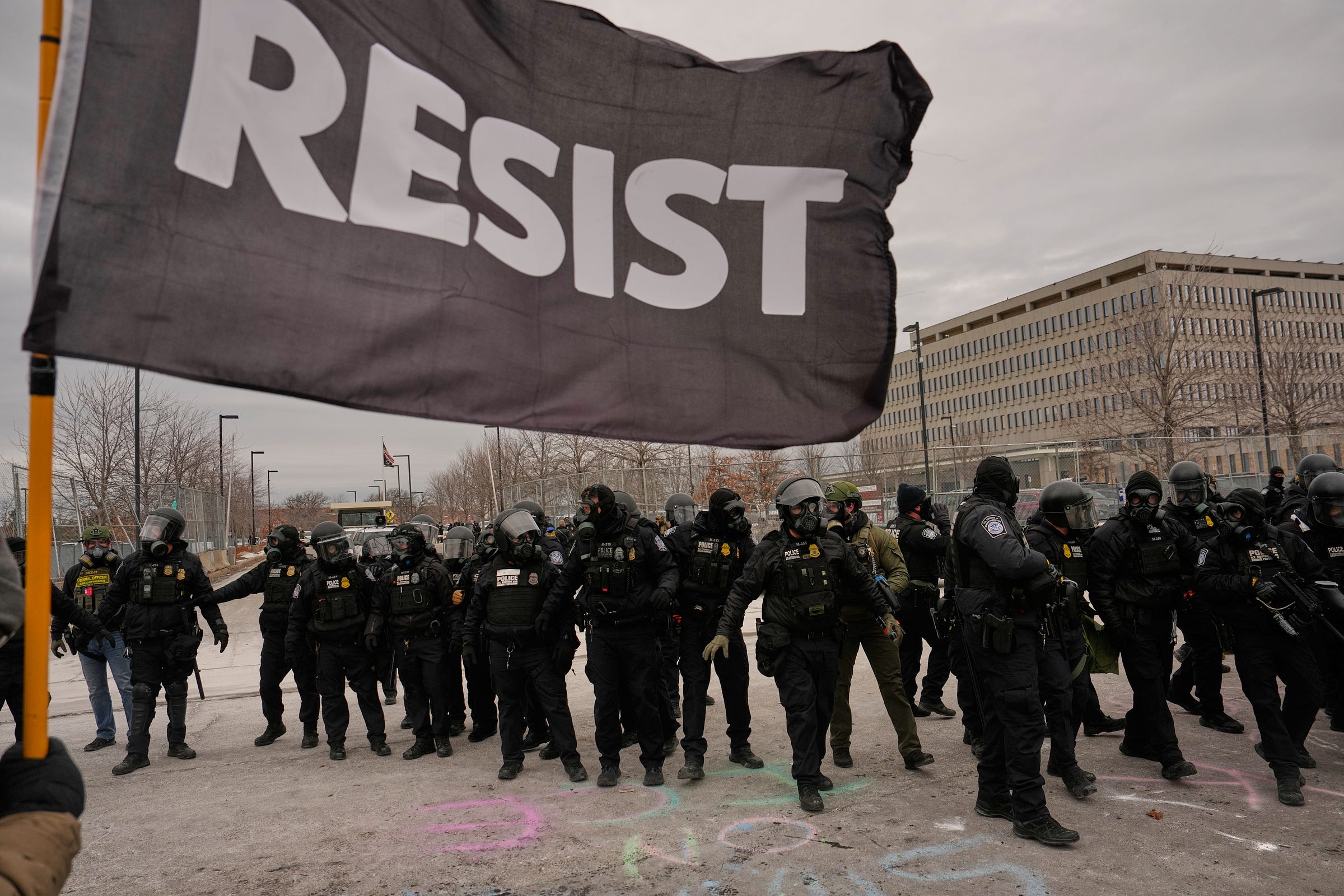
Federal immigration officers confront protesters outside Bishop Henry Whipple Federal Building in Minneapolis, Minnesota, on Jan. 15, 2026. (John Locher/Associated Press)
Other groups also filed briefs to support the denominational groups in the appellate court. The American Civil Liberties Union argued the injunction remains “necessary to protect the religious practice of thousands of people in this country from yet another unlawful attack by the Trump administration on religious exercise.” The ACLU documented the Trump administration’s record of infringing on religious liberty rights to insist that houses of worship should be protected from the administration.
“Absent the district court’s order, the decision to raid a church, set up a checkpoint outside a mosque, or use a synagogue’s parking lot as a staging ground for arrests, would be left to the discretion of line officers without any articulated substantive limits and subject only to the verbal or written approval of certain regional supervisors,” the ACLU wrote. “Especially against the backdrop of the repeated behavior described above — where the administration undermined religious practice in a wide variety of circumstances — it is likely that this discretion would be exercised in a manner that similarly violates legally protected religious freedoms.”
Fair and Just Prosecution, an organization that brings together local elected prosecutors and district attorneys to work toward “a justice system grounded in fairness, equity, compassion, and fiscal responsibility,” also filed a brief supporting the denominational groups. They argued that the Trump administration’s shift is “eroding public trust in prosecutors and police when houses of worship become settings for immigration surveillance and enforcement.”
“Houses of worship often provide social welfare services such as support groups, counseling, meals, childcare, classes, and even shelter. When these services are compromised, people suffer, communities fray, and the resulting instability makes crime more likely and law enforcement’s job more difficult,” the group added. “Knowing that no place is sacred to immigration enforcement stokes the public’s reasonable fear of aggressive enforcement.”
The appeals court is still considering the matter. Meanwhile, a different federal appeals court in August upheld a similar injunction protecting congregations affiliated with the Cooperative Baptist Fellowship and several regional Quaker groups in addition to a Sikh Temple in California. And another federal appeals court in October overturned a lower court ruling denying a similar injunction for 27 mainline Protestant and Jewish groups.
As seen with this myriad of cases and court filings, the religious resistance to DHS continues.
As a public witness,
Brian Kaylor
A Public Witness is a reader-supported publication of Word&Way. To receive new posts and support our journalism ministry, subscribe today.