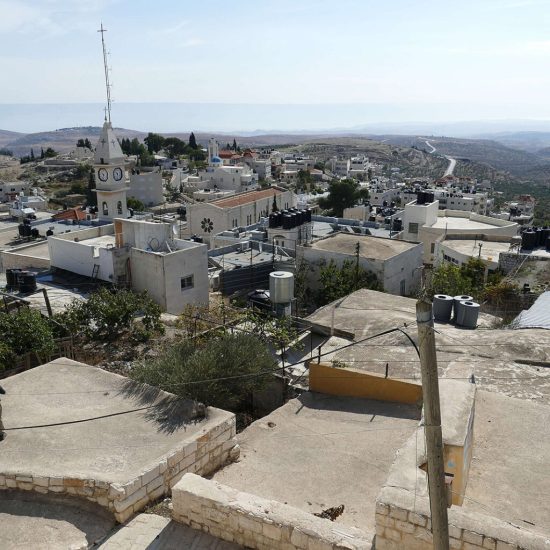
(RNS) — Nearly 10,000 students in Jerusalem’s Christian schools started the academic year a day late after the schools closed Tuesday (Sept. 1) to protest Israel’s refusal to renew entry permits for more than 70 Palestinian teachers and staff from the West Bank.
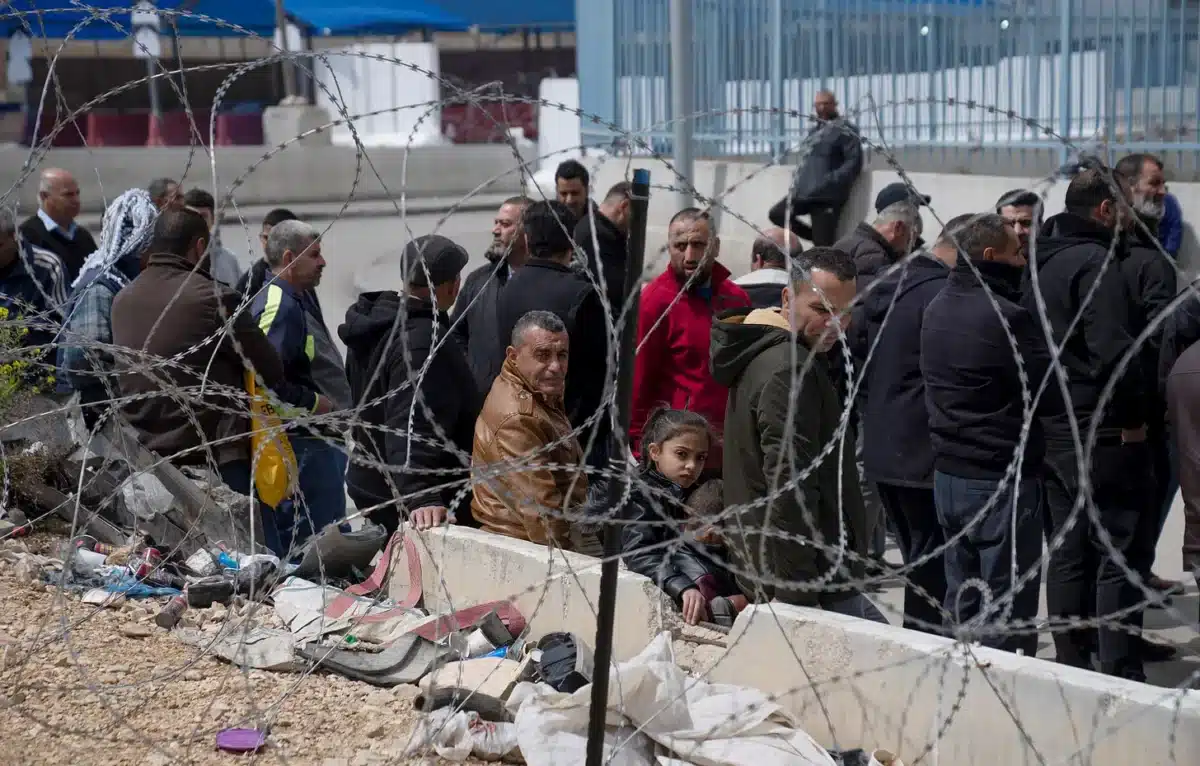
FILE: Palestinians wait behind a barbed wire fence as they seek to be allowed to cross from the West Bank into Jerusalem for a religious service on March 31, 2023. (Nasser Nasser/Associated Press)
The Christian schools announced the closure Aug. 31, saying the permit denials had come “suddenly and without notice,” leaving them unable to prepare for the 2026–2027 school year. The 15 schools serve students from Jerusalem’s Christian communities and include institutions that have operated for hundreds of years.
“These schools are an important part of the Jerusalem Mosaic, especially for the Christian communities,” said Hagop Djernazian, a Jerusalem Armenian community activist. “They give a safe home for many children and for their students. They keep the traditions of the local communities alive.”
In response to the protest, Israeli authorities relented Tuesday, announcing that the permits would be approved and the staff allowed to enter. The permits are currently confirmed only through the end of the calendar year, leaving the schools uncertain whether their teachers and staff will be able to remain for the full academic year.
“We are worried that they may not be renewed, or we will have to force them to renew them, or if there will not be a solution, then we will find ourselves in the same problem that we were in the past few days,” he said. “We are afraid that it is part of a broader issue that can affect our freedom of religion and the right of education of our children.”
Israeli authorities did not give a reason for the initial rejection or ultimately limited approval of the entry permits.
“Israel’s permit regime — reminiscent of the notorious South African apartheid pass system — greatly limits the ability of Palestinians anywhere under Israeli rule to access the best talent for their schools,” said Philip Farah, a founder of the Palestinian Christian Alliance for Peace. “It’s shameful that a state that purports to represent the Jewish people — who had been ghettoized in Europe — is imposing ghettoization on another people.”
Farah was a student in the 1960s at St. George’s School in Jerusalem.
“At the time, several of our teachers were from places outside of Jerusalem,” he said. “Some of the teachers were Christians from villages that still have sizable Christian communities, like Taybeh and Zababdeh,” villages in the West Bank.
The issue also comes at a time when many East Jerusalem schools are undergoing radical change, as this year new first and seventh grade classes will replace the Palestinian curriculum they had historically used with the Israeli curriculum. The move has been strongly criticized by Palestinian leaders in the West Bank and Gaza.
“This constitutes an attack on the right of Jerusalemite students to education based on curricula that reflect their history, identity, and national culture,” the Palestinian Authority’s Jerusalem Governate Spokesman Marouf al-Rifai said in a statement on Facebook. “The adherence of Jerusalem’s people, teachers, and students to the Palestinian curriculum is not merely an adherence to a textbook, but rather a defense of memory, identity, history, and the right to determine the national narrative.”
Most of the Christian schools follow international and church curricula and were not affected by the “Israelization” process. Nonetheless, the affair is only the latest pressure Jerusalem’s Christian communities have faced in recent years.
According to a report by the Jerusalem-based Rossing Center for Education and Dialogue, 2025 saw more than 150 attacks on Christians in Israel, up from 111 in 2024 and 89 in 2023. Only about 1.9% of Israel’s population is Christian, and 80% of Israeli Christians are Arab.
Earlier in April, an Israeli soldier smashed a statue of Jesus with a sledgehammer in southern Lebanon while another soldier photographed the act, resulting in their removal from combat service and prompting the Jewish state to appoint a special envoy to the Christian world. In May, a man chased and assaulted a French Catholic nun in Jerusalem. This month, the nun’s attacker was acquitted on the grounds of mental health but confined to a psychiatric hospital.
“Unfortunately, in recent years, it has turned to be a hobby for extremists to spit towards the Armenian convent, to vandalize church property, to attack clergy,” Djernazian said. “Five or six years ago, one time or two times in a month there was an attack against Christian clergy; today it’s daily. So you can feel the change, you can feel the rise in harassment and the fact that the government is not giving any importance to these things.”
Djernazian said he’s hopeful that Israel’s upcoming elections in October will provide some relief, but for most of Jerusalem’s Christians there is little reason to have faith in the electoral system.
The vast majority of the Christian population in Jerusalem is made up of Palestinian Arabs and members of Latin or Greek Catholic, Greek Orthodox, Armenian Orthodox and other churches whose history in the city stretches back centuries.
East Jerusalem Arabs live in a complicated political reality. After Israel annexed East Jerusalem in 1980, 13 years after its capture in the 1967 Six-Day war, most of East Jerusalem’s Arab residents became permanent residents rather than Israeli citizens, giving them the right to participate in the city’s municipal elections but not Israel’s national ones.
Their status was further imperiled by Israel’s West Bank barrier, which was built in the midst of the second Intifada. The 440-mile-long fortification bisects East Jerusalem and cuts many neighborhoods off from Israeli infrastructure and social services while still partitioning the residents from the Palestinian Authority’s jurisdiction.