Like some of you, I don’t find social media particularly appealing. As a contented introvert who values quality over quantity, I’m at odds with the many platforms before we even begin. With little patience for the fluff and easy voyeurism abounding there (that also exists in real life), I only participate enough to stay reasonably conversant about digital trends and the tangled web of online interaction. I did, however, come across the actor and influencer Druski’s latest church parody that has been trending.

Rev. Dr. James Ellis III
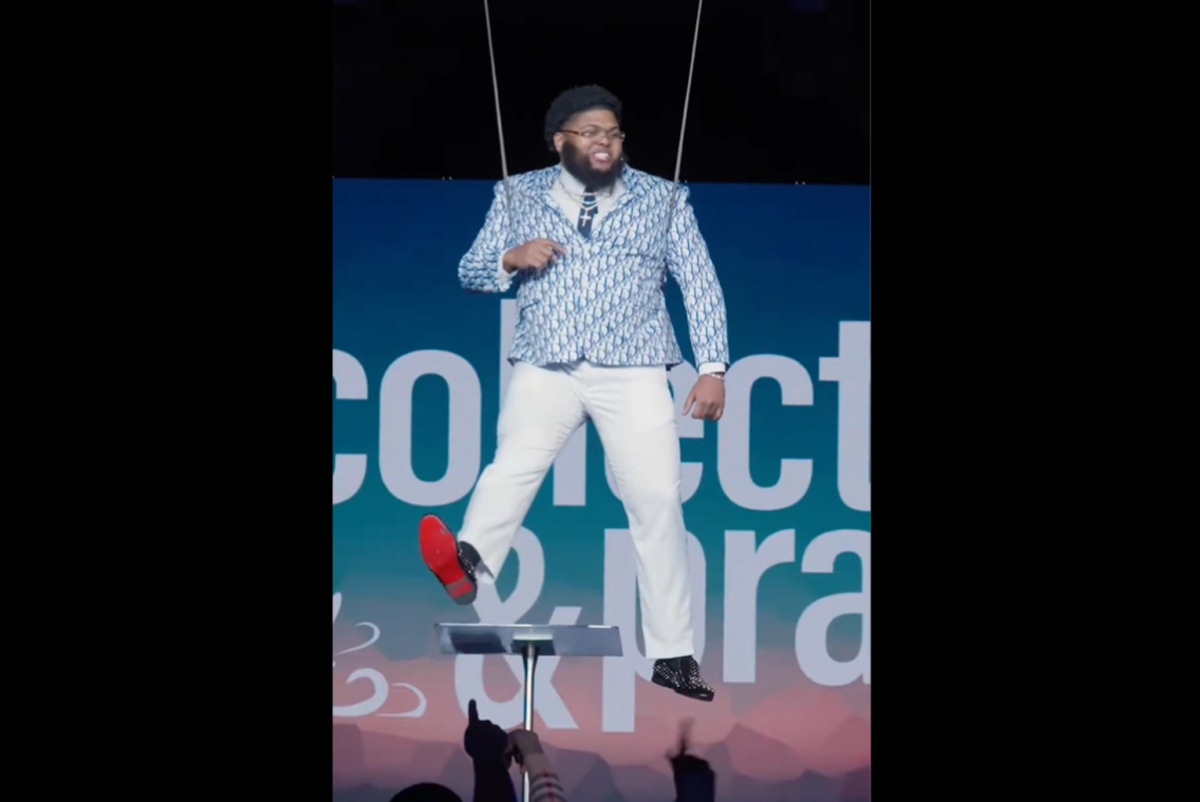
If you haven’t seen it, he imitates a pastor throughout, but not just any pastor — a visibly materialistic, slimy one. At one point, he’s suspended from the sanctuary ceiling amid choreographed blasts of smoke from a fog machine, wearing a shiny, loud Bad Boy-era or Steve Harvey-style suit. He does the worm across the stage, urges the congregation to donate $4 million by the end of the service to fund a new church in Zimbabwe, and is later seen handling cash fresh from a money-counting machine.
He also rebukes someone who asks about prayer for his wife, pointing out that the man hasn’t contributed any tithes or offerings. Over two minutes and thirty seconds, he pokes fun at a highly capitalized, manipulative way of doing, and being, the church.
Everyone’s sense of humor will, of course, engage with the video differently, if at all. What’s hilarious to one person may fall flat for another or be offensive. But for what it’s worth, despite being an exaggeration that some feel unfairly targets God’s people, one reason it resonates so widely is its relatability.
Even when a viewpoint isn’t completely “ironclad,” it can still be legitimate. Moreover, Druski’s interpretation of church life isn’t merely the product of professional writers indiscriminately pitching ideas in a room. To our shame, the material can be found in almost any real, random church across the country, echoing a phrase diehard fans of The Martin Show know by heart: “Get it together, or leave it alone.” Let that sink in.
The Church must stop whining about valid criticism made about it, no matter who delivers it. If there is truth in the critique, however uncomfortable it may be, we should face it openly and surrender to the Spirit’s intention to sanctify us through confession, repentance, and reform. Anything short of that makes God’s people look like temperamental weaklings, stuck digesting spiritual Similac instead of the meat that’s needed for growth.
It speaks to an individual example, but David clearly sinned and then covered it up by secretly arranging for the battlefield murder of Bathsheba’s husband, Uriah, who was a loyal soldier in his own army. How sick can you get? And he only came clean, so to speak, once his friend and prophet Nathan was used by God to call him out (1 Sam 11-12). If you haven’t noticed, the Bible (and those who have attempted to model its truth through the centuries) rarely reads like an episode of The Brady Bunch. If anything, it is a blend of Family Guy, P-Valley, and Law & Order.
Comedian Druski’s viral skit (video screen grab)
Brutal honesty about our colossal faults, individually and collectively, is not optional. To all of us, much has been given, and much is required (Luke 12:48), but I wonder, in times like these, if we actually believe that. The responsibility is on us, not the world, to remain faithful to God and God’s Word.
This issue goes far beyond the abominable conduct of certain worship styles or debatable ministry approaches. It concerns something much deeper, and more alarming and offensive for those of us who profess to love the Lord: cancerous beliefs and practices that deny Scripture and the image of the crucified Christ presented within it. We need to call sin what it is, wherever we find it among us. One way we’ve failed to do this is with the prosperity gospel or health-and-wealth doctrine.
It argues that ostentatious, conspicuous consumption and easy living are birthrights for anyone who pleads the blood of Jesus. In his own way, consciously or not, Druski is comedically naming this malady. Unfortunately, we’ve endorsed “pimp culture” and childish pageantry in many of our churches that exploits rather than protects. Whether it’s a small church or a large church, Black church or White church, suburban or urban, we see evidence of this, subtly and demonstratively, in all ecclesial systems and expressions.
I got turned around in some little town I’d never been to before
Workin’ my way through a middle of June midnight thunderstorm
There was somethin’ in the headlights that stopped me on a dime
She was scared to death, so I said, “Climb in,” and in she climbed
Ohhhhhhh
This is how “Get in the Truck” opens, the 2022 song by HARDY featuring Lainey Wilson. Without promoting waywardly deputizing ourselves as vigilantes, I really like the song simply for what it is: entertainment. And yet, it helps us see some of what is wrong with American Christian theology.
What I mean is this: We tend to identify with the woman in the story who has been abused, or with the stranger who rescues her — not with the abuser. We assume we are the good ones: relatively innocent, well-intentioned, impartial, and spiritually superior. We think we’re off the hook because we take communion, pray, attend church, or adhere to a broadly Protestant moral compass.
But we forget that it is we who stand in need of prayer (Luke 18:13), first and foremost, as the chief sinners (1 Tim 1:15). Most churches today are not remotely “mega” in size or scope, hopefully we know, nor do they reflect a fleshly, fickle faith — one that has nothing to do with the Bible and is proudly averse to conflict or suffering.
They are not swarming with the sick antics and values that Druski mocks. And yet, his embellishments, wrapped in satire, cannot be denied or discounted. In the Black Baptist tradition, after making a potentially convicting point, the preacher might say that if you can’t say “amen” in response, then say “ouch.” This is as good a time as any to lean into that manner of self-examination.
James Ellis III is an ordained Baptist pastor leading Maplewood Reformed Church in Holland, Michigan. He also serves as an Assistant Professor of Practical Theology at Winebrenner Theological Seminary. His latest books are In Those Days as Today: Preaching through the Book of Judges and Dysfunction in the Name of Jesus: Confronting the Idol of Pastoral Workaholism.