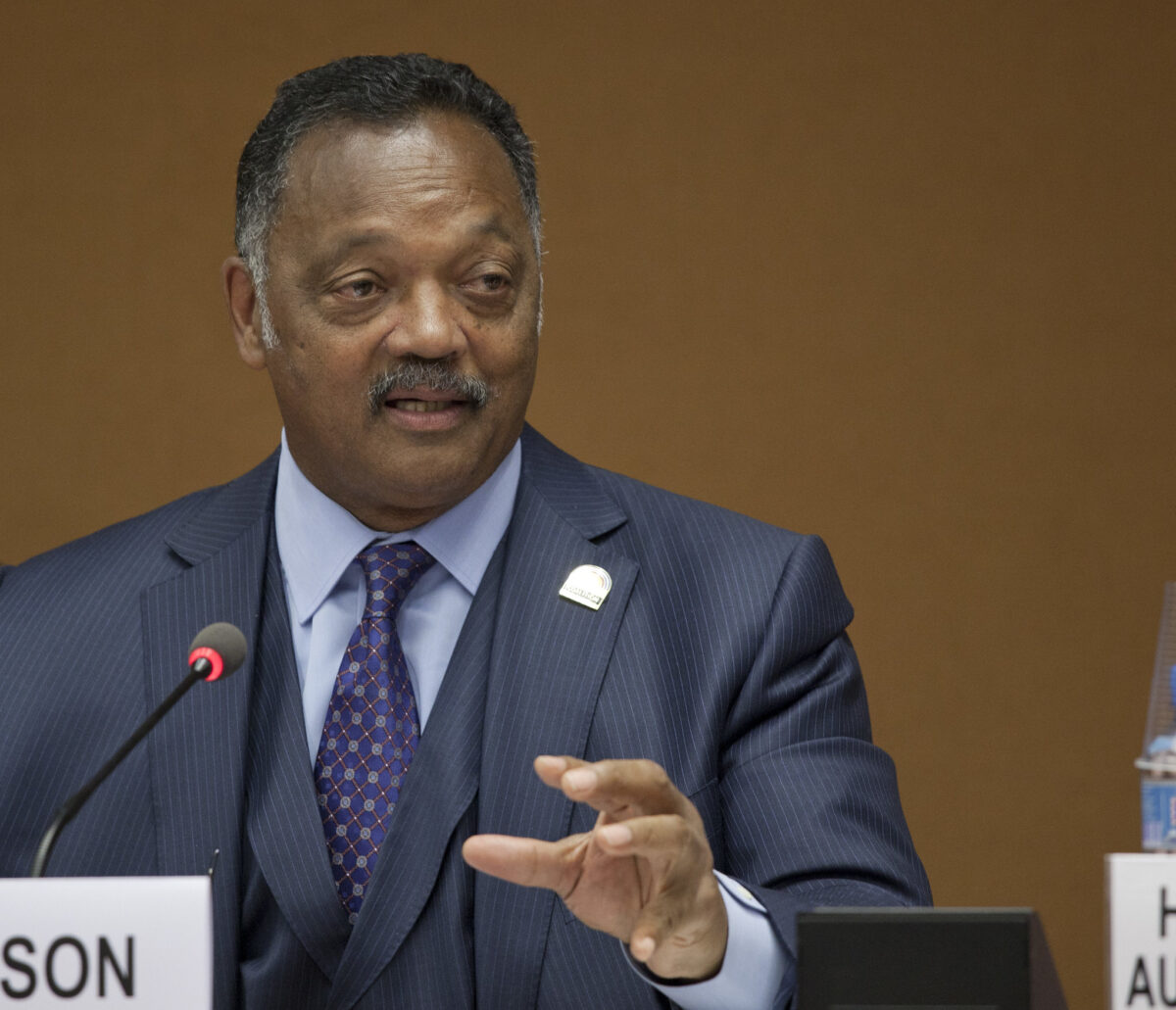
(RNS) — The Rev. Jesse Jackson Sr., a longtime civil rights activist who twice vied for the Democratic presidential nomination in the 1980s, died Tuesday (Feb. 17) at age 84.
Reverend Jesse Jackson speaks at the UN for the International Day for the Elimination of Racial Discrimination on March 21, 2012. (Photo by Eric Bridiers / Flickr)
A protégé of the Rev. Martin Luther King Jr., Jackson was the founder of the Rainbow PUSH Coalition, a social justice organization, but he intertwined his advocacy with politics and diplomacy, serving as a special envoy to Africa for the Clinton administration and as a shadow senator representing Washington, D.C., in the 1990s.
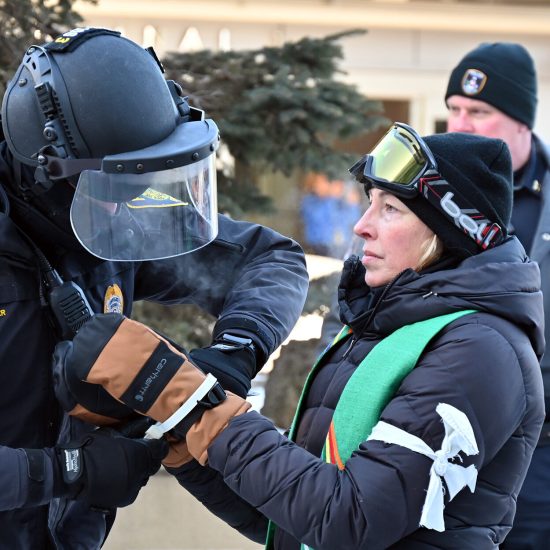
But before ill health prevented him, Jackson continued to appear on the front lines of causes for which he was long an advocate. In the summer of 2021, he was arrested twice outside the U.S. Senate at rallies urging passage of voting rights legislation, led by the Poor People’s Campaign, a revival of King’s anti-poverty movement.
As he had for decades, Jackson led the protesters in chanting one of his trademark phrases: “I am! Somebody! I may be poor! But I am! Somebody! I may be unemployed! But I am! Somebody! I may not have health care! But I am! Somebody! Respect me! Protect me! Elect me! I am! God’s child!”
Jackson had long lived with Parkinson’s disease, but it had been announced in November that he had suffered from progressive supranuclear palsy, a rare neurodegenerative condition, for more than a decade.
At the time of Jackson’s November hospitalization, the Rev. Al Sharpton, president of the National Action Network, called Jackson “a mentor, a friend, and a brother for more than 55 years.”
In a statement to The Associated Press released Tuesday, Sharpton wrote that Jackson “taught me that protest must have purpose, that faith must have feet, and that justice is not seasonal, it is daily work,” adding that Jackson taught “trying is as important as triumph. That you do not wait for the dream to come true; you work to make it real.”
In 2023, Jackson announced he was stepping down from the Rainbow PUSH Coalition, which he had led for more than 50 years. He was briefly succeeded by a Dallas pastor, the Rev. Frederick D. Haynes III, but Haynes resigned the position within months. Yusef Jackson, one of Jackson’s sons, currently serves as chief operating officer of Rainbow PUSH, which is known for its work on social justice, peace, and creating more equitable educational and economic opportunities.
In “Keeping Hope Alive,” a 2020 collection of his sermons and speeches, Jackson said he was inspired to start using the “somebody” phrase after reading theologian Howard Thurman’s “Jesus and the Disinherited.” Jackson recalled the book as he sought to lift the spirits of demonstrators camping out on Washington’s National Mall in rainy conditions during the original Poor People’s Campaign shortly after King’s assassination.
“I’ve been all around the world, and it resonates as much as it did fifty years ago; all around, in every language, people struggle for a sense of somebodiness — marginalized people struggling to find some hope for oxygen, something that helps you to breathe,” he wrote. “It never grows old.”
Though many may have thought of Jackson as more of a politician than a minister, the Rev. Valerie Bridgeman, dean of the Methodist Theological School in Ohio, said he was both. “I don’t think Jesse Jackson saw his political life as something different from his call from God as a preacher,” she told Religion News Service in a 2021 interview.
That dual calling was exemplified by phrases that he used as miniature sermons. “’Keep hope alive’ certainly is an encapsulation of the gospel,” said Bridgeman, who also is a scholar of homiletics, or the art of preaching. “So is ‘I am somebody.’”
In the acknowledgments section of the 2000 book, Jackson described “Keep hope alive” as “the assignment” given to him by King.
CNN anchor Abby Phillip, author of the 2025 book “A Dream Deferred: Jesse Jackson and the Fight for Black Political Power,” described Jackson’s rhetorical prowess as embodying a sense of “moral grounding” during his runs for president.
“One of the things that made Jesse Jackson such a powerful speaker was not just that he used rhymes and alliteration,” she said at The Texas Tribune Festival in Austin on Nov. 15. “He spoke through religious texts and spoke about a moral premise for his candidacy.”
Over the last dozen years, Jackson continued his activism, speaking out against police killings of Black people, joining the centennial commemoration of the Tulsa race massacre, and marching for peace in a Chicago community wracked by gun violence.
When the revival of the Poor People’s Campaign, co-chaired by the Revs. William Barber II and Liz Theoharis, culminated at a 2018 rally in Washington, he was there to urge the crowd to continue get-out-the vote efforts as they sought to address poverty and other social ills. “We have the power to take our nation back in November,” Jackson said. He asked the audience to repeat: “I can vote. I will vote. I must vote.”
In a statement Tuesday, Barber, who met Jackson as a college student, said, “Jesse Jackson was a gift from God and a witness that God exists in the ways he cared for and lifted all people, the way he called forth a rainbow coalition of people to challenge economic and social inequality from the pulpit to a historic presidential run, the way he dared to keep hope alive whenever the nation struggled with being who she says she is and yet ought to be.”
Jackson, a native of Greenville, South Carolina, first made headlines in the summer of 1960 as one of the “Greenville Eight,” a group of Black students who sought to desegregate the town’s public library on the advice of a minister and executive of the state NAACP. Entering the library after being told to leave, the students were arrested and released on $30 bond, according to American Libraries magazine.
After graduating from North Carolina A&T State University, he interrupted his studies at Chicago Theological Seminary in 1965 to start working with the Rev. Martin Luther King Jr. in the civil rights movement. Ordained a Baptist minister in 1968, Jackson earned his master of divinity degree from CTS decades later.
“This institution connected me to the great theologians,” he told Jet magazine in the year 2000, citing Reinhold Niebuhr and Paul Tillich, “and solidified my belief that if we try, we can each make a difference.”
In 1966, Jackson was appointed by King to lead the Chicago expansion of Operation Breadbasket, an economic development program of King’s Southern Christian Leadership Conference that increased job opportunities for African Americans. Jackson was appointed its national director the next year. He founded the economic empowerment organization, Operation PUSH — for People United to Serve Humanity — in 1971 in Chicago and a Washington-based social justice group, National Rainbow Coalition, in 1984. The two merged in 1996 as the Rainbow PUSH Coalition.
When he ran for the Democratic Party’s presidential nomination in 1984, in a pioneering grassroots campaign bolstered by the support of Black churches, he drew 3.3 million votes, which he more than doubled in his 1988 run. But his some of positions, including his advocacy for an independent state for Palestinians, were out of step with the Democratic establishment. He ignited controversy in his first campaign when he was caught on a microphone referring to New York City as “Hymietown,” and though he later apologized, the remark strained relations with Jews.
For most of the 1990s, Jackson was a shadow U.S. senator in the nation’s capital, serving in an unpaid role to lobby for statehood for the District of Columbia.
In 1997, a year after his two organizations merged into the Rainbow PUSH Coalition, Jackson was named a special envoy to promote democracy in Africa for the Clinton administration. He also was involved in diplomacy on his own terms, sometimes drawing controversy for roles that nevertheless aided in the release of U.S. civilians and soldiers detained across the globe.
“The Rev. Jesse Jackson at least puts himself on the line,” wrote the Rev. Andrew Greeley, a Catholic priest and sociologist, in a 1999 Religion News Service commentary Jackson’s mission to Yugoslav President Slobodan Milosevic when he traveled with an interfaith delegation. “He flies to Belgrade, rescues three American prisoners and calls for a bombing halt while the pope writes letters.”
In the 2000s, his diplomacy extended to the Baptist world. He was a prominent participant in a historic meeting of four Black Baptist denominations: the Progressive National Baptist Convention, National Baptist Convention of America, National Missionary Baptist Convention of America, and National Baptist Convention, USA.
Though the four had severed ties over a variety of matters, they sought to find common ground on social issues. Jackson successfully suggested they should include opposing the Iraq war, which was listed in a joint statement.
“It’s time to go back to the streets to complete Dr. (Martin Luther) King’s agenda,” said Jackson, at the 2005 event, where he said he was affiliated with all four of the religious bodies.
Over 60 years of activism, Jackson was nearly ubiquitous at times, sometimes bringing prayer into settings that were primarily secular.
Recently released footage captures him at the 1969 Harlem Cultural Festival, announcing that Mahalia Jackson and Mavis Staples would sing “Precious Lord, Take My Hand” as a musical prayer.
Prior to his 1996 prime-time speech at the 1996 Democratic National Convention, bowing his head, he asked delegates to pray for former Commerce Secretary Ron Brown and others who had died in the four years since the party had met.
Two years later, in another intersection of faith and politics, the reverend was invited into the White House to be with the Clinton family as they prepared for the president’s public admission to an inappropriate relationship with former White House intern Monica Lewinsky. Jackson also led an anti-impeachment prayer vigil on the U.S. Capitol steps, saying, “The American people do not view Bill Clinton as a bad man. They see him as they see themselves, as flawed, as saved by grace.”
In 2000, Clinton awarded Jackson the Presidential Medal of Freedom, the nation’s highest civilian honor.
“It’s hard to imagine how we could have come as far as we have without the creative power, the keen intellect, the loving heart, and the relentless passion of Jesse Louis Jackson,” Clinton said in the ceremony. “And God isn’t done with him yet.”
The next year, Jackson made headlines for a more controversial reason. In a statement asking for forgiveness and prayers, he admitted to an extramarital affair that led to the birth of a daughter. “I fully accept responsibility and I am truly sorry for my actions,” he said.
Bridgeman said she hopes future generations will recall Jackson with all of his complexities and not solely for his controversies.
“It’s easy to criticize Jesse Jackson of the 2000s but having no appreciation of the Jesse Jackson of the 1960s and ‘70s and ‘80s,” she said. “He was of a generation and helped move our liberation forward, helped us figure out the shape of our fighting, our rights, our dignity for our self-determination. And I hope that history will not freeze him in a time but really do some nuancing of all of who he was and is.”
As he concluded a speech to the annual conference of his Rainbow PUSH Coalition in 2002, Jackson spoke on the theme of the conference that also seemed to be a focus of his life: “From Slavery to Freedom: Leveling the Playing Field.” He recalled King, his mentor who was a proponent of faith in action, as he urged continuing work on equal access to voting, education, and wealth.
“We need to have the full assurance that God did not bring us this far to leave us now,” he said in the speech included in “Keeping Hope Alive.” “So we march for healing and hope. God will forgive our sins and heal our land.
“Keep hope alive.”