(RNS) — For most people, being slammed to the pavement by a group of police officers and violently handcuffed in front of a screaming crowd would be a traumatic experience. When that situation befell the Rev. Michael Woolf last November as he was protesting outside an Immigration and Customs Enforcement facility near Chicago, he says the experience was, indeed, “extremely traumatic” — but it was also something else.
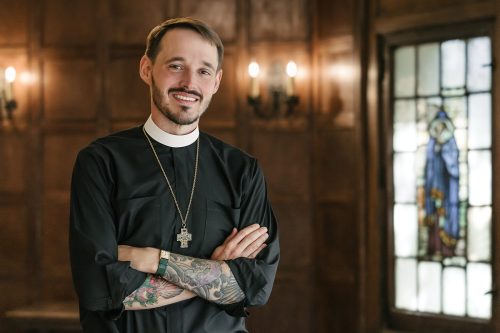
The Rev. Michael Woolf. (Photo © Becca Heuer Photography)
“I had a lot of clarity when that was happening,” Woolf, with a lingering Alabama twang, told Religion News Service in a recent interview.
According to Woolf, a pastor ordained in both the American Baptist Churches USA and Alliance of Baptists denominations, that clarity came from recognizing the significance of a white pastor with U.S. citizenship advocating for immigrant rights. In addition to immigration being an emphasis of his ministry for years, his doctoral dissertation was focused on the Sanctuary Movement, the 1980s-era faith-led effort where houses of worship defied the federal government by offering up their churches as living spaces to migrants from Central America.
To Woolf, the November protest outside of the ICE facility in Broadview, Illinois — one of several demonstrations by faith leaders at the site last year — was an extension of that Sanctuary legacy.
“People being willing to stand up for their neighbors, to stand up to the state with all its violence and all its capacity to inflict harm — that’s all Sanctuary values,” he said. “Those are Sanctuary ethics.”
In multiple interviews with RNS, Woolf explained his arrest has proven to be one of the most important moments of his life, in part because the months since have given the pastor of Lake Street Church in Evanston, Illinois, a unique opportunity to draw attention to what he calls “Sanctuary ethics.” When a photo of his arrest — with his face, framed by the knees of two policemen, straining toward the camera and a cross dangling from his clerical collar — was widely shared on social media, Woolf was inundated with inquiries from major television news outlets, radio shows, and podcasts.

The Rev. Michael Woolf is detained outside the U.S. Immigration and Customs Enforcement detention facility in Broadview, Ill., Nov. 14, 2025. (Video screen grab)
The ensuing media blitz made Woolf one of several faith leaders who have been elevated to national prominence for protesting ICE, with the photograph of his arrest eventually lauded by The Atlantic as one of the most important news photographs of 2025. But Woolf says he is particularly moved by the hundreds of supportive messages he has received from people inspired by the theology he embraces, one that centers immigrants, Muslim Americans, and others targeted by a government he believes is distorting Christianity’s message.
“Whatever we withhold from vulnerable people because we’d like to be comfortable, is whatever we withhold from God,” he said. “So, for me, I meet God at these protests in Broadview.”
All the attention feels a world apart from his childhood in Alabama, where he grew up in a fundamentalist Baptist church. It was a community where Harry Potter was effectively banned, he said, and messages he heard on Sundays sometimes evoked a “blending of God and country” he now associates with Christian nationalism, which he condemns.
Even so, Woolf said he’s grateful for the way Scripture shaped his early years. Regular Bible reading remains a “constant” of his personal spiritual life, and Woolf argued the sacred text has remained a century-spanning seminal work because it “has things that challenge us, things that push us.”
“I feel like I’m sometimes the only mainline Protestant minister who’s read the Bible a couple times,” he joked.
Woolf’s family eventually moved to Tennessee, where he began attending a church in the Cooperative Baptist Fellowship — a denomination founded by a moderate faction of the Southern Baptist Convention that broke away in the early 1990s. Inspired by an active youth group, Woolf says he discerned a call to become a pastor at age 16.
“This is the only job I’ve ever wanted to do,” he said.
He went on to pursue a degree in religious studies at the University of Tennessee. There, he became fascinated with faith-led peace activists such as Daniel and Philip Berrigan, Catholic priests who protested the Vietnam War, as well as leaders of the Sanctuary Movement.
“That was part of my broadening horizon — about how faith and justice can talk together,” he said.
He carried that interest into his studies at Harvard Divinity School, which he was drawn to because of its emphasis on an interfaith student body. Woolf finally became ordained after completing his Masters of Divinity there in 2014 and promptly began working at First Baptist Church in Jamaica Plain, Massachusetts, a neighborhood of Boston.
But even as he finally embarked on his lifelong charge as a pastor, Woolf continued at HDS in a doctoral program, which eventually resulted in a book about whiteness in the Sanctuary Movement. The book — “Sanctuary and Subjectivity: Thinking Theologically about Whiteness and Sanctuary Movements” — interrogates the complexities of the effort, particularly power imbalances. Woolf stressed that while less-vulnerable Sanctuary congregations put themselves at risk to aid immigrants, they also ideally provided a platform for vulnerable populations to speak for themselves.
Even so, Woolf sees a clear lesson for white pastors like himself living in the U.S. amid Trump’s mass deportation campaign.
“I think the thing to take is that people with privilege have to use it,” he said. Those like himself, he explained, “have to be willing to put their safety” on the line and “lay it at the feet of this intense moral issue.”
“I consider everything at Broadview an extension of Sanctuary,” he said.
According to Ruth Braunstein, professor of sociology at Johns Hopkins University who studies faith in the public square, the visible presence of clergy such as Woolf at immigrant rights protests can strike a chord with a broad swath of Americans. She pointed to the viral photo of Woolf’s arrest, arguing that it not only made a statement about religious support for immigrants, but also functioned as a de facto rebuttal to the Trump administration’s tendency to invoke Christianity on social media while promoting mass deportation efforts.
“I think the image proved so powerful because it disrupted the administration’s persistent effort to frame nativism as a core Christian virtue,” Braunstein said in an email. “We know from reams of survey and other data that this is empirically false — that Christians hold widely varied views on immigration. But data is rarely as powerful as an image. In this case an image of a white Baptist pastor being forcefully arrested for resisting the administration’s nativist policies showed clearly that all Christians are not in agreement on this issue.”
The Rev. Hannah Kardon, a Chicago-area United Methodist pastor who was also arrested last year in a separate protest outside the Broadview ICE facility, agreed.
“I think the images of clergy getting arrested have been so meaningful to people because they are hungry to see leaders actually try and live their morals, and because it puts a lie to an administration that at every turn wraps itself in the name of Jesus while torturing His beloved children,” Kardon said in a text message.
Kardon said such images expose a dynamic she has seen emerge in local efforts to push back against DHS: that the coalition opposing the administration’s immigration policies is broad, and includes non-religious and religious alike.
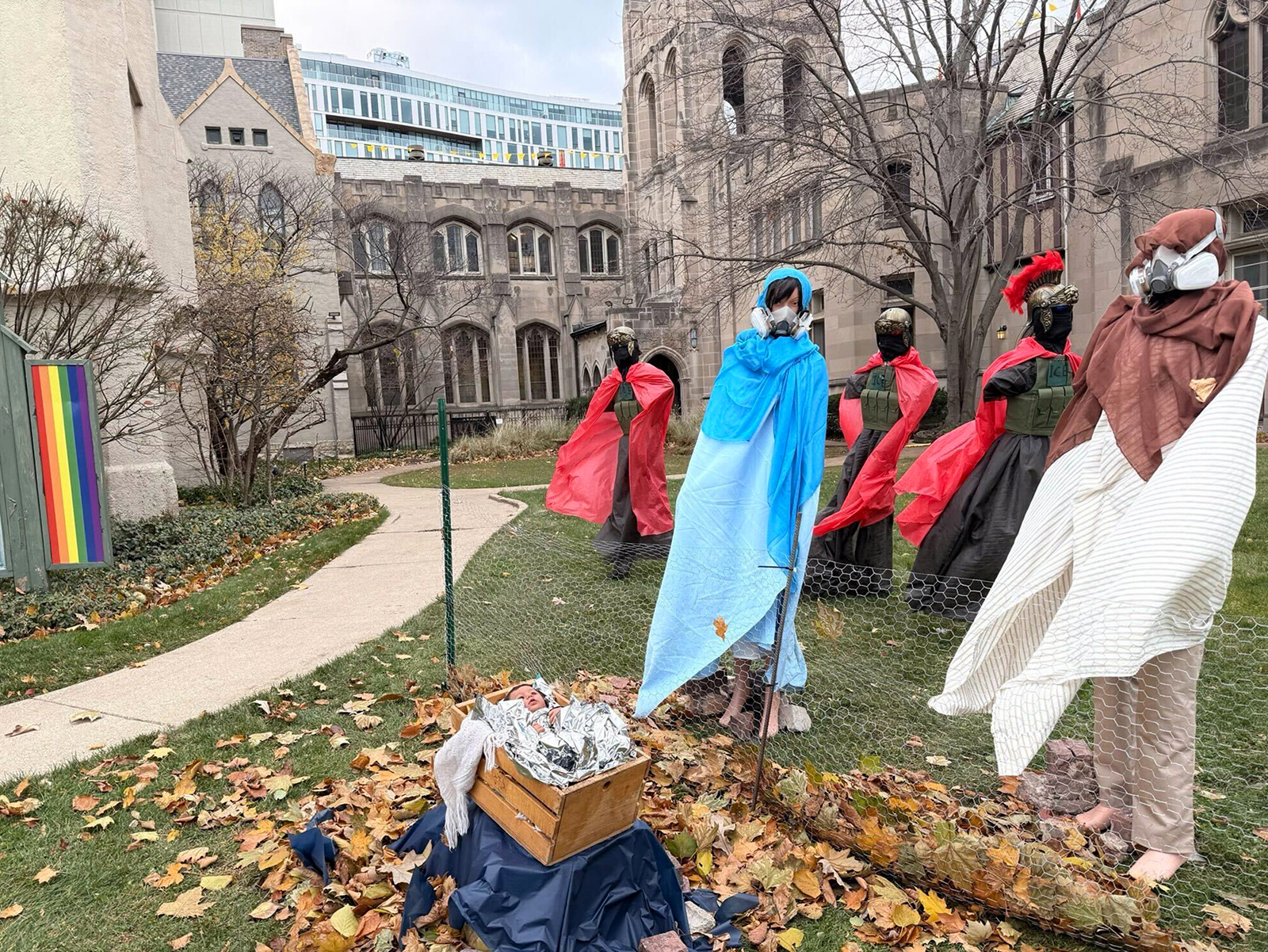
A Nativity outside Lake Street Church in Evanston, Illinois. (Photo courtesy of the Rev. Michael Woolf)
It’s a sentiment that has long resonated with members of Woolf’s church in Evanston, a congregation he began leading in 2019 and which shares his interest in interfaith work, social justice activism, and the Sanctuary Movement. Lake Street Church even identifies as a “Sanctuary church” and actively provides housing to an immigrant family. Roughly a month after Woolf’s arrest, the congregation garnered headlines when it erected an evocative Nativity scene depicting Mary and Joseph in gas masks, baby Jesus in handcuffs and wrapped in a reflective blanket that resembled those used in detention centers, and Roman soldiers as ICE agents. The display sparked backlash from conservatives, with DHS officials decrying it as “offensive to Christians.” The baby Jesus was eventually taken.
In response, the church erected a new sign.
“Where are Mary, Joseph, and Jesus? We don’t know: They are being detained in a labyrinthian hellscape where their loved ones are unable to locate them,” the sign read.
Meanwhile, Woolf has helped lead trainings for other faith leaders hoping to push back against DHS. Last year, he spoke with clergy in Minneapolis, Charlotte, New Orleans, and other cities to help “equip them with the strategies on what it looks like to resist, whether it’s detention centers or ICE tactics.” He has also helped denominational leaders craft public letters about immigration issues and says he has been inspired by the number of “moderate pastors” who appear to resonate with his views.
“That’s been really life-giving for me, because I think it has real results,” he said.
Activism, of course, can take a toll. Charges levied against Woolf related to his arrest were only recently dropped, but he’s quick to note that some of his fellow activists are still facing a legal battle. And Woolf has struggled to explain his arrest to his 8-year-old child, especially as footage and images of the moment remain memorialized on the internet. And he frets over which risks are worth taking.
But his family is no stranger to the public eye. In February, he published a book with his spouse, scholar and fellow Baptist pastor, the Rev. Anna Piela, on “Confronting Islamophobia in the Church.” The two have been actively promoting the book, which Woolf says is in keeping with a number of overlapping interests.
“White Christian nationalism, ICE enforcement, Islamophobia that is really rampant in our country right now — all these sorts of things are really linked,” he said. “What it means for me, in my life, is that it’s really important to show up and be in solidarity with people like the Muslim community.”
And Woolf has no intention of halting his efforts to advocate for immigrant rights, saying he remains focused on issues in the Chicago area. His sudden national prominence notwithstanding, Woolf said he is passionate about local grassroots activism, generally dismissing the idea of national faith leaders “parachuting” in to lead efforts to resist DHS. While dramatic moments like his arrest can make a splash, he pointed to “deeply unsexy” efforts to halt the construction of DHS detention facilities as the next frontier of immigrant rights advocacy.
“It doesn’t help if I show up in another locality,” he said. “What’s useful is if the pastor or rabbi or imam that everybody respects in that area suddenly becomes equipped — through funds, resourcing, toolkits, all these different things — to be able to show up to something like a city council meeting.”
For his part, Woolf said he’s also not exactly eager to get arrested again. But the experience left a lasting impact on him all the same — partly for the opportunity it provided him to preach a message, and partly for what it taught him about himself.
“Until you’re put in some of those scenarios, you’re not really sure if you have courage,” he said. “But I guess I found out I have some courage.”