NOTE: This piece was originally published at our newsletter A Public Witness.
On Saturday night (July 4), jokes emerged on social media as lightning (along with heat and other weather conditions) disrupted the Trump takeover of the Semiquincentennial celebrations in Washington, D.C. Thousands who gathered on the National Mall that afternoon were forced to evacuate and seek shelter in nearby federal buildings and museums. Real-life metaphors abounded. The IRS announced their building was full, so people should shelter elsewhere. Yes, too many people were seeking a tax shelter! And numerous MAGA supporters sought safety from the storm in the National Museum of African American History and Culture. They went woke!
Then came the jokes about the weather forcing a delay of the fireworks and the speech President Donald Trump insisted on giving before the big show. Several people joked that Trump had “lost the mandate of heaven,” and many others suggested God was judging Trump with the strikes. Journalist Dave Jorgenson quipped, “It’s starting to feel a little biblical.”
To be clear, if divine lightning flashed down from the heavens, it wouldn’t match any biblical account of a deliberate act of God’s judgment. There are poetic passages describing God as casting the lightning, and many bolts did strike around Mount Sinai as Moses was up there apparently getting posters for schools, but God isn’t recorded as deliberately striking people (despite a psalmist asking for it against enemies in a Psalm that Pete Hegseth likes to quote).
However, it could be a sign from Zeus since he’s the god who in stories actually strikes people with lightning. I’m not a believer in Zeus, so while the thunderbolt and lightning may have been very, very frightening, it probably shouldn’t be read as a divine sign.
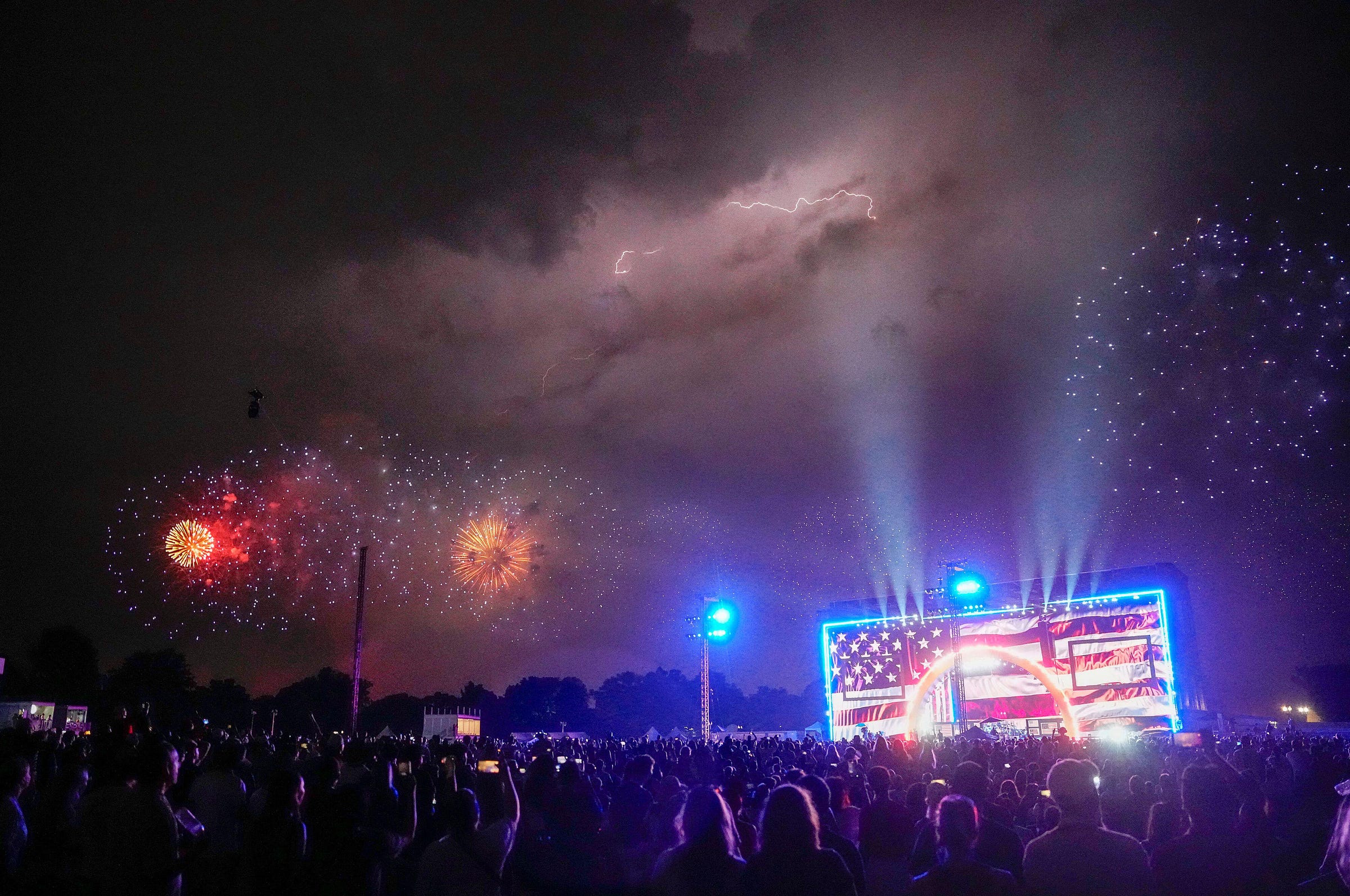
A bolt of lightning lights up the sky during a fireworks display over the National Mall in Washington, D.C., on July 5, 2026. (Photo by Bonnie Cash/UPI/Alamy Live News)
The lightning jokes lit up social media because of how inappropriate Trump’s behavior has been in making the national celebrations about himself. After referencing the poor weather and the “lightning blaring” as he finally gave his remarks shortly before midnight, he made comments unbefitting of the occasion or the office of the presidency. He grossly exaggerated the crowd size, pushed false claims of voter fraud, and blasted people who tried to hold him accountable to the laws of the land.
Trump also worked in some Christian Nationalist rhetoric to try to forcibly baptize America on its birthday. Like when he misquoted the text being celebrated 250 years after its crafting. Trump declared, “As our Declaration of Independence tells us, we are all made in the image of one Almighty God. And a communist will never say that. That’s for sure.” As a non-communist, I also won’t say that the Declaration tells us that. Because it does not say that. That’s for sure!
But none of that was the worst part, at least theologically, in Trump’s speech. He also used language to cast the United States as godlike. If God did strike down people for blasphemy, we would’ve seen it in the lightning and heard it in the thunder at that moment. But instead, we just got a few photographs of lightning flashing during the fireworks that finally started as the calendar switched to the Fifth of July.
So since Zeus ignored Trump’s unholy speech, this issue of A Public Witness strikes at the flashing heresy in Trump’s Fourth of July remarks. And it also thunders some disapproval as well to similar rhetoric recently offered by Speaker Mike Johnson.
Strikes Twice
If we put aside the partisan attacks, the conspiracy theories, and the petty personal vendetta, the speech would’ve been short enough for the fireworks to actually occur on the Fourth. And it would’ve at that point sounded a lot like normal, over-the-top presidential rhetoric about American greatness. Like calling the United States “the most extraordinary, most exceptional, most incredible nation ever to exist on the face of the earth.” Or that the American people are “a historic and heroic people” and “the bravest and the best.” We expect a national leader to talk like that on a national holiday even if we recognize that other people are also historic and brave. It wouldn’t be the Fourth without fireworks, Joey Chestnut downing dozens of hot dogs, and some presidential exaggeration to make us scream like after a World Cup goal.
But there’s one part of the speech that warrants more scrutiny. This wasn’t your run-of-the-mill nationalistic pride or the inappropriate Trump asides. This was full-blown heresy.
“God bless the immortal patriots of 1776, and long live the cause of independence. May it reign forever and ever and ever. We will always be on top,” Trump declared. “For 250 years, the United States of America has been the hope, the promise, the light, and the glory among all of the nations of the world.”
Hope of the world? Not according to Matthew 12:21, where it’s the name of Jesus.
Light of the world? Not according to Matthew 5:14, where it’s Jesus’s followers who reflect Jesus (who in John 1:9 is called “the true light” that came into the world).
Glory among the nations? Not according to Psalm 96:3, where the psalmist declares God’s “glory among the nations.”
One of the heresies of Christian Nationalism is it makes the nation into an idol. But Trump took that to a particularly gross level by calling America the hope, light, and glory of the world. And to top it off, he expressed his longing for the kingdom of the red, white, and blue to “reign forever and ever and ever,” which can only happen if the United States is the kingdom of God or overthrows and colonizes it.
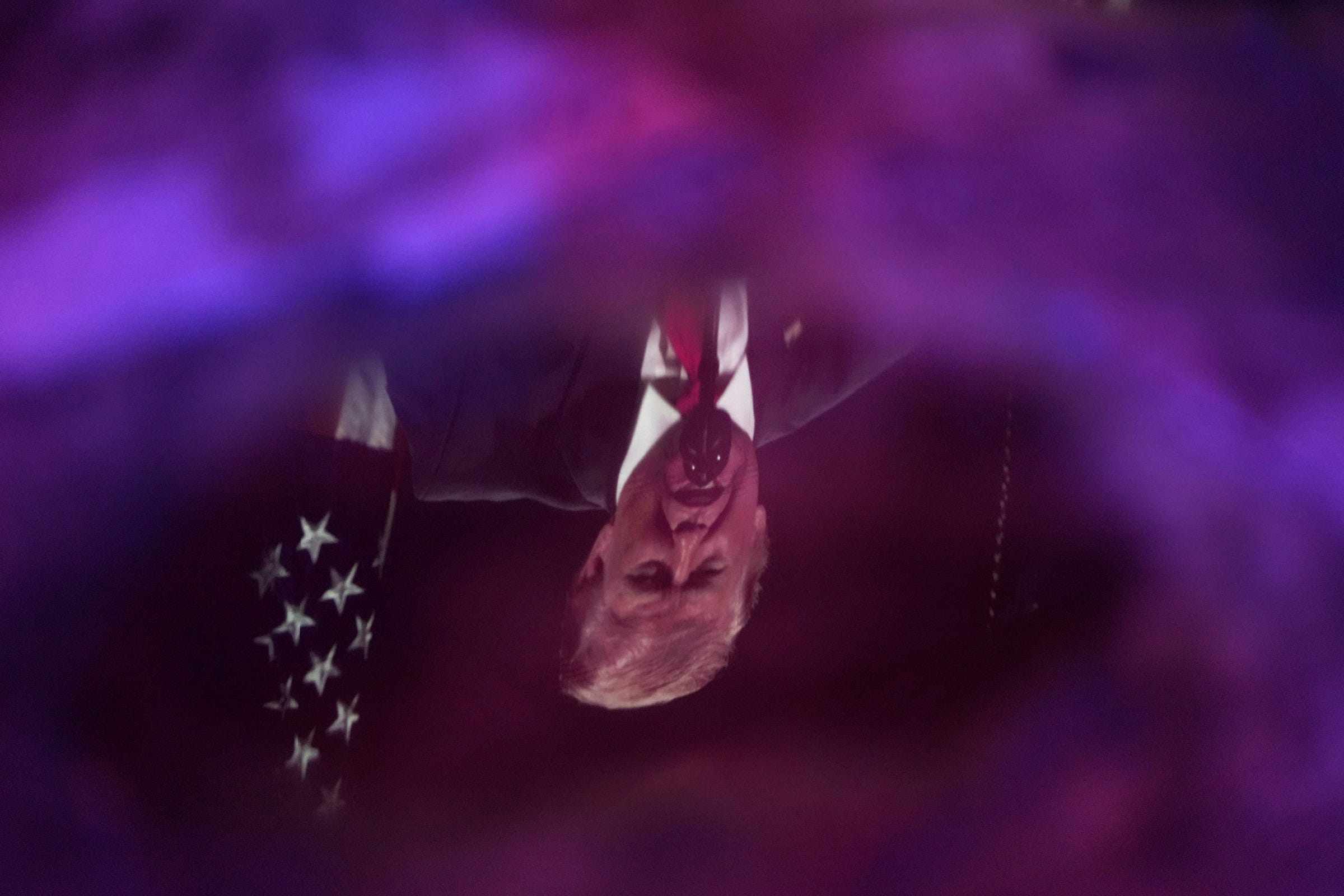
President Donald Trump appears in the reflection of a puddle of water as he speaks on the National Mall in Washington, D.C., on July 4, 2026. (Mark Schiefelbein/Associated Press)
Despite the blatant blasphemy by Trump, it was actually the second time in recent months that a major political leader used such rhetoric during a major event at the National Mall. During the so-called “Rededicate 250” worship rally in May, Speaker Mike Johnson offered similarly problematic comments. As I noted in an MS NOW column last week, Johnson cannot rededicate something that wasn’t dedicated in the first place. Putting that aside, Johnson’s prayer seemed less about dedicating the nation to God than dedicating the nation as God.
“Over each of our 250 years, America has been a land of hope and liberty, a place of miracles, and the light and glory of all nations because of you,” he declared.
It’s not quite as bad as Trump’s, but it would still be playing with danger if God were a Zeus-like thrower of lightning.
Clearing the Air
The remarks by Trump and Johnson may be extreme, but they fit a general pattern of using Christian language and biblical imagery to glorify America. In recent months, we’ve seen the Department of Homeland Security release a video that kidnapped John 1:5 to make them and their red and blue flashing lights “the light” that “shines in the darkness” which the darkness cannot “extinguish.” We’ve seen Secretary of Pulp Fiction Pete Hegseth conscript Isaiah 6:8 to make the call of a prophet instead about calling soldiers to serve America — and the Pentagon misused that verse again that way in social media posts on July 4. And we’ve seen other examples of politicians and preachers taking passages out of context to deify the United States during recent patriotic celebrations.
This kind of rhetoric matters. Jesus taught us that we cannot serve two masters. We cannot pledge allegiance to two lords. Thus, we must reject any effort to make an earthly nation — any nation — the eternal kingdom of God that is the hope, light, and glory of the world. No matter how great a nation is (or it thinks it is), it pales to the glory of God. No matter how powerful a nation’s military is (or it thinks it is), it pales to the power of the kingdom that will reign forever and ever and ever.
The difference between an earthly empire and the kingdom of God is so great that we dare not use the same language to describe them. It’s like the quip from Mark Twain: “The difference between the almost right word and the right word is really a large matter — ’tis the difference between the lightning-bug and the lightning.” Don’t confuse the bug with the lightning!
As a public witness,
Brian Kaylor
A Public Witness is a reader-supported publication of Word&Way. To receive new posts and support our journalism ministry, subscribe today.