NOTE: This piece was originally published at our newsletter A Public Witness.
Most times when the World Cup rolls around, I find myself gathering for a week with Baptists from around the world. That adds a higher level of excitement to the matches as people from the various countries will show up to morning worship either ready to dance or practice lament. Last week, I joined people from 65 nations at the annual gathering of the Baptist World Alliance in Toronto, Canada.
The event started just after our host nation found itself knocked out of the World Cup. So speakers mixed their thanks to our Canadian friends with some condolences. Attendees from various nations gathered in restaurants in the evenings to watch games together or even kept an eye on early matches streaming on their phones. When France took out Morocco in the Quarterfinals, a theologian from there raised her hand in victory. My favorite moment occurred after Norway bested Brazil in the Round of 16. A Brazilian Baptist leader the next morning mentioned his mourning as he started his remarks. As he mentioned the result, I turned to where I knew a Norwegian friend was sitting and saw him rowing in his pew, thus copying the viral rowing antics of Norwegian fans as they visited the United States for the tournament.
Beyond the World Cup flavor to the gathering, the global nature of the gathering meant stories from around the world were highlighted. The news of the world isn’t just hypothetical or streaming on screens. For many who showed up at Tyndale University last week, they’re living it. So we heard from a Ukrainian leader who shared stories from the frontline of the Russian invasion and how churches are ministering even as they’re being targeted by drones. We heard from an activist from Myanmar who had to flee after the military coup five years ago but who works to help refugees and those still in the nation. We heard from pastors in India just weeks after three Baptist pastors were killed after attending a peace conference. We similarly heard from pastors in Nigeria where there have been years of deadly violence. And we heard from leaders in Lebanon who continue to minister to Syrian refugees and their own people amid bombings by Israel.
Coming together like this matters because, as European Baptist Federation leader Alan Donaldson said during the event, “coming together” from various countries “reminds us of our shared humanity,” “that we love and serve the same Savior” and “that evil, war, nationalist rhetoric can be overcome in Christ.”
“The rise of so-called Christian Nationalism, or nationalism that has borrowed Christian symbols, challenges the fundamental understanding of the image of God,” he added. “It seeks to drive out people who are different from us, failing to recognize the image of God in them and therefore failing to live in community, failing to share a table, failing to exemplify God’s kingdom, where we will be gathered from every tribe and nation and tongue.”
As Donaldson’s comments suggested, the gathering included a strong focus on working toward peace and justice. This included reflections by Canadians about work in their nation to address injustices committed against Indigenous peoples, as well as broader efforts around the globe. So this issue of A Public Witness treks to The Six to cover the recent gathering of the Baptist World Alliance.

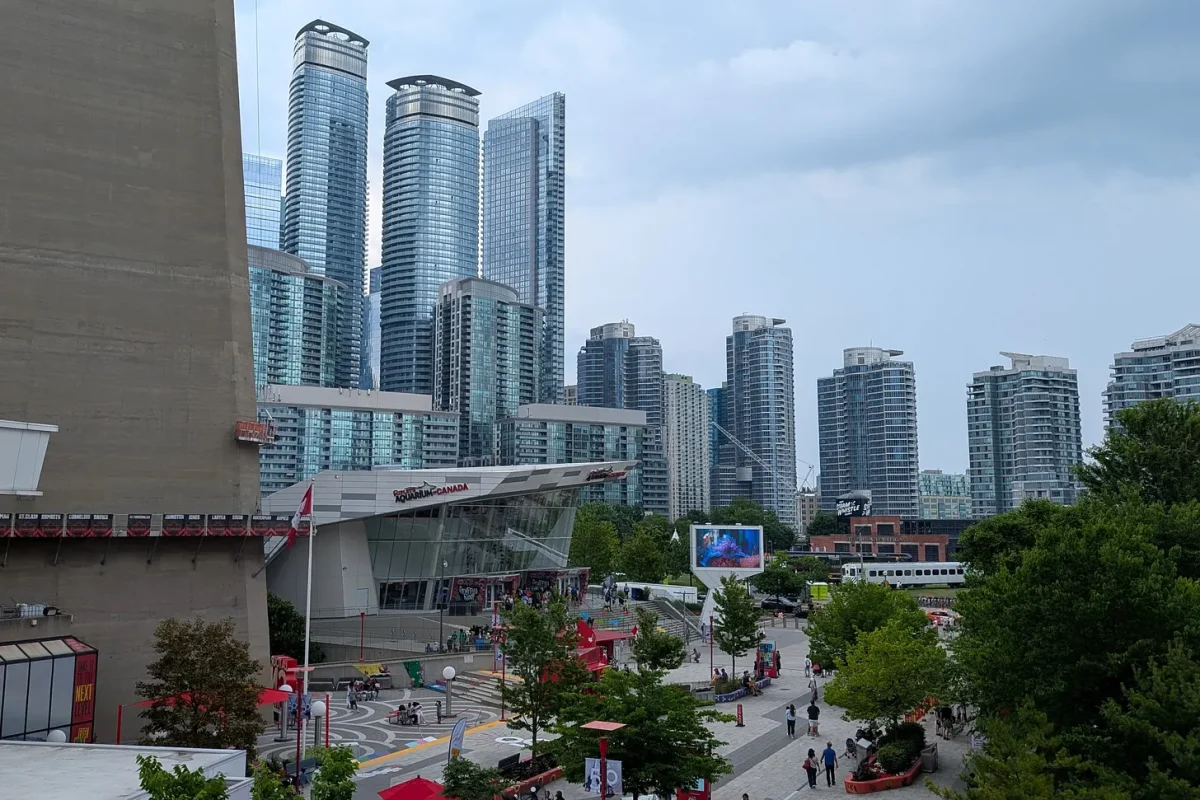
Part of the Toronto skyline from the base of the CN Tower. (Brian Kaylor/Word&Way)
Indigenous Justice
Leanne Friesen, the executive minister of the Baptist convention of Ontario and Quebec, set the stage for the context in which the gathering was occurring in Toronto. She noted that the city has been deemed “the most culturally diverse city in the world,” with more than 50% of the population “not born in Canada.” But she also acknowledged that while Canadians like to point out how they’re not like the United States — with its mass shootings, lack of public healthcare, and pushing of imperial politics — there are many injustices for them to deal with as well.
“You will actually meet people from all over the world; you will hear countless languages, see many cultural expressions,” she added. “A young man from Sri Lanka may serve you your coffee at Tim Hortons. … Your Uber driver probably spoke several languages. The mayor of Toronto was born in Hong Kong.”
“Canada makes space for many different views and ideas. Canada doesn’t insist on one way of thinking, but celebrates all different ways of seeing the world,” she added. “We do not judge other people’s culture and insist that they change what they believe or practice. Canadians are indeed very nice, very welcoming. If you bump into us, we’ll apologize to you. But also, if you look beneath the hood a little bit, sometimes this can lead to us looking a little like the Pharisee in the story that Jesus told, who turns to his neighbor, who is also praying, and says, ‘Thank you, God, you did not make me like him.’”
Friesen recounted hearing this attitude in the aftermath of the police killing of George Floyd in the United States. But then, she added, “less than a year later, the headlines were full of a different story.” In May 2021, it was reported that the remains of 215 people believed to be Indigenous children were found in unmarked graves on the grounds of a former residential school. Soon, similar unmarked graves were found at other such boarding schools that the Canadian government funded but were often run by Christian groups from 1828 to 1997 and in which children were taken from their families in order “assimilate” them into Canadian society. More than 4,000 Indigenous children died in the residential schools.
“A year after us Canadians were saying, ‘Surely not us with that racism problem in the States,’ we heard of thousands of unmarked graves of children who had died in the residential schools. And we had to say, ‘Us, too.’ Now, we could have been listening for the years that our Indigenous brothers and sisters have been telling us this,” Friesen said. “There have been countless stories. Last year, I visited one of our churches in Mistissini, Quebec, a Cree church. Every member of that church had been to a residential school. Every single one of them had been physically, sexually, and emotionally abused. Every one.”
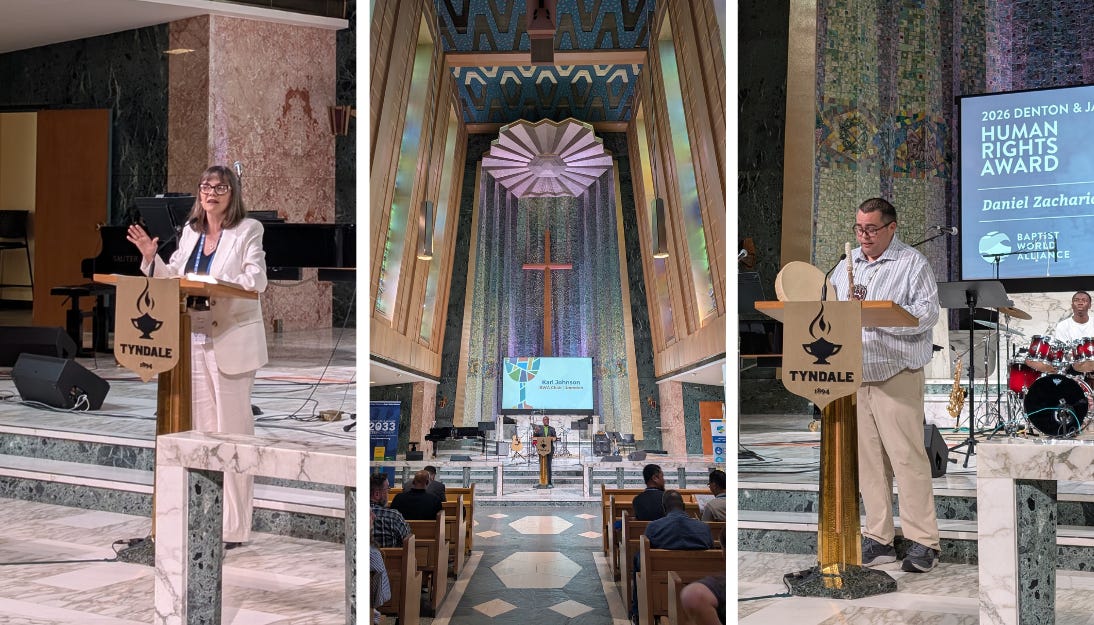
From left: Leanne Friesen talks about Canadian society; BWA Chair Karl Johnson of Jamaica leads the annual gathering in the chapel of Tyndale University; and Daniel Zacharias sings and beats the drum as part of a presentation on Indigenous justice. (Brian Kaylor/Word&Way)
Talking even more about the injustices against Indigenous peoples and the work toward greater inclusion today was Daniel Zacharias, a New Testament professor at Acadia Divinity College in Mi’kma’ki (Nova Scotia). A coauthor of Reading the Bible on Turtle Island: An Invitation to North American Indigenous Interpretation, Zacharias received the BWA’s annual human rights award last week in recognition of his decades of work with Canadian churches on Indigenous issues. At the gathering, he argued for a biblical focus on welcoming people, which he contrasted with approaches when the gospel “has been coupled with colonialization.” With the colonial approach, “Welcome was conditional, cultural and worldview differences were judged harshly, and the agency of personal conviction and communal discernment was overseen by the colonial gaze. Paternalism and colonization seeks a cultural hegemony and denigrates anything that sits outside of that as something not proper for inside the church or at best tolerated when necessary.”
“To put it simply: The good news was often bad news for Indigenous people in this country,” he added. “For indigenous people who received Jesus into their lives, this did not usually stop these discriminatory thoughts in the church. My parents’ generation and upwards frequently heard from the pulpit that Indigenous culture was pagan, wrong, or even demonic. This is part of our collective legacy as Christians in this country.”
Zacharias urged those present not to repeat the errors of trying to erase a culture, as if Indigenous people must abandon who they are in order to become Christians.
“No theology exists in a cultural vacuum. Every culture and every era has engaged with Jesus in their own terms, and this is not a failure of faithfulness. It’s what it looks like when the gospel actually takes root in different places and cultures and times,” he said. “If you truly want to sit at the table of Christ with people who are different than you, then you sit with the entirety of their stories because that’s the worldview they live in, just as we sit with the entirety of your story.”

From left: the stadium where the Toronto Blue Jays play, a mural by Derek Michael Besant, and a park fountain featuring sculptures of 27 dogs. (Brian Kaylor/Word&Way)
Help sustain the journalism of Word&Way by subscribing to A Public Witness!
Standing Against Violence
The issue of violence targeting vulnerable people is not just a Canadian problem nor merely a historical one. And beyond issues of wars and genocide, it also often shows up in homes and other places that should be considered safe.
Valérie Duval-Poujol, a French theologian and Bible translator, spoke about the need for better church advocacy against domestic abuse and other violence targeting women. The new BWA ambassador for standing against gender-based violence, Duval-Poujol specifically urged churches to join “The Red Chair Project,” an effort to place an empty red chair in a public space to draw attention to the problem of domestic abuse. A red chair sat on stage near the podium as she mentioned statistics about domestic abuse, including its prevalence among churchgoers.
After mentioning that “globally a woman or a girl dies at the hand of an intimate partner or family member” every 11 minutes, Duval-Poujol pointed to the chair: “This is why we have this chair for the victims of domestic violence. We miss them. We want to acknowledge them. They should have been at the table. But they’re not there. They cannot be. They have been killed by someone they were trusting.” She also urged pastors and churches to explore resources to find other ways to raise awareness and help prevent domestic abuse.
Another way the BWA bears witness against violence and injustices is through resolutions (and I serve on the resolutions committee). This year, the representatives passed four resolutions on empowering and caring for people with disabilities and special needs, serving vulnerable children (especially those living in active conflict zones), integral and polycentric mission (instead of a colonial “west to the rest” model), and working toward just peace among nations. The latter resolution “rejects the reemergence of imperial ideologies and theologies” along with “wars of ambition,” “unlawful annexation,” and other acts of violence. The resolution also urges Christians “to pursue a beloved community and courageously work for just peacemaking and flourishing freedom locally, nationally, and internationally.”
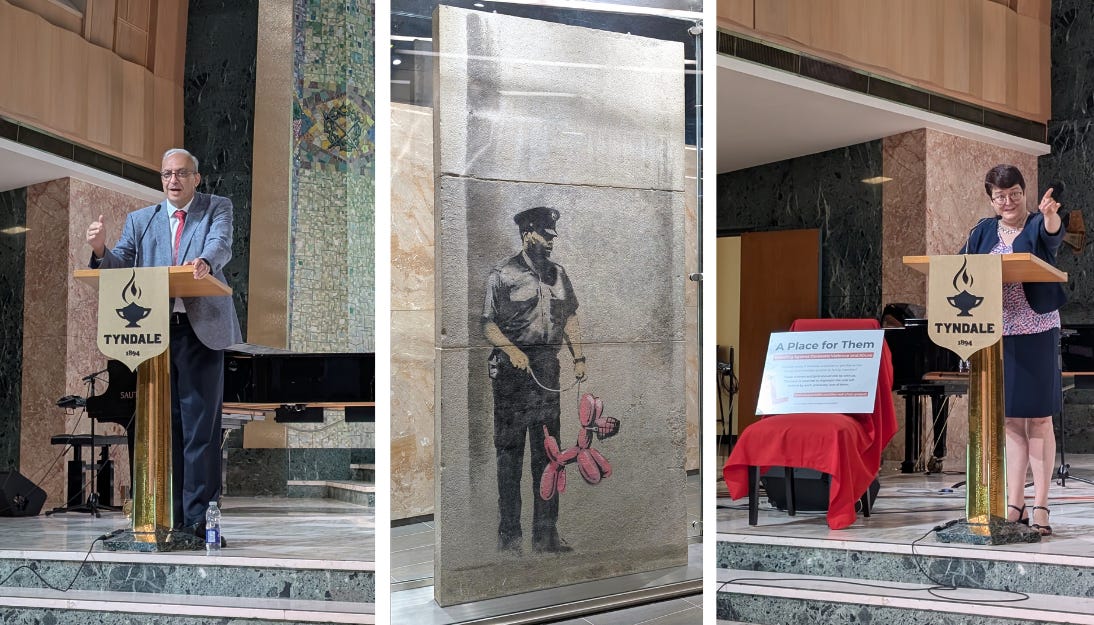
From left: Botrus Mansour, general secretary of the World Evangelical Alliance, speaks about faith in the Middle East; Banksy’s Guard with Balloon Dog in Toronto; and Valérie Duval-Poujol talks about “The Red Chair Project.” (Brian Kaylor/Word&Way)
Similarly, BWA General Secretary & CEO Elijah Brown warned against following the “imperial logic” of the “model of Caesar Augustus” as seen in how Augustus and Herod acted at the time of Jesus’s birth.
“Herod hears that there may be one child, one family who is living in one particular neighborhood, and the response is to deploy governmental soldiers, even if there are casualties or collateral damage. The logic of Caesar becomes so enraged it orders families torn apart and the innocent children harmed, no matter their status, citizenship, or the wail of weeping mothers,” he explained.
In contrast, Brown urged those present to work for peace and to show hospitality, especially to migrants and refugees.
“The people of Jesus pursue peace among enemies in the world. For the hospitality of biblical faithfulness often comes with great risk. Jesus not only sat at tables, he at times overthrew tables. For the table of Christ is incompatible with the table of economic exploitation, including economic exploitation in the name of God. We, too, must pursue a hospitality of risk in order to pursue peace among enemies. The need is all the more urgent at a time when too many are pursuing wars of ambition,” he said.
“Underneath the veneer of public rationales, one of the driving forces of violence today is self-centered, personal, ideological, political, and national ambition. BWA, let us denounce the rhetoric of political, cultural, or ethnic domination. Let us reject the misuse of religion that sanctifies national ambition, ethnic superiority, territorial conquest, or coercive rule. Let’s reject the emergence of imperial ideologies and theologies which seek to divide the world into zones of influence in order to impose their will upon neighbors or to seek coercive control in the name of power, proximity, religion, or history,” he added as he worked in quotes from the resolution this year on just peace. “Let us oppose wars of ambition, for just peace is never secured through domination or violent conquest.”
As a public witness,
Brian Kaylor
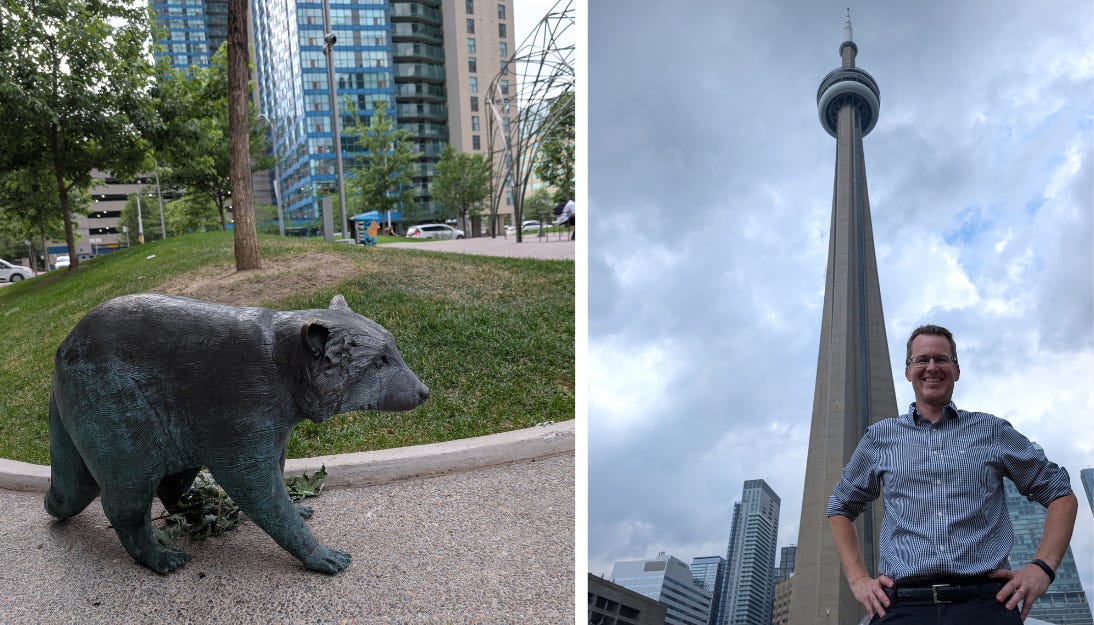
From left: A statue of a raccoon in the city with the most raccoons; and Brian Kaylor in front of the CN Tower, the tallest freestanding structure in the Western Hemisphere. (Word&Way)
A Public Witness is a reader-supported publication of Word&Way. To receive new posts and support our journalism ministry, subscribe today.