NOTE: This piece was originally published at our newsletter A Public Witness.
In new filings in federal courts in Minnesota and Massachusetts, the U.S. Department of Homeland Security insisted it did not violate a federal injunction prohibiting warrantless DHS enforcement actions at some houses of worship. DHS now claims it considered the injunction before spying on a Baptist church in Minneapolis, but refuses to turn over evidence to prove that. DHS also refuses to say if it has spied on other houses of worship covered by injunctions.
Earlier this month, filings in a criminal case in Minnesota revealed that DHS had spied on Lutheran, Episcopal, Unitarian Universalist, and Baptist churches in the Twin Cities and at a Lutheran church in Michigan. As first reported by A Public Witness, one of those churches was covered by a federal injunction. Court filings show that DHS agents on at least four occasions — including on two Sundays — surveilled people entering or leaving University Baptist Church. And on at least one occasion, it sent an undercover agent inside to secretly record people attending a Mixed Martial Arts class led by a progressive group in UBC’s building (and then the agent had to go back into the building to recover the recording device after realizing she had dropped it). These actions occurred despite prominent signs at the church notifying DHS agents that they are barred from entering.
While DHS admits that agents in its Homeland Security Investigations agency went to the church as part of its “Project Whipple Shield” effort, it refused to say if other protected houses of worship have been targeted in DHS investigations.
“HSI surveilled criminal suspects at or near the Church only during the four investigatory actions referenced above,” an HSI agent claimed in an Aug. 28 filing to a federal court in Massachusetts (where the injunction covering UBC was granted). “To my knowledge, HSI has not investigated any other location on the current protected areas list as part of Project Whipple Shield. I cannot confirm or deny that there are additional investigations at other locations on the protected locations list.”
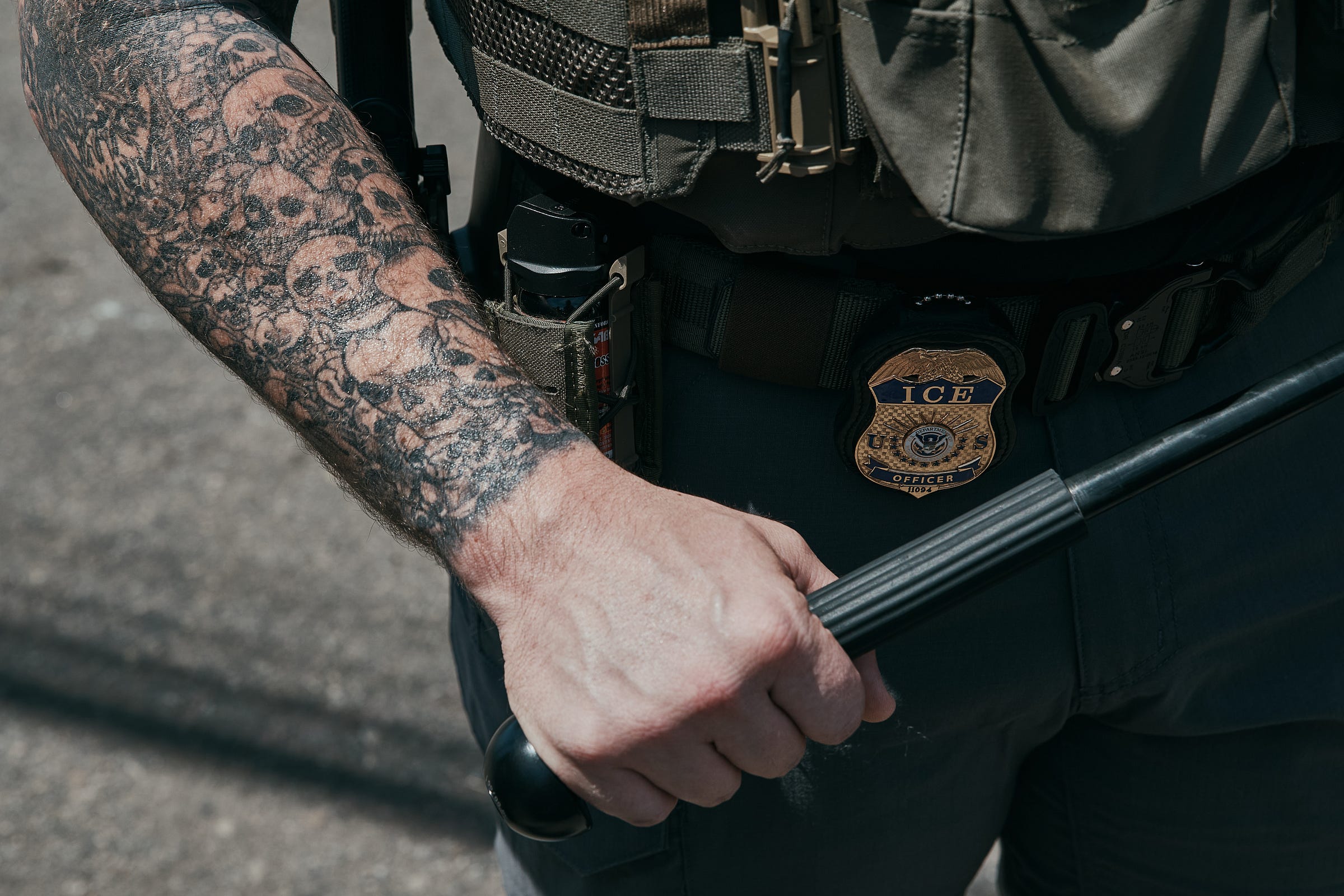
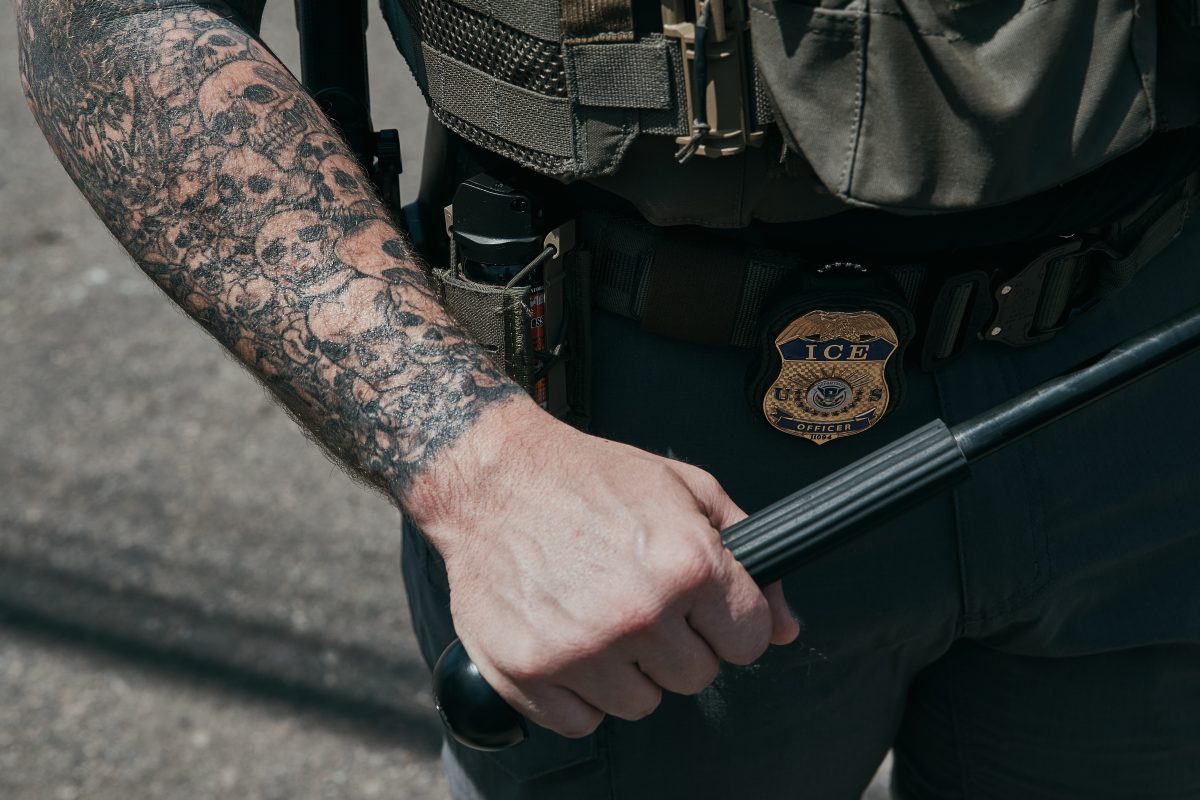
An ICE agent holds his baton outside the Delaney Hall detention center in Newark, New Jersey, during a protest on May 26, 2026. (Andres Kudacki/Associated Press)
The HSI agent also claimed in his statement that he knew about the injunction before the surveillance and authorized the actions at UBC after determining the injunction did not apply to his investigation. But beyond Zappone’s after-the-fact statement, DHS argued in its Aug. 28 filing in Massachusetts that it should not be required to turn over any documents from prior to the surveillance showing that it did actually discuss the injunction and whether it applied to the investigation.
The argument by DHS that the judge should trust the agency comes amid a series of allegations in other ICE-related cases that DHS and the Department of Justice have acted improperly. Earlier this year, federal prosecutors dropped criminal charges against people arrested for protesting outside an ICE detention center in Broadview, Illinois, after revelations of grand jury misconduct by DOJ prosecutors. U.S. Judge April Perry said she was “incredibly shocked” by the “prosecutorial behavior before a grand jury,” adding that “trust has been broken.” Perry is now considering whether to sanction the prosecutors. Because of the “Broadview 6” case, another federal judge ordered the government to turn over all grand jury materials in the cases of the 38 people arrested after a protest at a Southern Baptist church in St. Paul, Minnesota, where one of the pastors is also a local ICE leader. The ICE pastor and other ICE officials have since been criticized by a federal judge for violating dozens of court orders.
Because of these and other recent cases, the defense attorney for one of the “Minnesota 15” defendants told a federal judge in Minnesota last week that DHS should be required to turn over more documents from its investigation.
“We’ve got to the point that federal judges are telling the government, ‘We can’t rely on you anymore,’” defense attorney Kevin Riach said in court on Aug. 27, adding that the presumption that federal agents act in good faith has “evaporated.”
While DHS claims it considered the injunction before the four surveillance incidents, it also oddly argued it could not determine if the injunction actually applied to the three times when DHS surveilled UBC’s building without entering it. The federal injunction not only prohibits agents from going on the property of protected houses of worship but also from conducting enforcement operations within 100 feet of an entrance to the church. While the denominational groups who won the injunction noted in a court filing that the library parking lot surveilled by DHS agents is within 100 feet, DHS insisted in their response that “agents could not confirm” if that was true. Absent going to Menards for a tape measure, agents could’ve checked Google Maps to see that the lot is, in fact, within 100 feet of the door they recorded people entering and exiting.
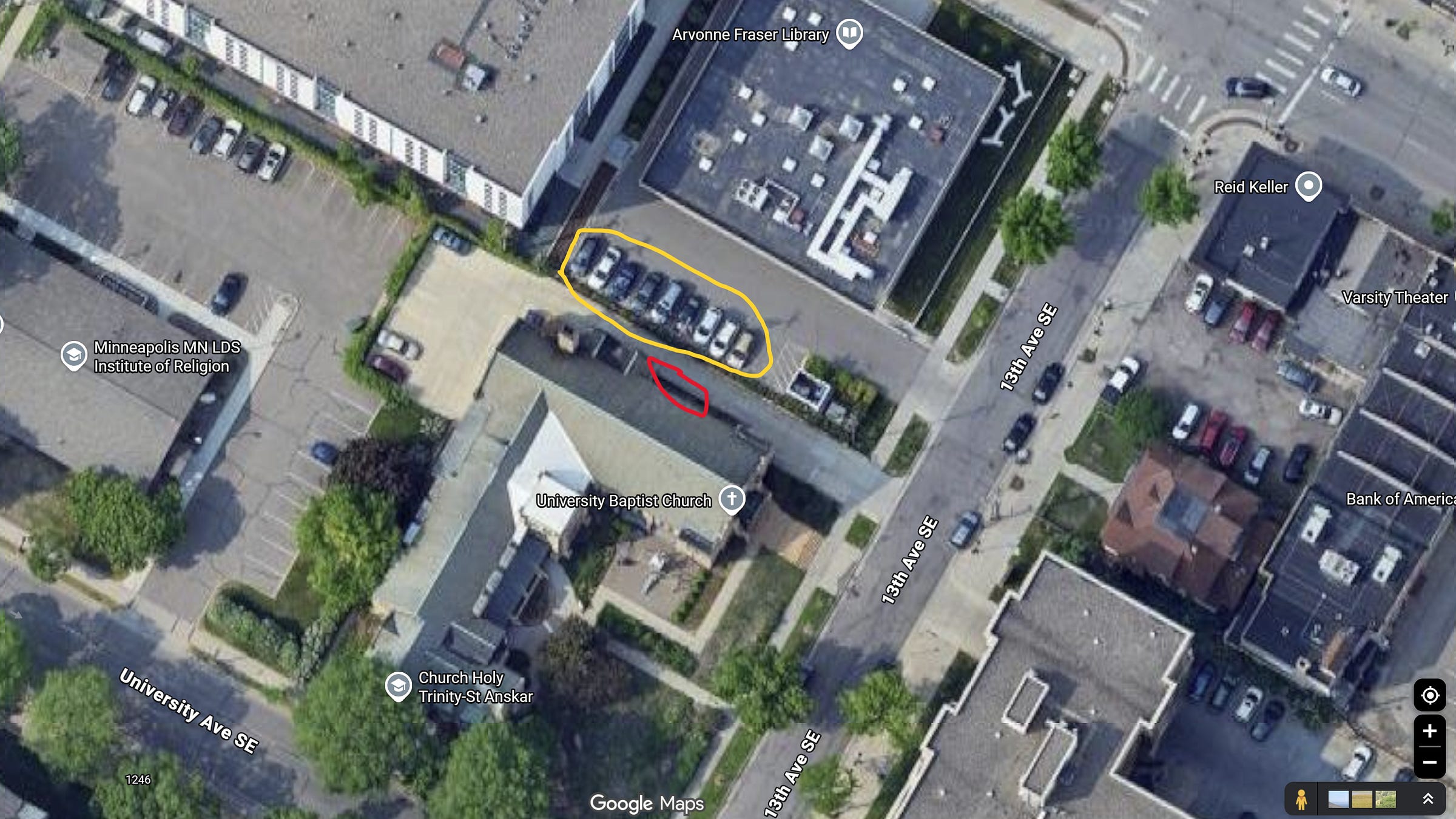
Screengrab from Google Maps of University Baptist Church, with an entrance to the church’s gym marked in red and the library parking lot marked in yellow.
Definitional Debates
The key argument by DHS that it did not violate the federal injunction comes down to a definitional dispute. Instead of arguing over what the definition of “is” is, DHS is claiming its investigation had nothing to do with immigration enforcement and didn’t occur at religious events. DHS insists its surveillance at UBC and the other churches was only about alleged criminal violations unrelated to immigration.
In February, before the DHS surveillance incidents, a federal judge granted an injunction protecting congregations in the American Baptist Churches USA, Alliance of Baptists, Metropolitan Community Churches and several regional synods of the Evangelical Lutheran Church in America. (A similar injunction that protects churches in the Cooperative Baptist Fellowship and several regional Quaker groups in addition to a Sikh Temple in California was upheld this month by a federal appeals court.) UBC is affiliated with both ABCUSA and the Alliance, which are both covered by an injunction, and the church was even specifically cited in the judge’s ruling as an example of why the injunction was granted as a result of an incident near the church during worship in January (and that incident was not even as close as the library parking lot).
The denominational groups in the case alerted the federal judge in Massachusetts of the surveillance and asked him to consider holding DHS in contempt of court. Noting that the injunction was not limited to just enforcing immigration laws, the groups said the incidents at UBC were violations since the judge had barred warrantless DHS actions conducted “in whole or in part, to enforce the immigration laws” (italics added in the faith groups’ filing). Since the investigation was done to stop individuals from allegedly trying to disrupt immigration enforcement actions during “Operation Metro Surge,” the plaintiffs insist DHS’s investigation was “in part” to enforce such laws.
DHS responded by arguing their investigation had nothing to do with immigration enforcement. However, it is also fighting motions that it turn over more documents detailing the extent of “Project Whipple Shield” and related investigations that led to the charges. The reference to “Whipple” in the investigation’s name refers to the Bishop Henry Whipple Federal Building, a facility named for an Episcopal bishop that served as the base of operations for the surge of ICE agents into the Twin Cities (which sparked the protest efforts then investigated by DHS).
DHS insisted in its filing on Aug. 28 that its investigations at the churches “were conducted in good faith” and did not violate the congregations’ First Amendment rights. But DHS also made that claim by suggesting it get to define what is a religious exercise or not. DHS argued, without any apparent sense of irony, that allowing any event at a protected church’s building to be covered by the injunction would “broaden the scope of the injunction so that their places of worship are effectively turned into sanctuaries.”
The religious groups disagreed in their own filing with DHS’s claims that the surveillance was not a violation of the congregation’s religious rights.
“Members of the church learned of the violations last week and have been shocked and upset that ICE not only was monitoring the church, and doing so on Sundays, a holy day of worship, but even entered the church itself,” a filing by the denominational groups noted. “As stated by a current member and recent president of the church: ‘This is a complete violation of our sacred space. The church is meant to be a place of sanctuary and safety — not infiltration by government agents.’”
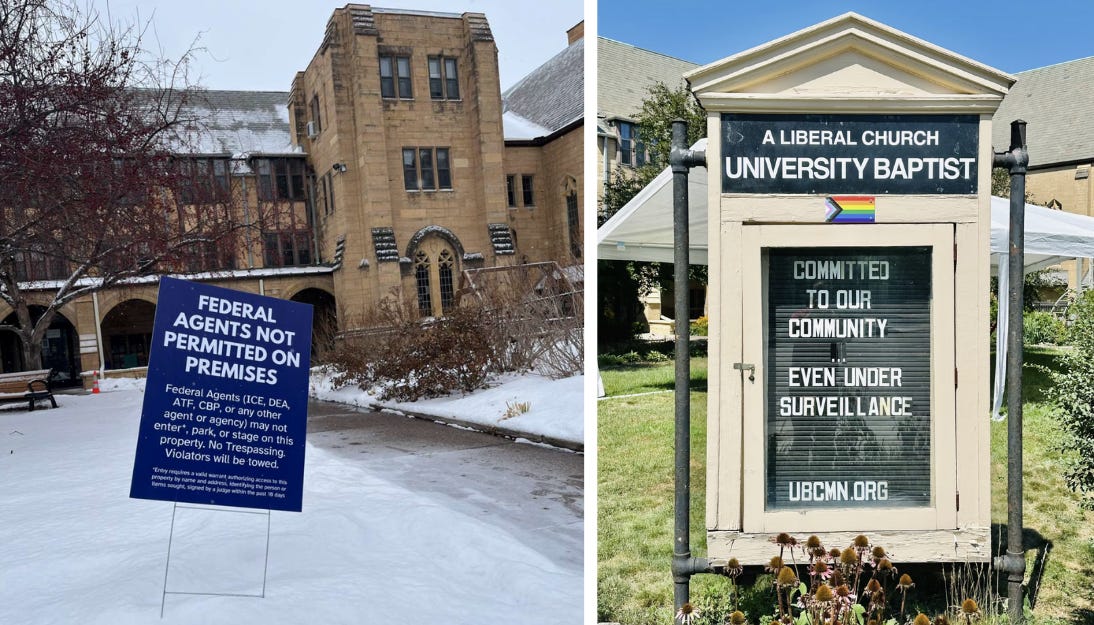
Left: An image included in a court filing on Aug. 14, 2026, of a sign outside University Baptist Church in Minneapolis, Minnesota. Right: UBC’s new message added to a sign outside their building after news of DHS spying on churches: “Committed to Our Community … Even Under Surveillance” (Courtesy of UBC)
Skye Perryman, president and CEO of Democracy Forward (which represents plaintiffs in the injunction case), also pushed back against DHS’s claims that their spying on churches was not problematic.
“Alarming evidence has shown that despite a court ordering them not to do so, ICE agents continue to invade churches and other places of sanctuary, terrorizing the people who seek refuge and respite within them,” Perryman said. “It is clear that the government will stop at nothing — including at church doors — in its campaign to stoke fear in communities across the country, so we are asking the court to hold them accountable for this intrusion. Democracy Forward is proud to represent our courageous clients, who are demanding accountability from a government that, instead of respecting their religious freedoms, is trying to actively abuse them.”
U.S. District Judge F. Dennis Saylor IV, who issued the injunction in February, set a video hearing for Sept. 4 to consider DHS’s actions and whether it should be held in contempt. Meanwhile, Judge David Schultz, who is overseeing the criminal case in Minnesota, said he would rule soon on whether or not to force DHS to turn over more documents to the defendants.
As a public witness,
Brian Kaylor
A Public Witness is a reader-supported publication of Word&Way. To receive new posts and support our journalism ministry, subscribe today.