NOTE: This piece was originally published at our newsletter A Public Witness.
A federal judge recently ordered the U.S. Department of Homeland Security to report about any protected church where it has conducted an immigration enforcement action. But the agency told the court it had no idea how many incidents there may be, insisting it had no reasonable way to check its own records.
After revelations last month that DHS secretly spied in a Baptist church in Minnesota covered by a federal injunction blocking warrantless DHS enforcement actions, the judge who granted the injunction ordered DHS to inform the court of any other “potential violation.” DHS claimed in court filings on Sept. 25 that they searched their records but couldn’t find any incidents beyond two others at Lutheran churches in Texas and California that were previously discovered by the denominations that won the injunction.
Attorneys for the denominations criticized DHS’s report on Sept. 29 as “poorly calibrated,” adding that the submitted records “only underscore the high, systemic risk of noncompliance” with the injunction. Rather than indicating a lack of incidents at protected churches, the new DHS court statements instead suggest a lack of quality record-keeping by DHS.
Filings in a criminal case in Minnesota revealed in August that DHS had spied on Lutheran, Episcopal, Unitarian Universalist, and Baptist churches in the Twin Cities and at a Lutheran church in Michigan. As first reported by A Public Witness, one of those churches was covered by a federal injunction. Court filings show that DHS agents on at least four occasions — including on two Sundays — surveilled people entering or leaving University Baptist Church in Minneapolis. And on at least one occasion, it sent an undercover agent inside to secretly record people attending a Mixed Martial Arts class led by a progressive group in UBC’s building (and then the agent had to go back into the building to recover the recording device after realizing she had dropped it). These actions occurred despite prominent signs at the church notifying DHS agents that they are barred from entering.
On Sept. 4, U.S. District Judge F. Dennis Saylor IV heard oral arguments virtually about whether or not to hold DHS in contempt for violating the injunction. While he has not yet ruled on that, he did immediately order DHS to let the court know within three weeks of any other immigration enforcement actions at a church covered by his injunction granted in February to congregations in the American Baptist Churches USA, Alliance of Baptists, Metropolitan Community Churches, and several regional synods of the Evangelical Lutheran Church in America. (A similar injunction that protects churches in the Cooperative Baptist Fellowship and several regional Quaker groups in addition to a Sikh Temple in California was upheld last month by a federal appeals court.)
After the denominations that won an injunction from Saylor informed the court about the DHS actions at the Baptist church in Minnesota, DHS claimed it had not violated the injunction since it was not trying to deport anyone in that investigation. A DHS official added in a filing, “I cannot confirm or deny that there are additional investigations at other locations on the protected locations list.” That admission led to the order that the agency inform the court of any other incidents. The new filings, however, essentially offer the same conclusion of neither confirming nor denying other investigations.
Two More Potential Violations
Late on the afternoon of Sept. 25 (the judge’s deadline), DHS announced its records didn’t reveal any incidents beyond those already mentioned by attorneys representing the religious denominations in the case. DHS only noted two other incidents, though the agency questioned if one of them even occurred. Neither incident appears to have garnered media coverage.
According to court filings by DHS, the attorneys for the denominations with the injunction contacted DHS attorneys on June 5 to ask about a potential violation of the injunction on April 19 at Iglesia Luterana San Pablo in San Antonio, which is part of the Southwestern Texas Synod of the ELCA. The allegation was that ICE agents waited in the church’s parking lot on that Sunday “to follow an individual as he left the place of worship and stopped the individual shortly after leaving the parking lot.” DHS claimed their “good faith effort” found no records for the alleged incident and that the San Antonio office of DHS’s Enforcement and Removal Operations office “located no records of ERO presence at the location in question on April 19, 2026.”
The Spanish-language Lutheran congregation in San Antonio had previously been mentioned in court documents as a reason for granting the injunction in the first place. A memorandum submitted last year by Bishop Susan Briner of the Southwestern Texas Synod of the ELCA explained to the court why she felt an injunction was warranted. She mentioned Iglesia Luterana San Pablo among the examples of how the Trump administration’s policies and actions were impacting congregations in her synod. The congregation had planned a “Know Your Rights” event for the church community in February 2025. Although they had held similar events at the church before, the new DHS policy allowing warrantless immigration enforcement actions at houses of worship “meant that the church was no longer a safe space.” The church worried, Briner added, that those who most needed the information would be scared to attend, so the event was moved to a house “where attendance was less obvious and people would feel safer and less exposed. The pastor told me that she still felt afraid every time the doorbell rang that night, and was constantly checking the windows to make sure that the curtains were closed.”
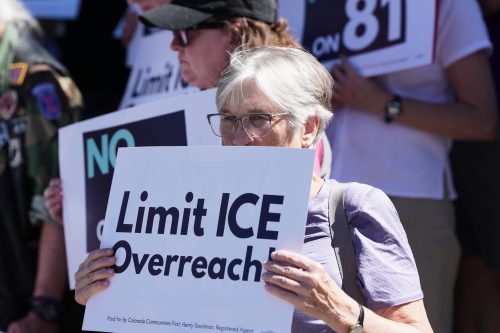
A woman holds a sign while rallying against a proposed state constitutional amendment in Colorado that would force local police law enforcement to cooperate with the U.S. Department of Homeland Security. (David Zalubowski/Associated Press)
While DHS questioned whether an incident occurred at a Lutheran church in Texas, it admitted one did happen at a Lutheran church in California. However, DHS maintains that arrest did not violate the injunction.
DHS reported that on July 17 the attorneys for the denominations with the injunction contacted DHS attorneys to ask about a July 8 incident when an ICE officer chased a man on the property of New Hope Lutheran Church in Agoura Hills, which is part of the Southwest California Synod of the ELCA. The DHS court filing says that four ICE officers were conducting surveillance at another address about 400 feet from the church when they approached a man to confirm his identity. The man allegedly fled, with two officers running after him. The man ran onto the church’s property, but DHS insists the officers saw no signs and did not know that as they chased the man and arrested him in the church’s parking lot.
In a separate court filing on Sept. 24, DHS submitted an email exchange between DHS attorneys and attorneys at Democracy Forward (which is representing the denominational groups) about the incident at the church in California. DHS insisted that the arrest was a “hot pursuit” where there was “a reasonable belief that there was immediate threat to human life or safety.” Thus, DHS argued the incident was not a violation since the officers unexpectedly found themselves on church property and apparently did not realize they were at a place protected by the injunction.
It is not clear if DHS would have even reported the California incident if the denominations hadn’t already flagged it. DHS claimed their overall search effort was limited because “the location of arrest is a free text field, so the locations may only list a physical address and not necessarily identify the location as ‘sensitive.’” Additionally, DHS noted its reports are not in “a single systems source” but in multiple places that “would then have to be cross-checked against the current list of over 5,000 protected locations.” Thus, DHS added it did not have time to physically check “approximately 296,783 encounter records created between February 13, 2026, to September 21, 2026.” Instead of checking all their records, they asked field offices to self-report any incident at a protected church and were told nothing had occurred.
DHS also reported that it searched some records “using the following keywords: ‘church,’ ‘synagogue,’ ‘mosque,’ and ‘place of worship,’” but those terms only yielded “false positives” for things like Falls Church, Virginia, or Church Street. DHS did not mention searching for the term that would capture Spanish-language congregations like the one in San Antonio: “Iglesia.”
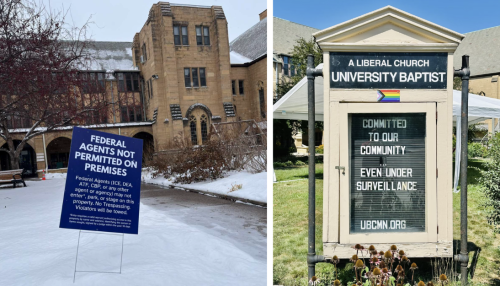
Left: An image included in a court filing on Aug. 14, 2026, of a sign outside University Baptist Church in Minneapolis, Minnesota. Right: UBC’s new message added to a sign outside their building after news of DHS spying on churches: “Committed to Our Community … Even Under Surveillance” (Courtesy of UBC)
In a response on Sept. 29, the denominations covered by the injunction criticized DHS’s report documenting only the two incidents previously identified by the denominations themselves. The faith groups insisted that “DHS’s poorly calibrated keyword searches and internal ad hoc discussions do not amount to the good-faith review the Court ordered.”
“DHS’s responses confirm that its lack of a reliable method for ensuring compliance has deprived it of a reliable method for identifying noncompliance. As DHS established, when its agents on the ground are aware that the preliminary injunction is implicated, they will sometimes simply discuss the preliminary injunction amongst themselves and decide whether they are about to violate it,” the denominations argued in their filing. “The supplemental declarations provide no evidence that DHS requires agents to document these discussions or their conclusions at all.”
“In its contempt remedy, the Court should impose at least the basic guardrails that DHS has not. DHS’s supplemental declarations weigh in favor of Plaintiffs’ recommendations that the Court order additional training for certain DHS officers and require DHS to designate an officer tasked with overseeing compliance and filing status reports,” the denominations added. “The declarations also suggest that the Court should consider requiring DHS to impose basic recordkeeping requirements to ensure that enforcement operations at or near Protected Areas are uniformly documented to facilitate record retrieval and compliance auditing.”
It is not known when Saylor will rule on the motion to hold DHS in contempt for its actions at the Baptist church in Minneapolis or if he will be satisfied with DHS’s self-reporting on other potential violations. Meanwhile, several additional denominations bodies are asking the court to extend the injunction to also cover their congregations. DHS is fighting that effort, still claiming the injunction is unnecessary and complaining that adding additional protected locations would make compliance even more difficult.
As a public witness,
Brian Kaylor